Why Winter Is When Hidden Water Leaks Finally Show Themselves
That stain didn’t appear overnight. Here’s why hidden water leaks surface in winter, what they do to your decor, and how to tell damp from condensation.

It usually starts as something you almost ignore. A faint brown ring on the ceiling that wasn’t there in August. A patch of paint above the skirting that has begun to blister. A cupboard that smells faintly of damp washing no matter how often you air it. You tell yourself it’s the weather, and in a sense you’re right - but not in the way you think.
Here’s the thing most homeowners don’t realise: the leak behind that stain probably didn’t start in winter. It has very likely been seeping quietly for weeks or months. Winter simply dragged it into the light.
Why the Colder Months Bring Leaks to the Surface
Several things change in a home once the temperature drops, and each one works against a small, hidden leak staying hidden. The heating goes on, so pipework that has sat at a steady temperature all summer starts expanding and contracting every day - and tired joints, old compression fittings and worn seals are exactly the places that begin to weep under that movement. Cold snaps add their own stress, with water in exposed pipes contracting, and in extreme cases freezing and splitting a pipe outright.
At the same time, the house itself stops helping. Windows stay shut, airflow drops and humidity climbs. Moisture that would have quietly evaporated in July now lingers in plaster and timber long enough to leave a mark. Nothing new has necessarily gone wrong - the conditions have simply stopped hiding what was already there.
What a Hidden Leak Does to Your Decor
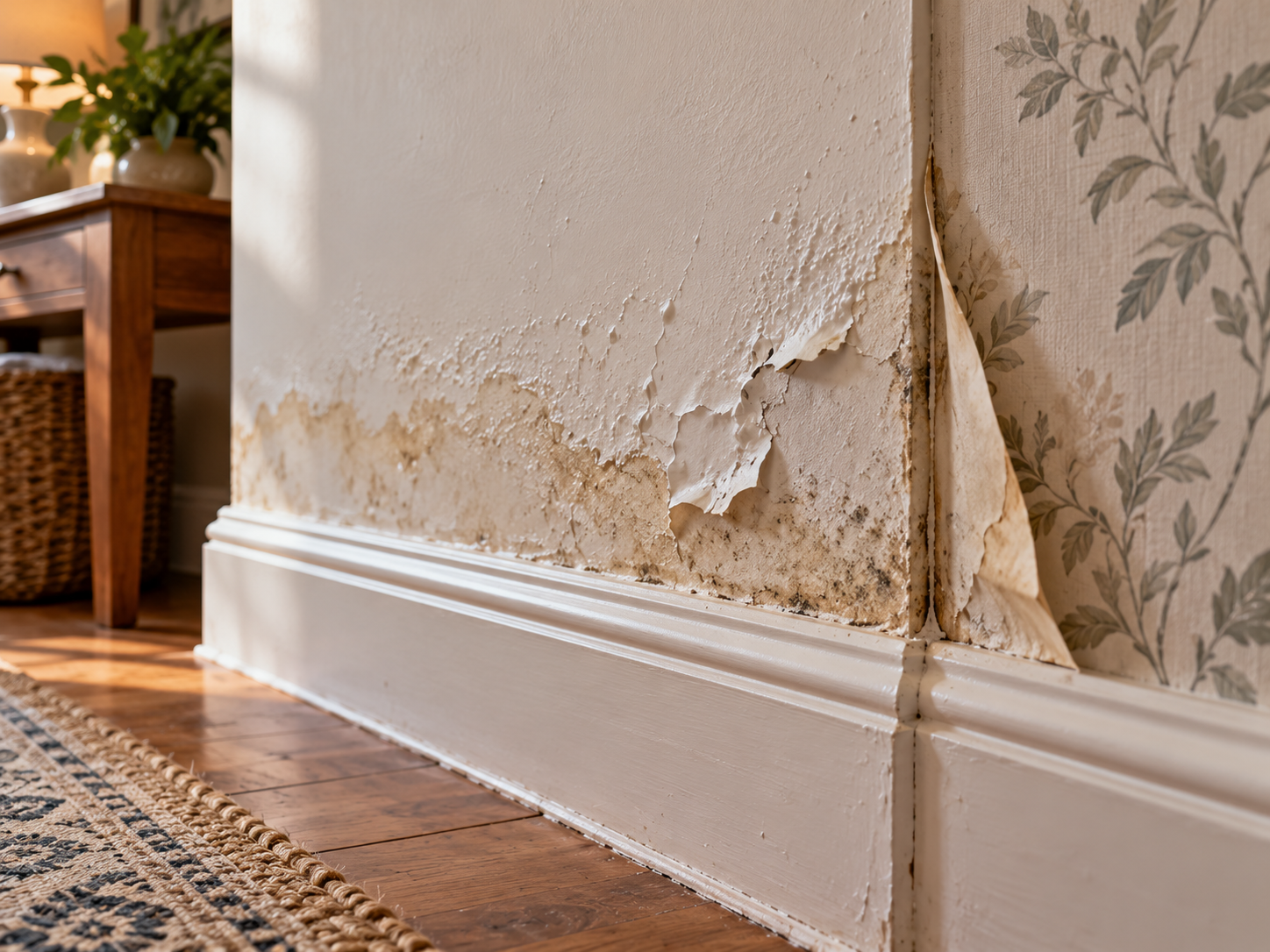
Long before anyone thinks of ‘plumbing’, a hidden leak announces itself through your interiors, which is why it so often gets mistaken for a decorating problem. Paint is usually first to go, blistering or peeling as moisture pushes through from behind. Wallpaper lifts at the seams or develops a stubborn bubble that refuses to be smoothed away. Plaster darkens, then softens, leaving tide marks that reappear within weeks of being painted over.
Lower down, floors begin to tell the story too: timber cups or springs underfoot, laminate swells at the joints, and skirting boards pull slightly away from the wall. There’s often a smell before there’s a mark - that distinctive musty note in a cupboard or a corner of a room. Every one of these is a finish you paid for, quietly being undone by water you can’t see.
Condensation or a Real Leak? How to Tell the Difference
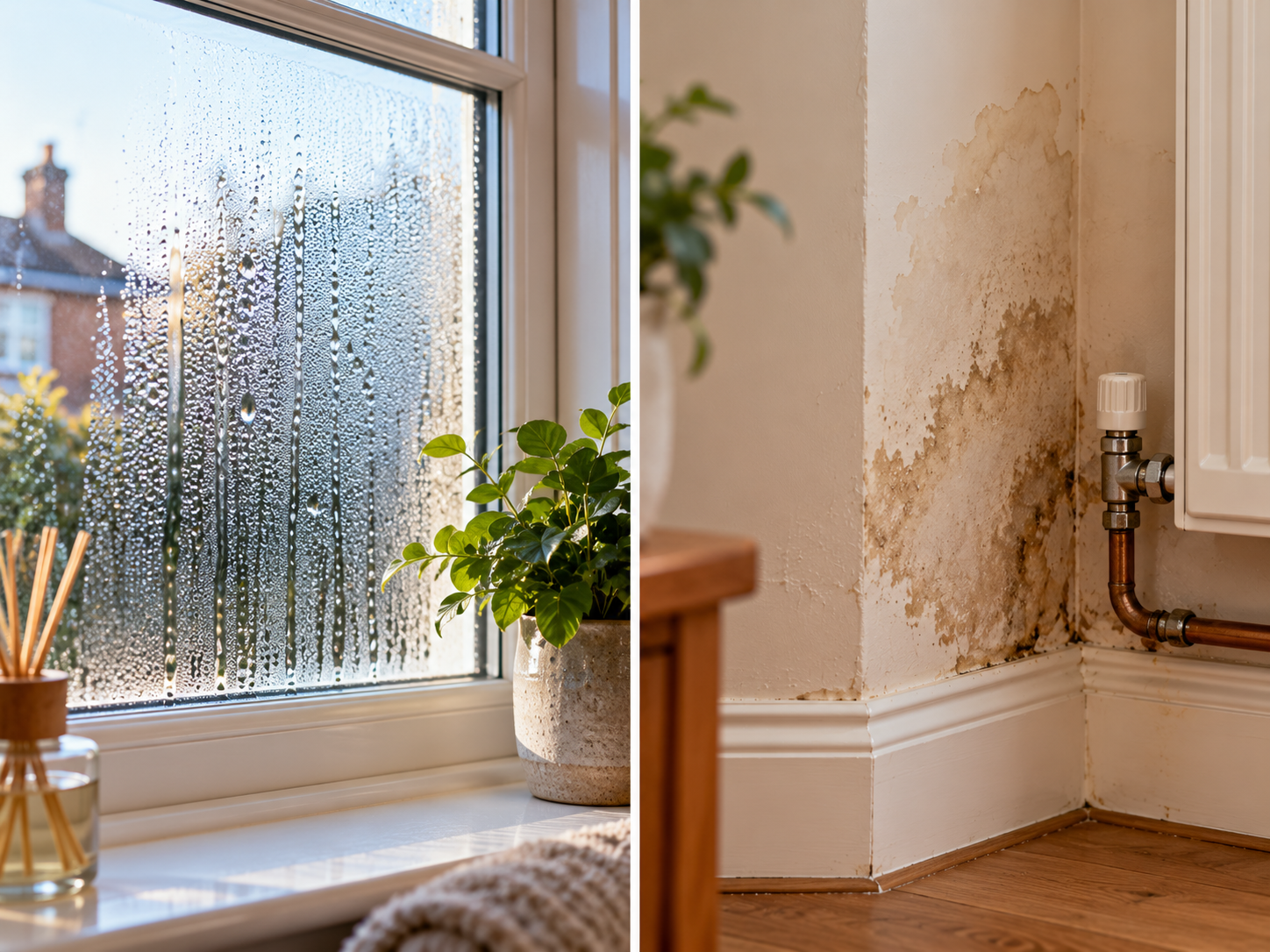
This is where many people lose months, because the two look similar and winter produces plenty of condensation. The distinction is mostly about pattern. Condensation tends to appear on cold surfaces - windows, external walls, cold corners - is worst in bathrooms and kitchens, improves noticeably with ventilation, and shows up in several places at once. A leak behaves differently: it is localised, often close to pipework, bathrooms or above a kitchen, and it tends to grow rather than come and go. Crucially, it doesn’t care how often you open a window.
There’s one simple test worth doing before you call anyone. Turn off every tap and water-using appliance in the house, then check your water meter and note the reading. Leave it an hour or two without using any water, and check again. If the reading has moved, water is going somewhere it shouldn’t - and you’re dealing with a leak, not condensation.
Where Winter Leaks Usually Start
Hidden leaks are predictable creatures. The usual suspects are pipework running through unheated spaces - lofts, garages, cellars and the void under a suspended floor - where the temperature swings most and nobody ever looks. After that come joints and compression fittings, which loosen imperceptibly over years of thermal movement, and radiator valves, which can weep so slowly that the carpet beneath dries between drips.
Bathrooms and kitchens contribute their share through failed sealant and waste connections behind units, where water tracks along a pipe and emerges somewhere entirely unrelated. Older properties are more prone to all of it, simply because the pipework and fittings have had longer to age - which is why a home that has been fine for twenty years can suddenly produce a stain in its twenty-first winter.
Why Waiting Costs More Than You Think
The temptation is to repaint and hope. It rarely works, because the stain is a symptom and the water is still arriving. Meanwhile the damage compounds: plaster that could have been dried out needs hacking off and replacing, flooring that was merely damp begins to warp, and insulation loses its effectiveness once it’s wet.
The scale of the problem is bigger than most people assume. In the UK, insurers pay out around £1.8 million every single day for ‘escape of water’ claims, according to the Association of British Insurers - and a great many of those began as something small that someone meant to look at later. The gap between a quick repair and a full redecoration is usually just time.

Finding the Source Without Tearing the House Apart
The understandable fear is that investigating a leak means destroying the very rooms you’re trying to protect - floors up, plaster off, cupboards out. It doesn’t have to. Modern professional leak detection uses non-invasive methods such as thermal imaging, acoustic equipment and moisture mapping to pinpoint where water is actually coming from, rather than guessing and opening up walls until something turns up. For anyone who cares about their interiors, that precision is the whole point: you repair one small area instead of redecorating three rooms because the search went wide.
Act Early and Your Home Barely Notices
A hidden leak caught in November is a repair, a patch of fresh plaster and a touch-up of paint. The same leak found in March is a ceiling, a floor and a redecoration. If you’ve spotted a stain that keeps coming back, a smell that won’t shift or paint that blisters in the same spot every year, it’s worth having someone look properly rather than painting over it one more time. Homeowners around London and the South East can call on a firm like Bromley Plumbers - a family-run, Gas Safe registered team with decades of combined experience in tracing and fixing exactly this kind of problem. Your decor will thank you for acting while the mark is still small.
Stay up to date with our latest ideas!