White Bugs on Plants: ID Chart and How to Get Rid of Them
Identify white bugs on plants with a practical ID guide and learn how to remove common pests, protect plant health, and prevent future infestations.

What are the white bugs on my plants?
White bugs on plants are almost always sap-sucking pests, and the most common one is the mealybug: a small, soft insect covered in white fluff that looks like bits of cotton stuck to stems and leaf joints. If the bugs fly up in a little cloud when you touch the plant, they are whiteflies. If the white specks are down in the soil and jump when you water, they are springtails, and those are harmless.
Take a breath. This is one of the most common plant problems there is. It usually arrives on a new plant, not because you did something wrong, and most plants can be saved with supplies you may already have at home.
The short version:
Fluffy and stuck in place: mealybugs, or sometimes scale
Fly up when you touch the plant: whiteflies
Tiny pale specks with fine webbing: spider mites
In the soil: usually springtails or soil mites (harmless), sometimes fungus gnat larvae or root aphids
Do they bite? No. None of these bite people or pets
The fix: isolate the plant, wipe or rinse off what you can see, spray with insecticidal soap or neem oil, and repeat every week for 3 to 4 weeks
Quick ID chart: match what you see
Find the row that sounds like your plant. The first column uses the words most people use, not the textbook names.
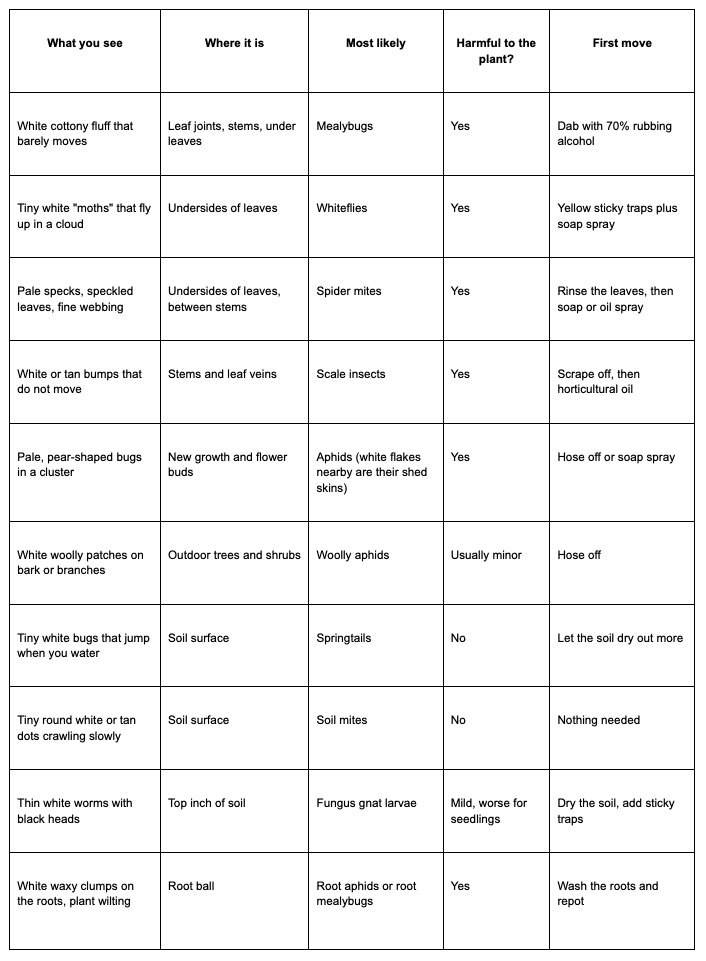
Still not sure? Snap a sharp close-up in good light and run it through a bug identification tool. A name takes the guesswork out of everything that follows, because each pest needs a slightly different fix.
Three quick questions that narrow it down
You can rule out most suspects in under a minute by checking three things.
Does it fly? Tap the plant. If a puff of tiny white insects lifts off and settles back, you have whiteflies. Tiny dark flies rising from the soil are fungus gnats instead.
Does it jump? Water the plant or poke the soil. White specks that hop are springtails. They eat decaying matter, not your plant.
Does it move at all? White fluff that barely moves is mealybugs. A hard bump that never moves is scale. Specks too small to see clearly, plus fine webbing, are spider mites.
Two simple tests help when the bugs are too small to judge by eye:
The paper test: hold a sheet of white paper under a leaf and tap the leaf. Specks that land and start crawling are mites.
The toothpick test: press a bit of the white fluff with a toothpick. A mealybug squashes and often leaves a pinkish or orange smear. Mold and mildew just smudge like powder.
Your phone camera on zoom works as a magnifying glass for both.
It might not be a bug at all
Plenty of white stuff on plants is not alive, or is a fungus and not an insect. Check this list before you spray anything.
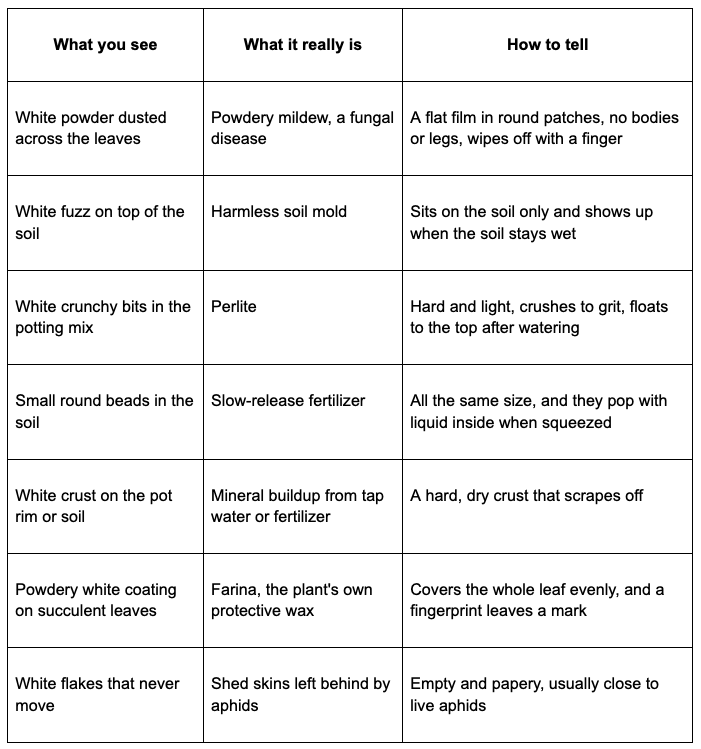
A good rule: real bugs have bodies, they gather in leaf joints and under leaves, and they often leave the leaves sticky. That sticky film is called honeydew, and it is a sure sign of sap-sucking insects.
The most common white bugs on plants
Six groups cover nearly every case. Each profile below tells you what it looks like, how serious it is, and the fix.
Mealybugs: the white cottony ones
Mealybugs are the most common white bug on houseplants. They are soft, oval insects up to about 1/4 inch long, coated in white wax.
Looks like: small tufts of cotton. The fluffiest clumps are egg sacs
Where: leaf joints, undersides of leaves, along stems, and sometimes under the pot rim
Damage: they suck sap, which causes yellow leaves, stunted growth and leaf drop. They leave sticky honeydew that grows black sooty mold and attracts ants
Favorite plants: succulents, jade, orchids, hoyas, pothos, African violets and citrus
How serious: slow but stubborn. A heavy infestation can kill a plant over a few months
Fix: touch each one with a cotton swab dipped in 70% rubbing alcohol, then spray the whole plant with insecticidal soap or neem oil once a week
Whiteflies: the tiny white flying ones
Whiteflies look like tiny white moths, about 1/16 inch long. The young ones (nymphs) are flat, pale ovals stuck to the underside of the leaf, and they do most of the feeding.
Where: undersides of leaves on tomatoes, peppers, kale, hibiscus, poinsettias and greenhouse plants
Damage: yellowing leaves, honeydew and sooty mold. In vegetable gardens they can also spread plant viruses
How serious: they breed fast in warm weather, with a new generation about every 3 to 4 weeks
Fix: hang yellow sticky traps to catch the adults, and spray the undersides of the leaves with insecticidal soap or neem oil every 5 to 7 days. Outdoors, a strong blast from the hose in the morning knocks numbers down
Spider mites: pale specks and fine webbing
Spider mites are not insects. They are tiny relatives of spiders, smaller than 1/50 inch, so you usually notice the damage first.
Signs: tiny yellow or white dots on the leaves, a dusty look, and fine webbing between leaves and stems
Why now: they love hot, dry air, so indoor outbreaks often start in winter when the heat is running
Fix: rinse the undersides of the leaves in the sink or shower, raise the humidity, and spray with insecticidal soap, neem oil or horticultural oil every 5 to 7 days
Good to know: systemic granules made for insects do not control mites
Scale insects: white bumps that do not move
Scale looks like small waxy bumps or shells glued to the plant. Some kinds, such as cottony cushion scale, carry a white, ridged egg sac. Adults stay put, and only the tiny young "crawlers" move.
Where: stems, leaf veins and bark, often on citrus, ficus and orchids, and on crape myrtle outdoors
Fix: scrape them off with a fingernail or soft toothbrush, dab with rubbing alcohol, then smother what is left with horticultural oil. Prune stems that are crusted over
Scale is the one people miss most, because it does not look like a bug. If you cannot tell a scale bump from a mealybug or a scar on the stem, a photo-based Insect Identify tool can settle it in seconds.
Aphids and woolly aphids
Aphids are pear-shaped and 1/16 to 1/8 inch long. Some are pale enough to look white, and the white flakes around a colony are their shed skins.
Regular aphids: cluster on tender new growth and flower buds, and cause curled, sticky leaves
Woolly aphids: wear white waxy fluff and live mostly on outdoor trees and shrubs such as apple, elm and hackberry. On a healthy, established tree they are mostly a cosmetic problem
Fix: hose them off, or use insecticidal soap. Outdoors, ladybugs and lacewings eat a lot of aphids, so skip the harsh sprays and let them work
White bugs in the soil
Most white bugs in potting soil are harmless and simply mean the soil is staying wet.
Springtails: jump when disturbed. Harmless. Let the top inch or two of soil dry between waterings and they fade away
Soil mites: slow, round dots. Harmless decomposers that need no treatment
Fungus gnat larvae: thin, see-through white worms with black heads, up to 1/4 inch long. They nibble fine roots and are mainly a risk to seedlings. Dry the soil out, add yellow sticky traps for the adult gnats, and water with a Bti product
Root aphids and root mealybugs: white waxy clumps on the roots. The plant wilts even though you water correctly. Slide it out of the pot to check, then wash the roots, throw out the old soil, scrub the pot and repot in fresh mix
How to get rid of white bugs on plants, step by step
This plan works for mealybugs, whiteflies, aphids, scale and spider mites. Skip it for springtails and soil mites, which only need drier soil.
Isolate the plant. Move it away from your other plants today, and look closely at the ones that sat next to it.
Rinse and wipe. Take the plant to the sink or shower and rinse the undersides of the leaves with lukewarm water. Outdoors, use the hose. This removes a big share of the bugs right away.
Spot-treat what you can see. Dip a cotton swab in 70% rubbing alcohol and touch each mealybug or scale. Test one leaf first and wait a day, because thin or fuzzy leaves can spot.
Spray the whole plant. Use a ready-to-use insecticidal soap, or neem oil mixed the way the label says. Coat the undersides of the leaves and the leaf joints until they drip. Spray in the evening or out of direct sun.
Repeat every 5 to 7 days for 3 to 4 weeks. Sprays kill the bugs they touch but not the eggs, so you need to catch each new hatch.
Treat the soil only if the roots are infested. Wash the roots and repot in fresh mix. For stubborn mealybugs or scale on non-edible houseplants, systemic granules (imidacloprid) worked into the soil are an option.
Watch for a month. Keep the plant apart and check it weekly. One missed egg sac can restart the whole thing.
Mixing your own spray
Soap spray: 1 to 2 teaspoons of pure liquid castile soap in 1 quart of water
Neem spray: 1 to 2 teaspoons of cold-pressed neem oil plus 1/2 teaspoon of mild liquid soap in 1 quart of warm water. Shake often and use it the same day
If a product label gives a different rate, follow the label.
Which treatment works on which bug
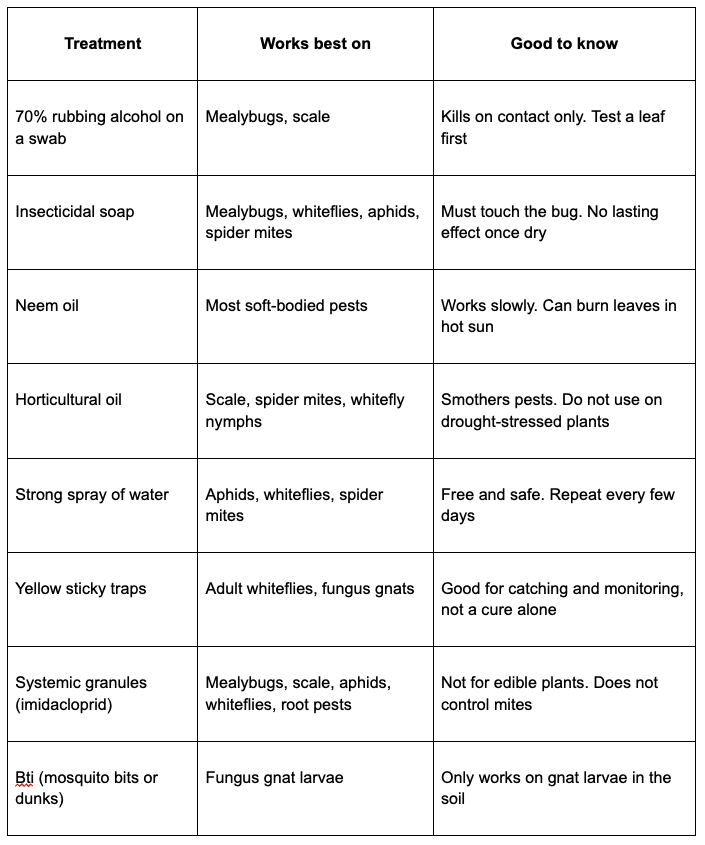
What to avoid
Spraying in direct sun or when it is above about 90°F, which can scorch leaves
Treating once and stopping, which is the main reason the bugs come back
Mixing several products together in one bottle
Using a spray on a wilted, thirsty plant. Water first and spray the next day
Houseplants versus garden plants
The bugs are the same indoors and out, but the best approach is different.
Indoor plants
You are the pest control. There are no ladybugs or other natural predators inside, so the bugs will not go away on their own
Isolation matters most. Plants share shelves and windowsills, and crawlers walk from pot to pot
Dry winter air invites spider mites. A humidifier or a pebble tray helps
Check plants that spent the summer outside before you bring them back in for fall
Outdoor plants
Start with the hose. A firm spray under the leaves every few days handles a lot of aphids and whiteflies
Protect the good bugs. Ladybugs, lacewings and tiny parasitic wasps feed on these pests, and broad-spectrum insecticides kill them too
Spray at dusk. Bees are less active then, and the sun will not scorch wet leaves
Deal with ants. Ants guard aphids and mealybugs to harvest their honeydew, so fewer ants means fewer pests
Expect to manage, not erase. Whiteflies can fly back in from nearby yards
Vegetables, herbs and fruit
Use only products labeled for edible plants, such as insecticidal soap or neem oil
Follow the wait time on the label between spraying and picking
Rinse everything you harvest
Never use systemic granules on anything you plan to eat
Are white bugs on plants harmful to people or pets?
No. Mealybugs, whiteflies, aphids, scale, spider mites and springtails feed on plants or on decaying matter in the soil. They do not bite or sting people, dogs or cats, and they do not move into furniture, carpet, food or skin.
The treatments are what need a little care.
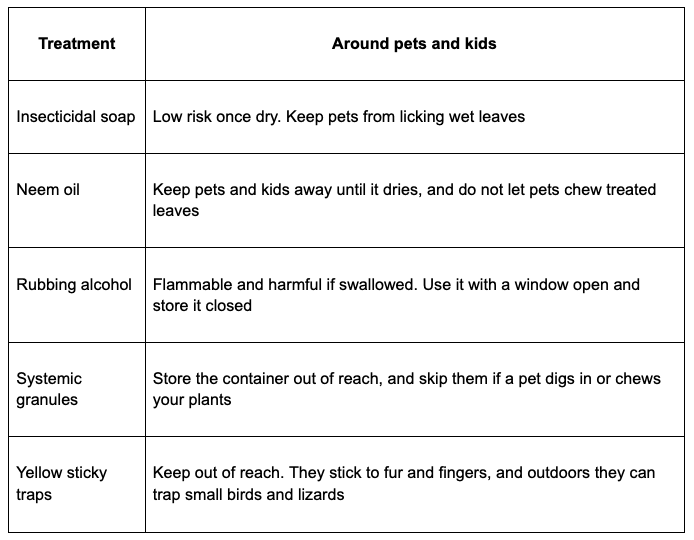
One more thing for pet owners: some common houseplants, including pothos, philodendron and peace lily, are toxic to cats and dogs if chewed. That is separate from the bugs, but worth knowing while you are moving plants around.
Always read the product label first. It is the final word on where and how a product can be used.
Should you save the plant or toss it?
Most plants are worth saving if you catch the problem early. Use these signs to decide.
Worth treating when:
The bugs are on a few leaves or stems, not the whole plant
The plant is still putting out new growth
You can commit to a weekly treatment for about a month
The plant is special, expensive or hard to replace
Better to let it go when:
More than about half the plant is covered
The roots are infested and the plant is cheap to replace
Two full rounds of treatment have failed
It sits in a large collection you do not want to risk
There is a middle path. Take a healthy cutting from a clean stem, check it closely, and start a new plant from that.
If you do toss it, seal the plant in a bag and put it in the trash, not the compost. Scrub the pot with 1 part bleach to 9 parts water, wipe down the shelf and saucer, and watch the neighboring plants for a month.
Why white bugs keep coming back
White bugs come back because eggs and hidden young survive the first treatment. Sprays only kill what they touch, and the next hatch shows up a week or two later.
The usual reasons, most common first:
You stopped too soon. The plant looked clean after one or two sprays, but the eggs had not hatched yet
You missed the hiding spots. Check leaf joints, the underside of the pot rim, drainage holes, the saucer, and any stake or trellis
The neighbors were never treated. One untreated plant nearby reinfests the rest
Old soil or a dirty pot was reused. Root pests survive in used potting mix
A new plant skipped quarantine. Most infestations walk in from the store
They flew back in. Outdoors, whiteflies return from nearby plants
Too much nitrogen fertilizer. It pushes soft, sappy growth that sap-suckers love
If you have treated every week for a month and the bugs are still there, do two things. Double-check the ID, because the wrong diagnosis means the wrong product. Then switch methods, for example from soap to horticultural oil.
White bugs by plant
The plant itself is a strong clue, because each pest has favorites.
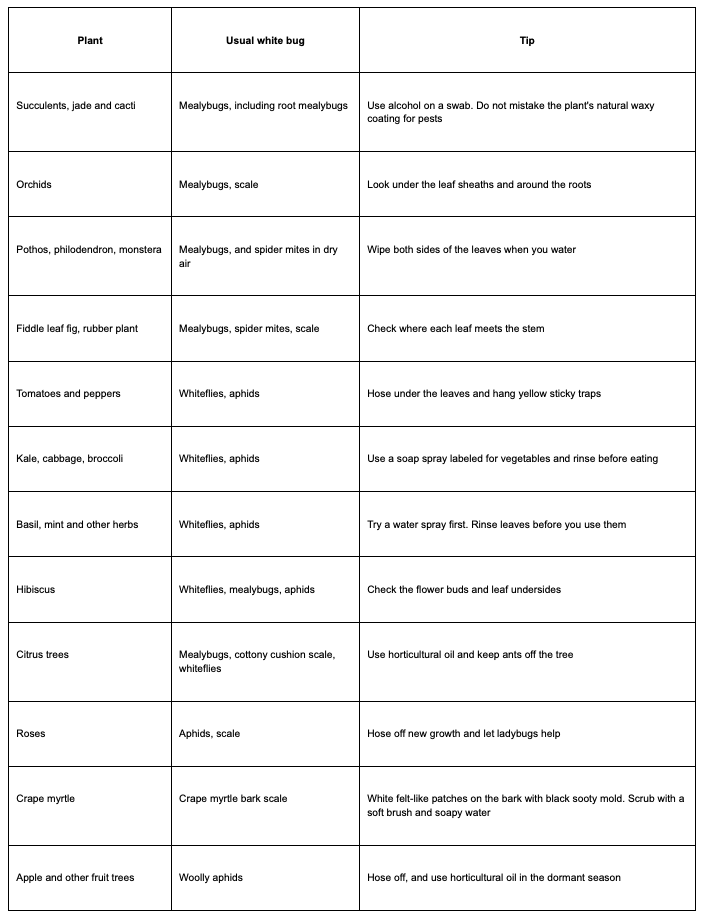
The right treatment also depends on the plant. Ferns, some succulents, and fuzzy-leaved plants such as African violets can be damaged by soap and oil sprays, so always test one leaf first.
Lost the tag and not sure what you are growing? A quick plant identification from a photo tells you what you have, so you can check how sensitive it is before you spray.
How to keep white bugs from coming back
Prevention comes down to catching them early and not carrying them in. Ten habits cover it.
Quarantine new plants for at least two weeks before they join the rest
Inspect when you water. Look under leaves and into leaf joints
Wipe the leaves with a damp cloth every few weeks
Let the top inch of soil dry between waterings
Go easy on nitrogen fertilizer
Use fresh potting mix and clean pots and tools
Give plants space so air can move between them
Check outdoor plants before bringing them inside for fall
Keep a yellow sticky card near your plants as an early warning
Outdoors, control ants and avoid sprays that kill ladybugs and lacewings
Frequently asked questions
What are the tiny white bugs on my plants?
Tiny white bugs on plants are most often mealybugs, whiteflies or spider mites. Mealybugs look like cotton and barely move, whiteflies fly up when the plant is touched, and spider mites are pale specks that leave fine webbing. All three feed on plant sap.
What are the white fuzzy bugs on my plants?
White fuzzy bugs on plants are usually mealybugs. On outdoor trees and shrubs they can also be woolly aphids or cottony cushion scale. All of them cover themselves in white wax, which is what makes them look like lint or cotton.
What are the tiny white bugs in my plant soil?
Tiny white bugs in plant soil are usually springtails or soil mites, and both are harmless. Springtails jump when you water, and soil mites crawl slowly. If the plant is also wilting for no clear reason, slide it out of the pot and check the roots for root aphids or root mealybugs.
Are white bugs on plants harmful to humans?
No. White plant bugs such as mealybugs, whiteflies, aphids and spider mites do not bite, sting or spread disease to people or pets. They only damage plants.
How did my plant get white bugs?
Most white bugs arrive on a new plant from a store or nursery. They can also come in on cut flowers, reused potting soil, a plant that spent the summer outside, or through an open window. It does not mean you cared for the plant badly.
Will white bugs spread to my other plants?
Yes. Young mealybugs and scale crawl from pot to pot, and whiteflies fly between plants. Move the infested plant away from the others right away and check its neighbors.
What kills white bugs on plants instantly?
Rubbing alcohol at 70% strength kills mealybugs, aphids and soft scale on contact. It does not kill the eggs, so one treatment is never enough. Follow up with insecticidal soap or neem oil every 5 to 7 days for 3 to 4 weeks.
Does dish soap kill white bugs on plants?
Dish soap can kill soft-bodied bugs, but it is a detergent and can strip the protective wax from leaves and burn them. Insecticidal soap is made for plants and is the safer choice. If you do use dish soap, pick a mild one with no degreaser or bleach, use about 1 teaspoon per quart of water, and test one leaf first.
Is it white bugs or powdery mildew?
Powdery mildew is a flat, dusty film that spreads in round patches across the top of the leaf and wipes off. Bugs have bodies, gather in leaf joints and under leaves, and usually leave the plant sticky. If nothing moves and nothing is sticky, it is probably mildew.
Can a plant recover from mealybugs?
Yes. Most plants recover fully from mealybugs if you treat them every week for about a month and remove badly damaged leaves. New growth usually comes in clean once the bugs are gone.
How long does it take to get rid of white bugs on plants?
It usually takes 3 to 4 weeks of weekly treatment to get rid of white bugs on plants. That covers the time it takes for hidden eggs to hatch. Keep watching for another month before you call it done.
Stay up to date with our latest ideas!