How to Move a Couch: A Practical Guide From Living Room to Truck
Learn how to move a couch safely from your living room to a truck with practical tips for lifting, protecting furniture, navigating tight spaces, and transport.

Everyone has a couch story. The one that got stuck on a landing, the one that took a chunk out of the door frame, the one that somehow fit going in and refused to come out. If you're working out how to move a couch this time, the good news is that the guides I compared keep returning to the same three habits: measuring, stripping it down, and wrapping it before it touches a wall.
Measure the couch and the route
Rent.com calls measuring arguably the most important step, and it's hard to argue. College Hunks Hauling Junk suggests taking its length, width and diagonal, plus its height from the floor to the top of the backrest. Write all four numbers down; you'll check them against every opening on the way out.
Then measure the path: every doorway, hallway, stair turn and the elevator, if there is one. Clear rugs, cords and boxes out of the way. If a doorway is only just too tight, Rent.com, Stimovers and P1 Logistic Services all mention taking doors off their hinges to gain a few precious inches.
Strip it down before you lift
A lighter, smaller couch is a safer couch. So before anybody bends a knee:
Cushions and throws off. Bag them. Rent.com uses big plastic or trash bags; Xpress Movers adds that bagged cushions travel better inside a box. If the seat cushions look fixed, Xpress Movers notes they're often held by a zipper or Velcro.
Legs off. Some twist off by hand, Rent.com says; otherwise it's a screwdriver job. Keep the legs and screws in a labeled bag. Almost every guide repeats this; Rent.com's reason is simply so you don't lose track of them.
Sectionals apart. College Hunks points out that most sectionals separate at the connectors, which cuts the weight significantly.
Sleeper sofas emptied. Xpress Movers explains that sleepers are heavier than regular couches because of the steel bed mechanism and mattress. Take the mattress out and secure the mechanism so it can't unfold mid-carry.
How to wrap a couch for moving
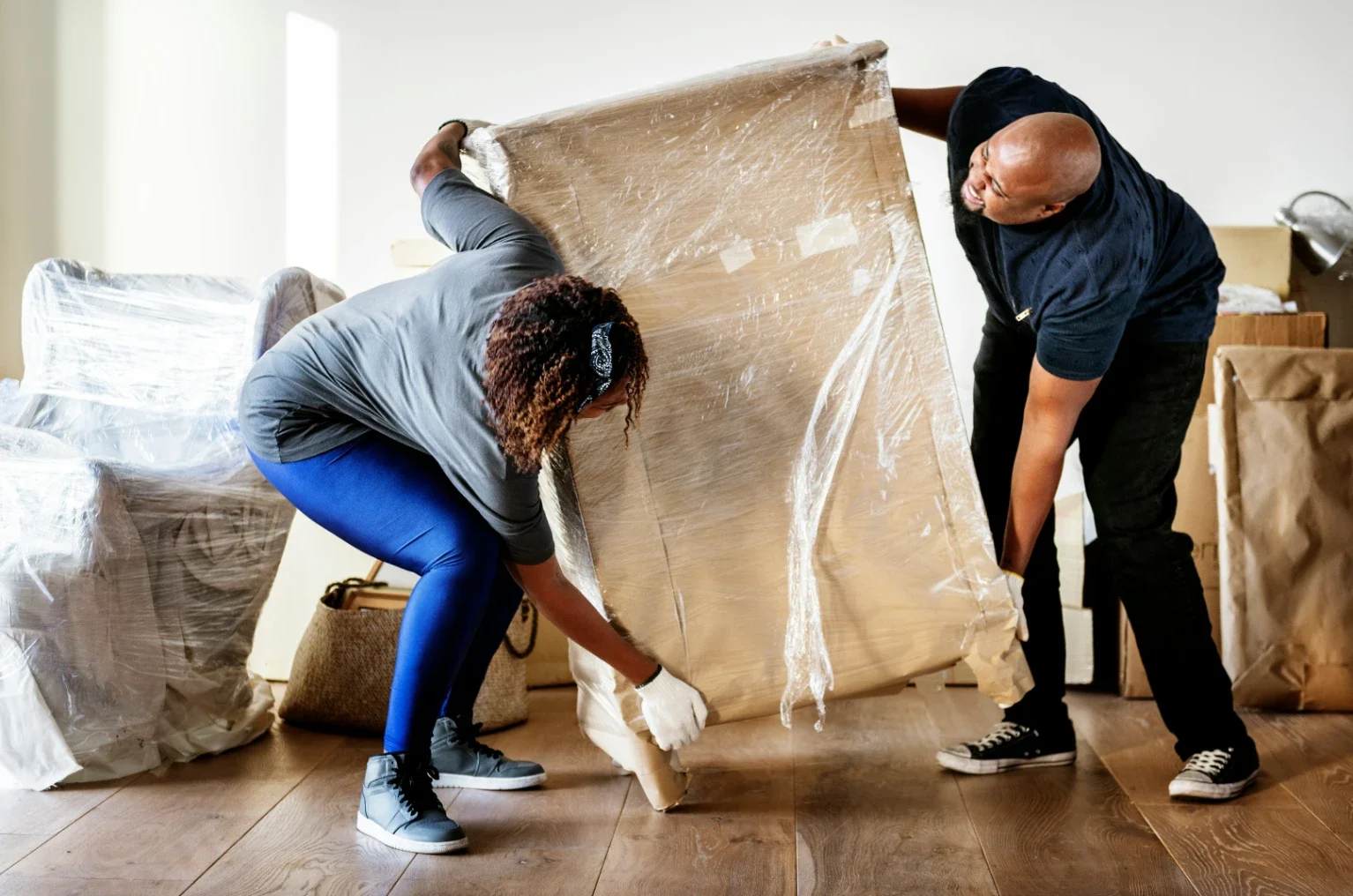
Moving blankets or furniture pads go on first. Then comes the part where the guides disagree: plastic stretch wrap. Rent.com wraps the whole couch in plastic. Stimovers treats plastic, pads and cloth as interchangeable options. College Hunks puts stretch wrap over the blankets to hold them in place and keep loose parts secure. Xpress Movers is strict: tape goes on the pad, and the adhesive should never touch the couch itself.
Where do I land? Blankets on the upholstery, stretch wrap over the blankets. It protects fabric and leather from tape and grime, and it keeps the blankets from slipping off on the stairs. Pay extra attention to the arms and corners, which College Hunks flags as the parts most likely to hit walls and door frames. Xpress Movers also makes a point people underestimate: in a moving truck, constant rubbing against other items works like sandpaper and can mark a piece even through a pad.
Moving a couch through the house
Flat floors: sliders or a furniture dolly
On hardwood or tile, furniture sliders under the feet (or under the frame, if the legs are off) do most of the work. Rent.com suggests buying oversized sliders and trimming them to fit. Sliders only help on flat surfaces, though; Stimovers and Rent.com both say they're useless on stairs.
For longer runs, Rent.com prefers a flat furniture dolly, the square platform on four wheels, over a hand truck for bulky pieces like couches, and notes that these dollies can handle up to 1,000 pounds. Bellhops describes a two-dolly trick for a small couch: lift one end onto a dolly, then the other.
Stairs
Stairs are the hardest stretch. Rent.com says a couch should never go up or down stairs with just one person and that you can't use dollies or sliders there, so it all comes down to your helpers. P1 Logistic Services disagrees about the dolly, saying it can make stairs easier combined with good lifting technique; I'd side with Rent.com on a narrow staircase. College Hunks and Xpress Movers agree the person at the bottom carries most of the weight, so put the stronger person there and let them set the pace. Lift with your legs, not your back, and wear boots or sneakers rather than sandals, as Bellhops puts it.
Tight doorways, briefly
The standard move is what College Hunks calls hooking: set the couch on end, seat toward the doorway, tilt it about 45 degrees, and rotate it through the frame. Stimovers suggests angling it so the longer side goes through first. If that fails, the answer is usually more disassembly, not more force.
Moving a couch into an apartment
Apartments add their own problems: shared hallways, narrow stairwells, and elevators a big couch may not fit into. Rent.com is the most apartment-focused of the guides I read, and its advice boils down to planning the exact route, clearing it, and wrapping the couch so it protects the building as much as the furniture.
It's also where the building, not the couch, is often the bigger worry. Green Moving, an Irvine-based moving company serving Los Angeles and Orange County, describes its routine for Irvine apartments, condos and houses this way: the crew pads door frames and floors along the carry path, wraps the furniture and takes apart what will not fit. Its hourly rate covers taking furniture apart and putting it back together, and nothing is added for stairs. For a couch headed into an upstairs condo or a tight apartment building, Irvine movers who work that way take the scraped-frame risk off your hands.
How to transport a couch
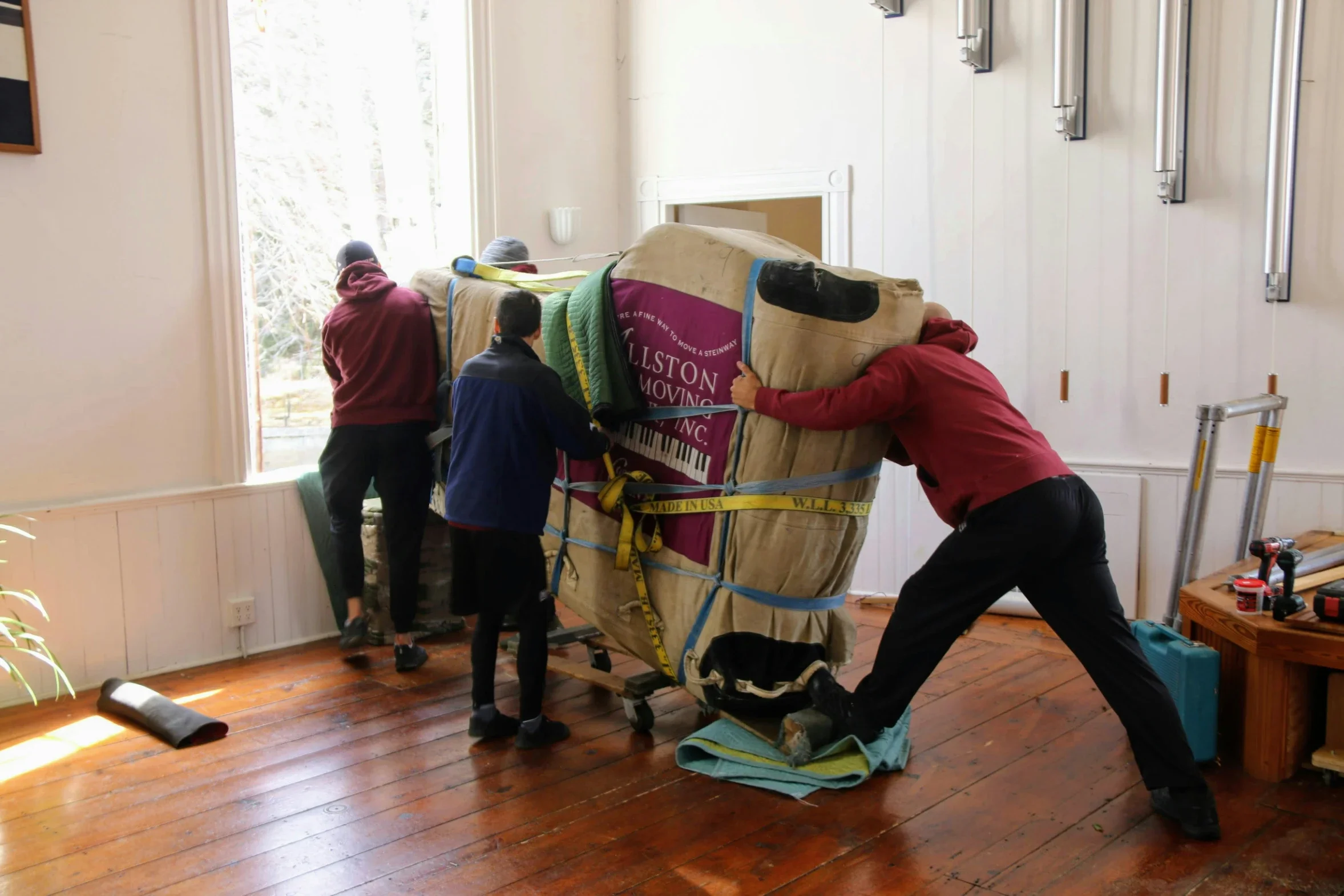
In a rental truck with a ramp, Rent.com rolls the couch up on the dolly, removes the dolly, and ties it down with straps so it can't shift. Can it ride on its end? None of the guides I read says it must. Xpress Movers says a well-padded sofa can be set down on any side, even its top, without damage. Just make sure it's strapped and not leaning on anything sharp.
Using a pickup? Bellhops recommends ratchet straps in the bed. On a car roof, it says to put blankets down first, secure the couch with bungee cords, straps or rope, and check the car's weight limit before you try. Bellhops also lists truck rental options such as U-Haul, Enterprise, Penske and Budget Truck.
How many people does it take?
This is the real disagreement between the guides. TWO MEN AND A TRUCK says it would never send one person to move a couch, and you shouldn't either. P1 Logistic Services says moving a sofa solo is entirely possible. Rent.com and Bellhops take the middle: alone only if the couch is small and light, and Rent.com adds that there should be no stairs.
For anything heavier, the numbers go up. College Hunks suggests at least one helper and up to four people for anything over 300 pounds. Xpress Movers says at least two strong people for a couch or sleeper, sometimes with a third on the heavy end on stairs. Rent.com says heavier, bigger couches may require at least four people.
Honestly, if you're asking whether you can move a sofa by yourself, you probably can't safely, not once there's a staircase involved.
What it costs to hire help
Stimovers puts typical professional rates at $25 to $50 per hour per mover, with extra charges for stairs or long distances. College Hunks notes that summer is the busiest season and suggests booking two to four weeks ahead. Against that, weigh the truck rental, the dolly, the straps, and what a gouged door frame costs to fix.
Stay up to date with our latest ideas!