15 Laundry Room Ideas That Keep Leaks From Ruining Your Floors
Discover 15 laundry room ideas that help prevent leaks and protect your floors, from waterproof materials and smart layouts to drainage and appliance safeguards.

A couple of winters ago I got a call from a family in Newtown on a Saturday night. They had just finished redoing their second-floor laundry closet: beadboard on the walls, open walnut shelves, a nice front-loader and dryer stacked side by side. They started a load, left for their son's basketball game, and came home about two hours later to water dripping out of the kitchen light fixture downstairs.
The cause was a rubber supply hose behind the washer. It was original to the house, close to twenty years old, and it had split right at the fitting. Nothing stopped the water once it hit the floor. There was no pan, no drain, and no sensor, and the hallway was solid oak. By the time I got there, the boards outside the laundry closet had started to cup, the kitchen ceiling was sagging, and my moisture meter was picking up wet subfloor under a bedroom doorway twelve feet away.
The laundry closet itself looked almost fine. Most of the damage was everywhere else.
I've been doing water damage restoration long enough to see that job, or something close to it, every few months. Washing machines move a lot of water, they usually sit somewhere you don't look, and most of them run while nobody's watching. The good news is that a laundry room can be pretty and still be built to handle a leak. These 15 ideas are the ones I'd want in any laundry room, whether it's a full room off the garage or a closet at the top of the stairs.
1. Swap Rubber Supply Hoses for Braided Stainless Steel
The black rubber hoses that come in the box with most washers are the weak point. They harden and crack with age, usually near the connection, and when one lets go it can push hundreds of gallons an hour onto the floor.
Braided stainless steel hoses cost about the same as a nice throw pillow and hold up much better. The Connecticut Insurance Department's water damage prevention tips note that washer manufacturers recommend replacing hoses every five years. Write the install date on a piece of tape on the hose so you're not guessing later.
2. Set the Washer in a Drip Pan With a Drain

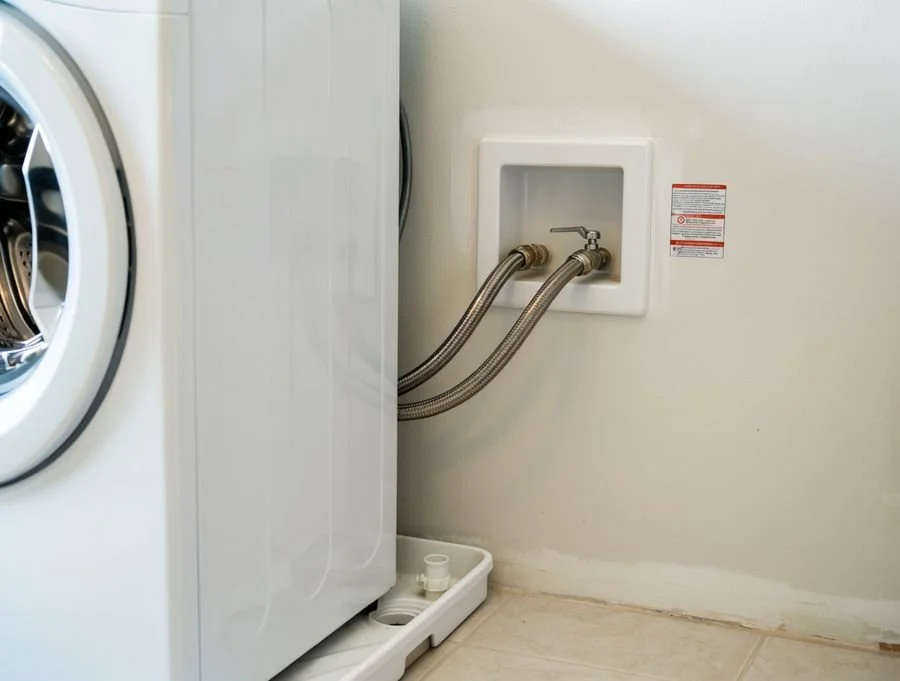
A washer pan is a shallow plastic or metal tray that sits under the machine. On its own it catches a slow drip. Connected to a floor drain or standpipe, it can handle a lot more than that.
If your laundry is upstairs or over a finished space, this is the one to do first. Pans come in white, gray and black, and they disappear behind the front of the machine once it's in place.
3. Add a Leak Sensor or an Automatic Shutoff Valve
A battery leak sensor on the floor behind the washer will sound an alarm, and the Wi-Fi versions send a notification to your phone. They're small, cheap and easy to forget about, which is the whole point.
If you want to go further, an automatic shutoff valve on the supply lines closes the water off by itself when a sensor gets wet. In the Newtown house, that one device would have turned a ruined kitchen ceiling into a damp towel.
4. Choose Flooring That Can Take Standing Water

Porcelain tile with a good grout sealer is the safest choice for a laundry floor. Luxury vinyl plank is a close second for the look of wood, though even "waterproof" vinyl can let water through its seams and into the subfloor underneath. Laminate and solid hardwood are the ones to avoid.
The surface is only half the story. After a leak, the real question is how much water got under the floor and into the ceiling below, and you usually can't tell by looking. There are plenty of restoration companies around Bucks County, and at Sunrise Water Damage we start every laundry leak with moisture meters and a thermal camera on the subfloor and the room underneath, since that's where the water tends to end up. The EPA's brief guide to mold and moisture says water-damaged areas should be dried within 24 to 48 hours to prevent mold, so it pays to find all of it quickly.
5. Run Tile Up the Wall Instead of Wood Baseboards
MDF baseboards act like a sponge. They swell at the bottom edge the first time they sit in water, and they never go back to flat.
A tile baseboard, or a cove base that curves from the floor up the wall, gives you a clean edge that wipes dry. It also keeps water from wicking up behind the trim into the drywall. If you're using the same tile as the floor, it reads as a deliberate design detail.
6. Use Moisture-Resistant Wallboard Behind the Washer
Standard drywall soaks up water from the bottom up. Behind and beside the washer, moisture-resistant or cement board holds up far better. Finish it with a semi-gloss or satin paint, which cleans easier than flat and shrugs off humidity.
If you love the beadboard look, PVC beadboard panels look nearly identical to wood once painted and won't swell.
7. Install a Washer Box With a Single-Lever Shutoff
Most older laundry rooms have two round faucet handles behind the washer, one for hot and one for cold. They're hard to reach and easy to forget about, and old ones often seize up.
A recessed washer outlet box with a single quarter-turn lever lets you shut off both lines in one motion. It sits flush in the wall, looks tidy, and gives your hoses room to bend without kinking.
8. Leave Access to the Valves
It's tempting to box in everything behind custom cabinetry. Just don't make the valves impossible to reach.
A removable panel, a cabinet with an open back, or even a gap of a few inches lets you shut off the water and check the hoses without pulling out a 200-pound machine. Pretty laundry rooms tend to fail here.
9. Keep Storage Off the Floor
Floor-level baskets, cardboard boxes of detergent and a stack of folded towels on the floor are all the first things a leak will reach. Wall cabinets, floating shelves and a hanging rod keep your supplies up and dry.
A rolling cart with metal legs is a good middle ground if you need something low. It lifts the bottom shelf a few inches and rolls out of the way if you need to mop.
10. Add a Raised Threshold at the Laundry Room Door
A slightly raised threshold, sometimes called a saddle, can hold back a shallow spill long enough to keep it in the laundry room instead of spreading under the hallway floor. That's the difference between replacing a few tiles and replacing a hallway.
It's a small detail, and in marble or a stained hardwood it can look like a nice finishing touch rather than a safety feature.
11. Pick Rugs That Dry Fast
A plush rug in front of the washer looks cozy. After a leak, it holds water against the floor for days.
Flat-woven cotton or indoor-outdoor rugs dry quickly and go straight in the wash. Skip the thick rubber backing, which can trap moisture underneath, and lift the rug every so often to check the floor.
12. Give the Room Real Ventilation
A laundry room without a window or fan stays humid long after the dryer stops. Over time that shows up as peeling paint, musty towels and mildew in the corners.
An exhaust fan on a timer switch is the simplest fix. In a basement laundry room, a small dehumidifier that drains into a sink or floor drain keeps the air dry without you emptying a bucket.
13. Keep the Dryer Vent Short and Sealed
A crushed or disconnected dryer vent dumps warm, wet air into the wall or ceiling cavity every time you run a load. You won't see it until the drywall starts to stain.
Use rigid or semi-rigid metal duct, keep the run as short and straight as you can, and seal joints with foil tape rather than screws. A recessed dryer vent box lets the machine sit closer to the wall, which looks cleaner too.
14. Put a Lint Trap on the Washer Drain
When a washer drains into a utility sink or a standpipe, lint slowly builds up in the drain line. One day the drain can't keep up and the sink overflows mid-cycle.
A mesh lint trap on the end of the drain hose costs a few dollars and catches most of it. Swap it out when it looks gray. A deep utility sink with a sprayer faucet also does double duty for stain treatment and plant watering.
15. Don't Run the Washer When Nobody's Home
This one's a habit, not a product. The Newtown family's hose would have burst whether they were home or not. The difference is whether someone is there to hear it in the first five minutes or comes home to it two hours later.
Start the load when you'll be around for the cycle, and make sure everyone in the house knows where the water shutoff is and how to turn it.
Conclusion
A laundry room doesn't have to look like a utility closet to handle a leak. Most of these ideas are invisible once they're in, like the braided hoses, the pan, the sensor and the moisture-resistant board behind the washer. The rest, like tile baseboards, a marble threshold and open shelving, look good on their own.
If you're redoing your laundry room anyway, pick two or three from the top of this list and build them in now. They're much easier to add before the cabinets go up.
Frequently Asked Questions
How often should washing machine hoses be replaced?
Washer manufacturers generally recommend every five years. Braided stainless steel hoses hold up better than rubber, but they should still be checked for kinks, rust or bulging near the fittings.
Is a washing machine drip pan worth it?
Yes, especially for a laundry room on an upper floor or over a finished room. A pan connected to a drain gives water somewhere to go instead of into the ceiling below.
What is the best flooring for a laundry room?
Porcelain tile is the most water-tolerant. Luxury vinyl plank is a good wood-look option, as long as you know that water can still get under it through the seams.
Do leak sensors really work?
They work well for what they do, which is warn you early. An automatic shutoff valve goes a step further by closing off the water supply on its own.
What should I do if my washer leaks onto a wood floor?
Shut off the water, unplug the machine, and soak up what you can right away. Then have the floor and the space below checked for hidden moisture, since wood and subfloor can stay wet long after the surface feels dry.
Sunrise Water Damage Restoration
975 Second Street Pike, Suite B
Richboro, PA 18954
(215) 399-6538
Stay up to date with our latest ideas!