Discover the home feature Australian homeowners are finally budgeting for and why it is becoming a priority for comfort, value, and daily living.
There is a moment most Australian families know well. A parent visits from interstate, navigates the stairs to the guest room on the upper floor, and says nothing. But you notice the way they grip the handrail. You notice it again at Christmas. By the following year you have quietly moved the guest bed to the ground floor, and no one acknowledges what that decision really means.
It is one of those small, loaded concessions that accumulates silently in homes built for a younger version of your family.
A growing number of Australian homeowners are deciding they would rather address it directly.
A Different Kind of Home Upgrade
When people talk about improving their homes in 2026, the conversation tends to land on kitchens, bathrooms and outdoor entertaining areas. These are the upgrades that photograph well, that get discussed at dinner parties, that feel immediately gratifying. A home lift does not usually make that list. It probably should.
Australia's residential housing stock is ageing alongside its population. The country will have more than 4.5 million people over the age of 70 by 2030, and the overwhelming majority of them intend to stay in their own homes for as long as possible. The term used in policy circles is "ageing in place," and it sounds bureaucratic until it becomes personal, until it is your own home you are trying to make work for the next 30 years rather than just the next five.
What has changed recently is that the practical and financial barriers to installing a home lift have come down considerably. The technology has caught up with the aspiration in a way it simply had not before.
What Modern Home Lifts Actually Look Like Now
The mental image most people carry of a home lift is either a clinical contraption bolted to a staircase or a large shaft carved out of a house during a major renovation. Neither image is accurate anymore for the category of compact residential lifts that has arrived in the Australian market over the past few years.
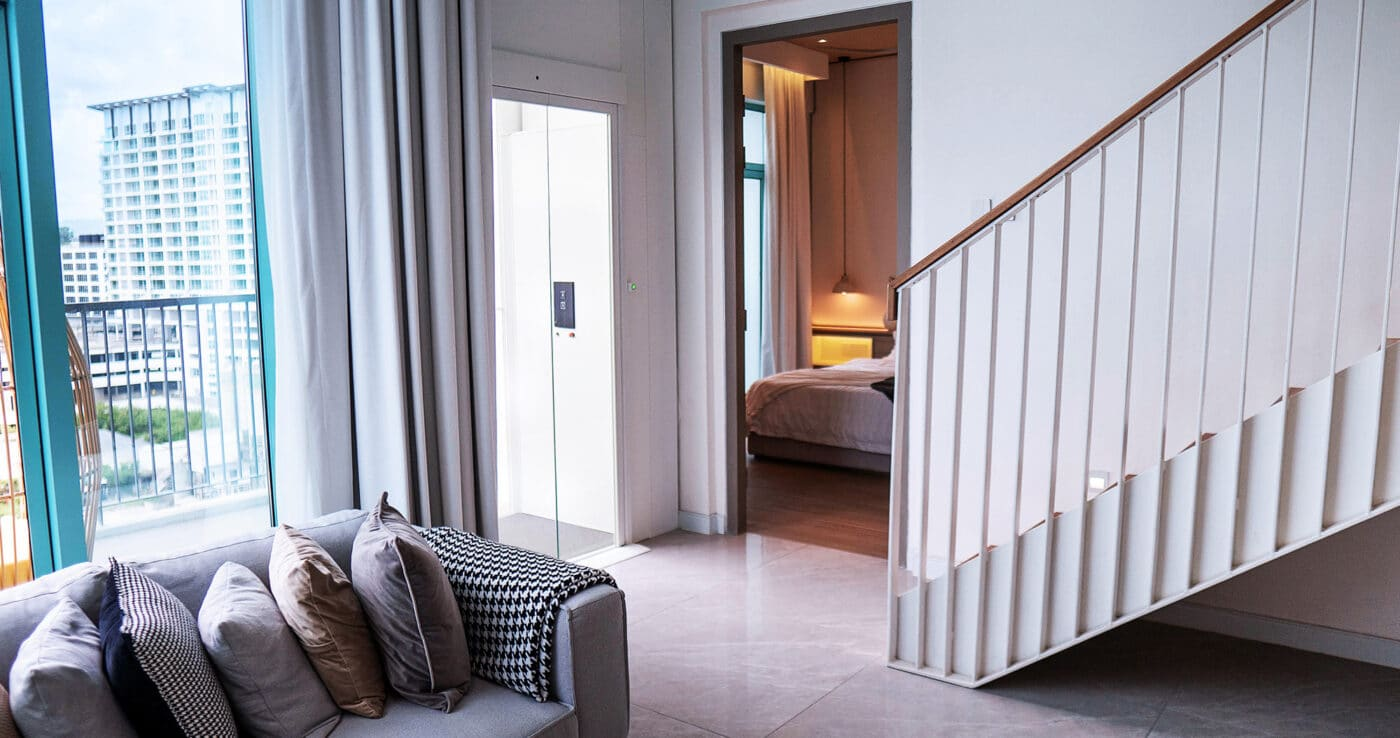
Swedish home lift brand SWIFT Lifts Australia is one of the clearest examples of how the product has evolved. Their lifts require no pit excavation and no separate machine room, which has traditionally been the point where residential lift projects became expensive and disruptive. The entire structure is self-supporting, the installation takes two to five days rather than weeks, and the footprint through the floor can be as small as 940 by 1025 millimetres. In practical terms, that is less structural disruption than a bathroom renovation.
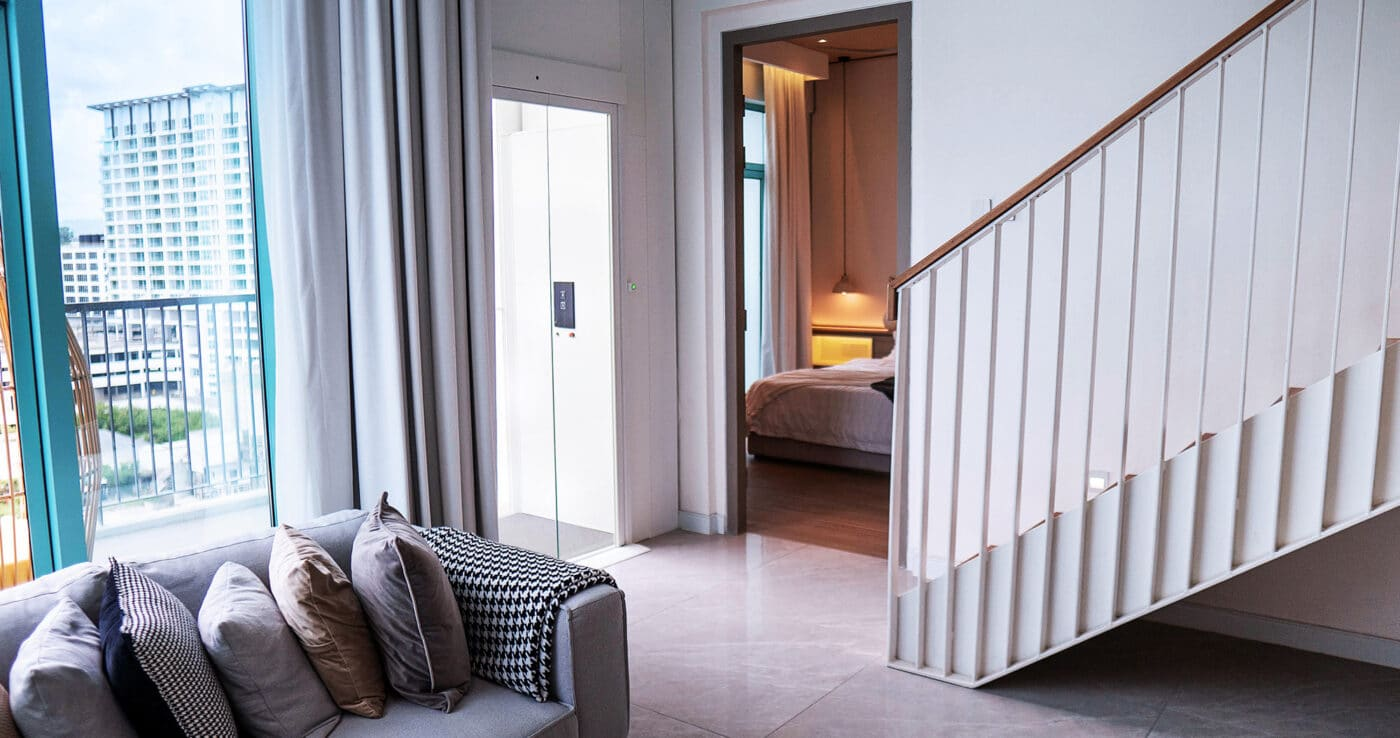
The design language has shifted too. These are not industrial products squeezed into a home context. The SWIFT range is built around Scandinavian minimalism, with ArtWall panels, carpet options from Danish design house Ege Carpets, and a touch display that lets you set floor names, adjust lighting and customise the experience. In a well-designed Sydney terrace or a modern Melbourne townhouse, it reads as a considered interior choice rather than a medical concession.
The Compact Lift and the Australian Home
Space is a genuine constraint in the cities where demand for home lifts is growing fastest. Sydney's Eastern Suburbs, the North Shore and Mosman are full of homes built on steep terrain where stairs between floors are steep, long and unforgiving. Melbourne's inner suburbs, Fitzroy, South Yarra and Carlton, have Victorian terraces and Edwardian homes that were never designed with accessibility in mind. In both markets, the compact residential lift has found a real use case that simply did not have a workable product to match it until recently.
The SWIFT Lite is the entry point in the range and the model that most directly addresses the space-conscious Australian home. It is battery powered, which means it keeps operating during a power outage, it carries up to 400 kg depending on the size chosen, and it is built to comply with Australian standard AS1735. It is also, for a product in this category, genuinely compact. The cabin can be configured to fit into spaces that would previously have ruled out a lift entirely.
For homeowners who have been assuming a residential lift was simply not a realistic option for their property, the Lite is usually the model that changes that assumption.
The Investment Conversation
Any honest discussion of a home lift has to address the cost, and the honest answer is that it is a significant purchase. It is not, however, an unreasonable one when placed in context.
Consider what Australians routinely spend on kitchen renovations, on outdoor decking, on home automation systems that control blinds and lighting. These are investments made in the comfort and enjoyment of a home over a long period. A residential lift sits in the same category, except that it compounds in value rather than depreciating with taste. A home with a lift is a more marketable home. Real estate agents in Sydney and Melbourne increasingly report that accessible features drive measurable interest from buyers, particularly downsizers who have already thought carefully about what they need from a property for the next chapter of their lives.
There is also the more personal calculation. The cost of a home lift measured against the alternative, whether that is moving to a single-storey home, funding modifications to a new property, or simply losing the ability to use parts of your own house, changes the arithmetic considerably.
A Feature Built for How Homes Are Actually Lived In
Australian homes are lived in across decades by families that change shape. Children grow up and leave. Parents and in-laws move in. Knees get replaced and slowly recover. The home that worked perfectly at 45 needs to keep working at 65 and 75.
The upgrades that age best are the ones that address how a home functions rather than just how it looks. A well-chosen lift, installed cleanly and designed to complement the interior rather than interrupt it, is exactly that kind of investment. It is quiet infrastructure for a life that does not stay still.
Stay up to date with our latest ideas!