Discover how long metal roofs last and what affects their lifespan, including material quality, installation, weather exposure, maintenance, and protective coatings.
The Short Answer: How Long Does a Metal Roof Last?
Most residential metal roofs last roughly 30 to 50 years or more, and the figure you'll often see quoted runs from 40 to 70 years depending on the system. A properly installed metal roof built as standing seam metal roofing can exceed 60 years, and premium copper and zinc roofs can pass the century mark. That's two to three times the service life of a typical asphalt roof. Whether you're choosing a new metal roof or trying to judge the one already over your head, the same idea applies: a metal roof is a system, and how long a metal roof will last is set by the first important component to fail, not by how long the metal panels alone can resist corrosion.
Average Metal Roof Lifespan by Material and System
The Metal Roofing Alliance gives a broad planning range of 30 to 50-plus years. A Metal Construction Association field study of 14 unpainted 55% aluminum-zinc-coated standing seam metal roofs, some with as much as 35 years of exposure, projected that comparable systems installed with current best practices could exceed 60 years. Use the table below as planning estimates, not expiration dates, and remember that how long a metal roof will last depends as much on detailing as on the base roofing materials. Among the common materials used today, the gap between options is wide.
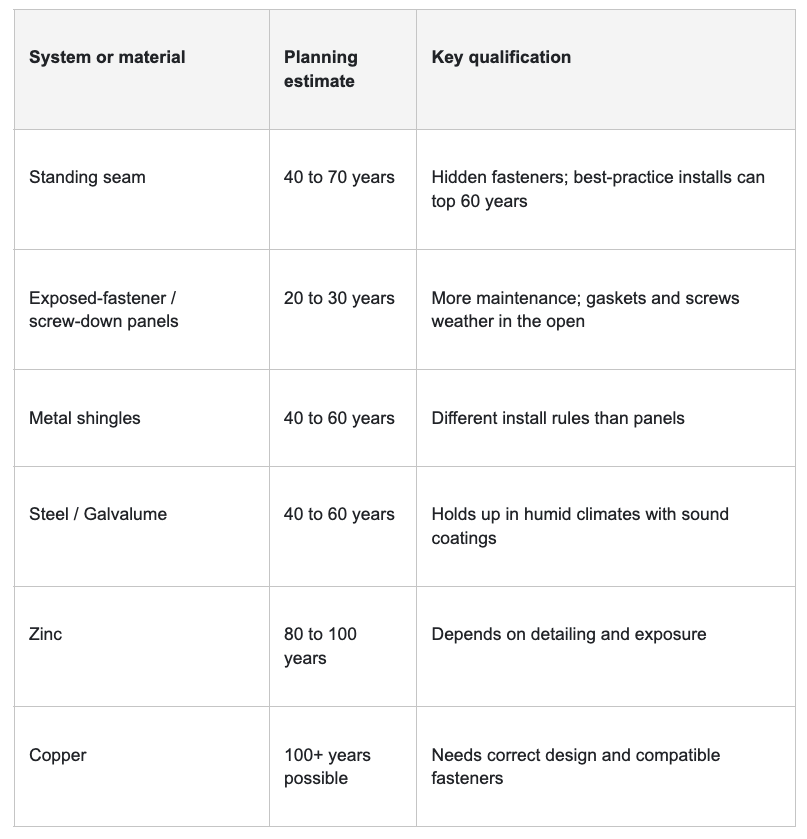
Aluminum roofing holds up well against corrosion, which is why it shows up often near the coast. Stone coated steel roofing offers another path, blending a metal roofing system with the look of tile or shake while keeping a long service life. The premium figures for copper and zinc roofs reflect ideal materials and skilled work, not ordinary painted steel. The type of metal roof you pick sets the ceiling, but workmanship decides how close you get to it.
Metal Roof Compare: How Exposed Fastener Systems and Hidden Fasteners Stack Up for Life Expectancy
Standing seam metal roofs hide their clips and fasteners beneath the panels, so the hardware stays out of the weather. Exposed fastener systems put gasketed screws directly through the face of the panel, where sun and thermal movement slowly wear the washers. When you metal roof compare the two, that's the main reason standing seam metal generally lasts longer, with a screw down metal roof landing toward the lower end of metal roof expectations. IBHS recommends inspecting those exposed screws for loose, stripped, overdriven or underdriven fasteners, since the metal can stay sound while the small details let water in. The long life expectancy of standing seam metal roofing comes largely from keeping those hidden fasteners sheltered, which is why screw down roofs typically need more attention over time.
A Metal Roof Is More Than Its Metal Panels
Here's the point that most lifespan charts skip: the panel is often the last part to fail, not the first. In that MCA study, the butyl sealant at laps and joints was the likely service-life-limiting component, and some ancillary parts corroded sooner than the main panels. The practical takeaway is that how long your metal roof will last is controlled by its weakest consequential component.
The parts that actually govern roof life include:
Fasteners and clips that hold everything down and allow movement
Seams where roofing panels join
Sealants at laps and transitions
Flashing details around edges and changes in plane
Underlayment beneath the metal roof
Penetrations for pipes, vents and equipment
Drainage paths that keep water moving off the roof
For steel, both the metallic coating on the substrate and the paint system matter. A high-grade protective coating slows UV breakdown and helps prevent rusting, but incorrect flashing can cause leaks and early failure no matter how good the panel is.
What Causes a Metal Roof to Fail Early?
A metal roof rarely dies of old age before it dies of a preventable problem. The reason many metal roofs leak early has little to do with the steel itself. The common culprits:
Poor installation. Wrong fastener spacing or poorly formed seams can cut decades off a roof's life, and a poorly installed system tends to need frequent repairs.
Coastal salt and corrosion. FEMA warns that salt exposure can drastically shorten the life of ordinary metal fasteners and connectors, so coastal homes need the right hardware.
Incompatible metals. Putting copper in contact with steel where moisture collects can trigger galvanic corrosion. FEMA advises against mixing dissimilar metals for this reason.
Standing water and trapped debris. Leaves and grit hold moisture against seams and finishes, which can lead to visible rust over time.
Incorrect fasteners. The wrong screw or washer undermines even a quality metal panel.
Uncoordinated rooftop work. Solar mounts, HVAC curbs or skylights added without proper flashing create fresh leak paths.
None of these is about the metal wearing out. Each one is a detail that got missed or ignored, which is why improper installation and metal roof maintenance matter more than the brochure number. Roofs that fail early almost always trace back to workmanship rather than the material.
Does Installation Quality Really Change How Long a Metal Roof Lasts?
Yes, and it's not a small effect. IBHS notes that the roof deck, the metal covering, building height, roof pitch and geographic location all shape the required fastening pattern. Get that pattern wrong and a wind-rated system that could resist high winds near 140 mph may not hold. The 2024 International Residential Code requires metal roofing to be corrosion resistant, properly tested and installed according to the manufacturer's approved instructions. Proper ventilation plays a part too: adequate attic airflow controls moisture and heat buildup beneath the deck, which protects the underlayment and framing the roof depends on. A metal roof installation that honors all of those details at once, installed correctly from deck to ridge, is what delivers the exceptional durability and weather resistance the material is known for.
How Much Life Is Left in an Existing Metal Roof?
Condition beats calendar age. A 35-year-old roof with sound seams and tight flashings can have more useful life left than a much newer roof riddled with installation defects. Instead of guessing from the install date, look at what the roof is actually doing. A quick scorecard:
Leak and repair history (one-off vs. recurring in several spots)
Coating and corrosion condition, especially red rust
Fasteners and seams for looseness or movement
Flashing details and penetrations for failed sealant or gaps
Storm damage from recent extreme weather such as severe hail
When calendar age and visible condition tell different stories, a professional inspection is far more useful than a generic lifespan chart. Bay Area owners, for example, can request a roof inspection from a local provider such as Symplify Roofing, which can separate a localized flashing or fastener problem from system-wide deterioration and give a clearer read on how much longer the metal roof will last.
Solar Panels and Rooftop Equipment Can Change the Equation
Every new penetration is a potential weak point. Solar mounts, rooftop HVAC and skylights all break the plane of the roof, and improper flashing around them is a leading cause of leaks. Coordinate any mounting with the roofing scope so the metal panels can still move with temperature changes, and make sure someone owns the flashing and future leak responsibility in writing. Companies that handle roofing alongside rooftop solar and HVAC work, such as Cobex Construction Group, illustrate why that responsibility should be assigned clearly rather than split between trades that never talk to each other.
How to Help a Metal Roof Reach Its Full Lifespan
A well maintained metal roof needs less upkeep than asphalt shingles, but it isn't maintenance-free. Routine care, even minimal maintenance done on schedule, keeps small issues from becoming major failures:
Inspect in spring and fall and after severe storms, per NRCA guidance.
Clean debris at least twice a year where leaves and grit collect, as the MCA recommends.
Keep gutters and drainage paths clear.
Monitor exposed fasteners and replace worn screws and washers.
Repair failed sealants and flashing details promptly.
Avoid unnecessary foot traffic on the panels.
Follow the manufacturer's maintenance instructions.
Recoating or repainting can extend the finish's life on steel roofs. One safety note: don't walk a steep or slippery metal roof. Check from the ground and bring in a professional for anything closer.
Metal Roof vs. Asphalt Shingles: Is It Worth It?
For buyers weighing the lower upfront cost of asphalt, the math usually comes down to time. A standard shingle roof lasts about 15 to 30 years, and high-quality architectural traditional asphalt shingles stretch to 25 to 40. A metal roof often lasts two to three times longer with less maintenance, which spreads the higher initial price across far more years. That longer lifespan is what makes the expected lifespan of metal a strong long term investment. That doesn't mean every home needs metal. If you plan to move soon or your budget is tight, asphalt shingles can be the sensible choice. If you intend to stay put, is a metal roof worth it? For owners who want fewer replacements over the life of the house, the longevity tends to justify the premium. When homeowners planning their last roof weigh their roofing options, that durability often wins.
Repair or Replace Your Metal Roof?
Most metal roof problems are repairable if caught early. Usually fixable:
One or two failed pipe boots or localized flashing details that have degraded
Isolated loose or damaged fasteners
Small areas of surface corrosion caught early
Localized sealant failure
Limited storm damage with intact surrounding metal panels
A full roof replacement evaluation makes sense when you see:
Widespread panel perforation or advanced red rust
Recurring leaks in several unrelated locations
Extensive seam failure or panel movement
Large-scale coating breakdown or rotten decking
Many old repairs that no longer form a coherent system
Recurring leaks in unrelated spots tell you more than the install date ever will. Age alone shouldn't decide replacement, and a new roof is a bigger commitment than targeted fixes.
Lifespan Versus Warranty: What a "40-Year" Roof Really Means
Warranty length is not the same as service life, and a single roof can carry several separate warranties:
Finish warranty for film integrity, fading and chalking
Substrate or perforation warranty against rust-through
Weathertightness warranty covering leaks
Workmanship warranty from the installer
These rarely share the same number. One manufacturer pairs 40 years of film-integrity coverage with 30-year limits on fade and chalk; another separates a 30-year paint warranty from a 20-year weathertightness warranty. A "40-year" roof does not mean 40 years of automatic leak coverage. Read the exclusions and check whether the coverage transfers if you sell.
Frequently Asked Questions
What is the 25% rule for roofing?
It's an insurance and industry rule of thumb that if roughly 25% or more of a roof is damaged, full replacement is often favored over patching. It's a guideline, not a universal code, and it varies by insurance company and jurisdiction.
How much does a 2,000 sq ft metal roof cost?
Cost varies widely by system, material, region and roof complexity. Standing seam and premium metals like copper or zinc run well above exposed-fastener steel. The only reliable number comes from a local quote on your specific roof.
Do metal roofs attract lightning?
No. A metal roof does not increase the odds of a lightning strike, and because the material is non-combustible and conductive, it can safely dissipate the energy if lightning does hit.
Are metal roofs better than asphalt shingles?
It depends on your goals. Compared with other metal roofs and with asphalt, a quality metal roof lasts two to three times longer, resists heavy snow and ice dams at the eaves, and needs less maintenance, but costs more upfront. If you're staying in the home for decades, that tradeoff usually favors metal.
Key Takeaways and Next Steps
A metal roof has no single expiration date. System design, proper installation, climate exposure and ongoing maintenance decide whether it lands at the lower end of the 30 to 50-plus year range or keeps performing past 60. So when many homeowners ask how long does a metal roof last, the honest answer is that condition and detailing matter more than the calendar. If you're planning a purchase or sizing up an aging roof, get a documented local inspection and judge the roof by its condition, not its birthday.
Stay up to date with our latest ideas!