Compare short-term rental guest portals for digital check-in, agreements, payments, upgrades, and access. See when Conduit Portals fits.

Property managers have historically pieced together the guest experience from a patchwork of tools — a PDF house manual, a separate check-in form, and a string of text messages answering the same questions over and over. Short-term rental guest portals change that by combining check-in, house instructions, and guest communication into a single digital hub that travelers can access from their phone before they even arrive. For hosts juggling multiple properties, that consolidation isn't just convenient; it's becoming essential as the short-term rental market grows more competitive and guest expectations rise.
The Rise of Digital Guest Portals in Short-Term Rentals
The short-term rental industry is expanding quickly, and that growth is pushing operators toward more automated, digital-first guest management. According to Grand View Research, the U.S. short-term vacation rental market is projected to reach USD 125.14 billion by 2033, growing at a compound annual growth rate of 7.3% from 2026 to 2033. The firm attributes this growth to travelers seeking unique, flexible, and personalized lodging, a rise in remote "workcation" stays, and continued demand for group and family travel. Notably, online and platform-based booking already represented a significant share of the market in 2025, as booking technology makes reserving a stay simpler than ever.
Globally, the picture looks similar. Future Market Insights estimates the global vacation rentals market at USD 101 billion in 2024, projected to reach USD 108 billion in 2025 and climb to USD 278 billion by 2035 — a 9.8% CAGR over that decade. While these two reports differ in scope (U.S. versus global) and forecast window, both point in the same direction: more guests, more bookings, and more pressure on hosts to manage the guest journey efficiently. Future Market Insights also flags voice-prompted and keyless check-in systems as an emerging trend, signaling that guests increasingly expect contactless, tech-enabled arrivals rather than meeting a host with a physical key.
As portfolios scale, manual check-in processes — coordinating key handoffs, answering repetitive questions by text, and manually verifying ID — become harder to sustain. That's the gap digital guest portals are built to close.
How Digital Check-In and Guest Portals Simplify Operations
Digital check-in and guest portals simplify day-to-day operations by automating much of what used to require manual coordination. Automated welcome communications can be triggered ahead of arrival, walking guests through what to expect and what's required of them before they get the door code. Because these portals are built mobile-first, guests can complete every step from a phone, without downloading an app or juggling paperwork.
Real-time updates and notifications keep guests informed of anything that changes, whether it's a slightly later check-in time or a new parking instruction. And because these portals connect directly with property management systems and booking channels, information stays consistent across every stay without a property manager having to re-enter details for each guest.
Conduit's guest portal product, for example, generates one branded link per stay that lets guests review their stay details, complete pre-arrival questions and identity checks, sign rental agreements or damage waivers, pay required fees, and purchase add-ons — all before unlocking the property through a compatible smart lock. It also includes a 24/7 AI concierge that answers property-aware questions using the guest's specific stay details, reducing the volume of basic questions that would otherwise land in a host's inbox.
Key Benefits of Integrated Guest Portals
Streamlined Check-In Process
Instead of exchanging multiple messages before arrival, guests can complete pre-arrival steps — reviewing stay details, filling out required forms, and verifying identity — all within one branded link. This removes the back-and-forth that typically clutters the days leading up to a stay.
Centralized House Instructions and Rules
House rules, Wi-Fi passwords, appliance instructions, and local recommendations often end up scattered across welcome binders, texts, and email threads. A unified portal keeps all of it in one place that guests can revisit anytime during their stay, cutting down on confusion and repeated questions.
Improved Guest Satisfaction and Reduced Support Inquiries
When guests can find answers themselves — whether that's how to work the thermostat or where to park — they're less likely to need to message their host directly. This self-service model reduces the burden on property managers while giving guests a smoother, more independent experience.
Enhanced Property Security and Access Management
Portals that integrate with smart locks allow access to be granted only once pre-arrival requirements, like identity verification or signed agreements, are complete. That adds a layer of security that a shared lockbox code simply can't match.
Best Practices for Implementing Guest Portals
Customize Branding: A portal that reflects your property's look and feel builds trust and makes the experience feel like a natural extension of the stay rather than a generic form.
Organize Instructions Logically: Structure content around the guest's actual journey — arrival, during the stay, and departure — rather than dumping everything into one long page.
Use Multimedia for Complex Procedures: A short video showing how to operate a finicky smart lock or a hot tub often communicates more clearly than a block of text.
Set up Automated Reminders: Timed notifications before arrival — confirming check-in steps or re-sending a door code — help guests arrive prepared instead of texting the host at 11 p.m. asking where the key is.
Comparing Approaches to Guest Communication
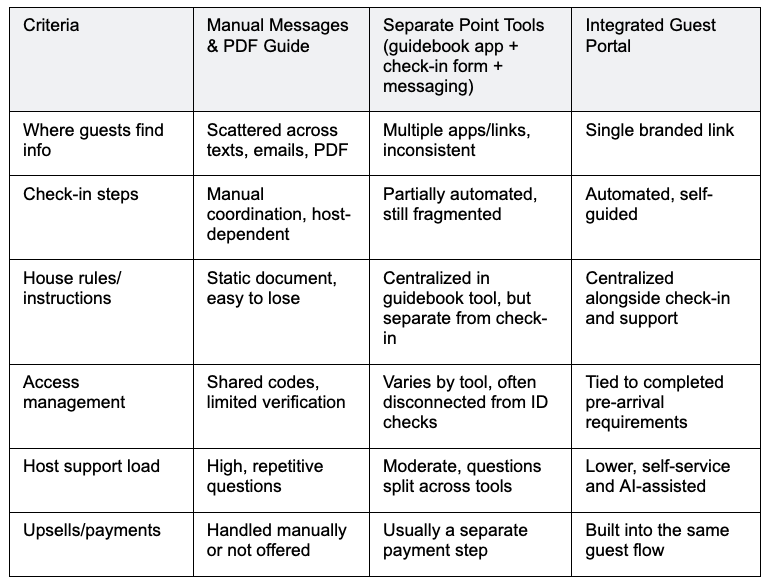
The table below compares three common approaches property managers use to handle check-in and house instructions.
Real-World Examples and Tips
Conduit's product page showcases a guest portal built for Rosewood London, where guests can view their suite details and stay dates and unlock their room with a simple swipe, directly from the portal. It's a clear illustration of how a hospitality brand can extend its identity into the digital check-in experience rather than handing guests a generic form.
Consider two illustrative scenarios that highlight why centralization matters. A guest arrives late at night and can't find the lockbox — a common pain point when instructions live in a separate email that's hard to find on a phone at 11 p.m. With a portal, those same directions, plus the door code, are one tap away from the same link the guest already used to check in. Or picture a guest unsure where to take out the trash halfway through their stay. Rather than texting the host, they check the portal's house guide section and find the answer immediately.
To maximize guest adoption, send the portal link as part of the booking confirmation, not just the day-of check-in message, so guests get comfortable with it early. Keep instructions concise and scannable, and test the portal from a guest's perspective before each new listing goes live.
Bringing Check-In and House Instructions Together
Short-term rental guest portals solve a problem that's only going to grow with the market: guests expect a smooth, self-service arrival experience, and hosts need a way to deliver that without multiplying their workload. By combining check-in, house rules, and support into a single link, property managers can reduce repetitive questions, tighten security, and free up time to focus on growing their portfolio instead of answering the same text message for the tenth time this month. If you're ready to see what a unified guest experience looks like for your properties, you can book a demo with Conduit Portals to explore the platform firsthand.
Frequently Asked Questions
What does it take to implement a guest portal?
Implementation typically involves connecting the portal to your existing property management system and booking channels, then customizing branding and house instructions for each listing. Most platforms, including Conduit, are designed to integrate with tools you already use rather than requiring a full operational overhaul.
How much does a guest portal cost?
Pricing varies depending on the platform, portfolio size, and feature set. For specific pricing, it's best to contact a provider directly — for example, by booking a demo with Conduit.
What are the main benefits of using a guest portal instead of a PDF guide?
A guest portal centralizes check-in, house rules, payments, and support in one mobile-friendly link, whereas a static PDF can get lost in email threads and doesn't update in real time or integrate with smart locks.
Do guests need to download an app to use a guest portal?
Not with Conduit's approach — guests access their branded portal through a single link per stay, with no app download required.
Can a guest portal work for both hotels and vacation rentals?
Yes. Platforms like Conduit are built to serve both hotels and vacation rental operators, adapting the same core features — pre-arrival questions, digital agreements, payments, and access management — to different property types.
Stay up to date with our latest ideas!