Compare Electrolux Water, Whirlpool, A. O. Smith and Culligan water softeners by grain capacity, service flow, regeneration efficiency and maintenance.

White deposits on shower doors, cloudy glassware, and scale inside water heaters are common signs of hard water. Dissolved calcium and magnesium cause these deposits, particularly when water is heated. A whole-home water softener removes hardness minerals through ion exchange, helping reduce new scale across bathrooms, plumbing, and household appliances. [1]
For American households comparing larger systems, 48,000-grain softeners are a useful starting point, but capacity alone does not determine performance. Electrolux Water, Whirlpool Water Solutions, A. O. Smith, and Culligan take different approaches to capacity, regeneration, controls, and maintenance.
What Does 48,000-Grain Capacity Actually Mean?
A grain rating measures how much hardness a softener can remove before its resin needs regeneration. It does not describe how many gallons flow through the unit each minute. The amount of water treated between regenerations depends on water hardness, household consumption, and the salt dose selected. [2]
For example, a theoretical 48,000 grains divided by 12 grains per gallon equals 4,000 gallons of treatment. Actual working capacity can be lower at salt-efficient settings.
A model advertised as 48,000 grains therefore needs closer examination of its service flow, regeneration requirements, and salt efficiency. NSF/ANSI 44 provides a recognized standard for evaluating residential ion-exchange softener performance. [3]
Four Water Softener Brands Compared
Electrolux Water — Smart Controls and Flexible Settings
The Electrolux Water Whole House Smart Water Softener features a 48,000-grain capacity and a 12.7 GPM service flow rate.
Its color touchscreen provides direct access to system settings and includes guided instructions for initial setup. Wi-Fi connectivity enables mobile app management and Amazon Alexa voice control, including adjustments to the preferred water softness level.
Standard, salt-saving, and holiday modes accommodate different household water-use patterns. The softener can also operate alongside a separate whole-home pre-filter, allowing sediment filtration and hardness reduction to be handled by dedicated treatment stages. [4]
Whirlpool Water Solutions — Demand-Based Regeneration
The Whirlpool Water Solutions WHES48 offers a maximum 48,000-grain capacity and an 11.9 GPM rated service flow. Its 6th Sense technology monitors household water consumption to schedule regeneration according to demand.
The system provides different capacity-and-salt-dose combinations, including 14,200 grains at 2.8 pounds of salt and 48,000 grains at 18.1 pounds. At its lowest salt dose efficiency reaches 5,090 grains removed per pound of salt.
A single-tank design, low-salt indicator, and built-in sediment filtration support routine operation and maintenance. [5]
A. O. Smith — Salt Monitoring and Compact Design
The A. O. Smith AO-WH-SOFT-450T provides a 45,000-grain capacity, making it a nearby-capacity alternative rather than an exact 48,000-grain match.
Its salt-sensing controls adjust regeneration based on household water use. A water monitor and Wi-Fi salt alerts help homeowners track consumption and maintenance requirements.
The compact single-unit cabinet includes a bypass valve and self-cleaning pre-filter, reducing the number of separate components to manage. The system is designed for households of four or more people, although service flow and plumbing requirements must also be considered. [6]
Culligan — Sensor-Based Softening and Professional Sizing
Culligan's Aquasential Smart High Efficiency series offers several configurations selected according to household water hardness, consumption, and plumbing requirements.
Aqua-Sensor technology monitors water conditions, while proportional brining regenerates the exhausted portion of the resin bed. This approach adjusts the regeneration process to actual treatment needs.
The system also supports water-use monitoring, app-based salt notifications, and professional installation or maintenance services through local dealers.
Unlike fixed-capacity models, Culligan's available configurations require evaluation of the selected unit's capacity, flow rate, and regeneration performance. [7]
At a Glance: Capacity, Flow, and Regeneration
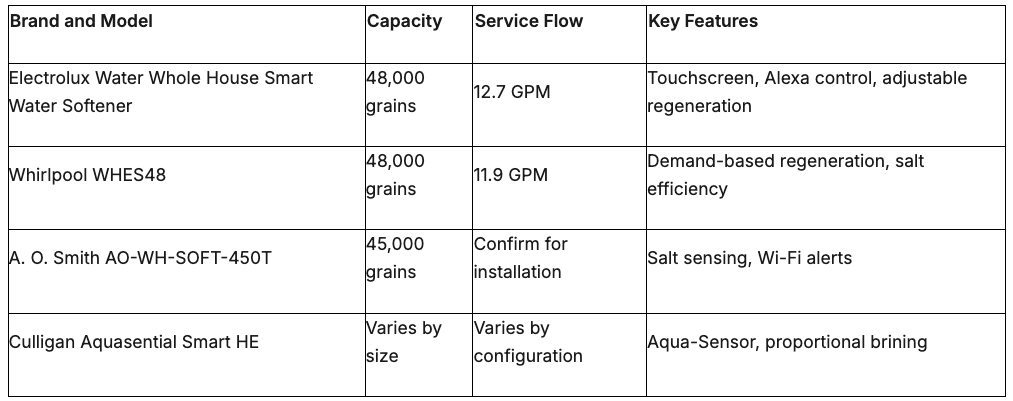
Specifications are manufacturer-published and may reflect different test conditions. Maximum grain capacity is not equivalent to capacity at a salt-efficient setting.
Will a Water Softener Keep Up With Three Bathrooms?
For a three-bathroom home, the most useful sizing measure is the amount of water required when several fixtures operate simultaneously.
Consider three 2.0 GPM showers running alongside a 1.5 GPM faucet. Combined demand reaches 7.5 GPM. If a washing machine begins filling at 3 GPM, total demand increases to 10.5 GPM.
The Electrolux Water Whole House Smart Water Softener has a rated service flow of 12.7 GPM, compared with 11.9 GPM for the Whirlpool WHES48. [4][5] Both exceed the illustrated 10.5 GPM demand, making them reasonable candidates for households with similar usage patterns.
Homes equipped with high-flow rain showers, multiple showerheads, or frequently operated appliances require additional flow capacity. The final installation should account for supply pressure, pipe diameter, and pressure loss through the softener.
Which Regeneration Features Reduce Salt Use?
Regeneration restores a softener's ability to remove hardness minerals. Conventional timer-based systems regenerate on a fixed schedule, while demand-initiated systems adjust the process according to water consumption or measured treatment conditions.
The U.S. Environmental Protection Agency recommends demand-initiated regeneration as an effective way to improve water and salt efficiency. [2]
Two performance measurements are particularly useful:
Salt efficiency: Grains of hardness removed per pound of salt.
Water efficiency: Gallons of regeneration water used per 1,000 grains of hardness removed.
Different manufacturers approach salt management in different ways. Whirlpool's WHES48 achieves a stated 5,090 grains per pound at its minimum salt dose. Electrolux Water incorporates a dedicated salt-saving mode and adjustable regeneration settings, with up to 30% lower salt consumption than conventional split-type softeners under internal laboratory test conditions. [4][5]
A. O. Smith uses salt-sensing controls, while Culligan combines sensor-based regeneration with proportional brining.
These features support efficient operation, but direct comparisons require consistent testing conditions, including water hardness, regeneration settings, and salt dosage.
How Water Softening Reduces Appliance Scale
When hard water is heated, calcium carbonate can form deposits inside water heaters and on plumbing surfaces. Over time, scale can reduce heating efficiency and restrict water movement. [1]
Ion-exchange softeners lower calcium and magnesium concentrations, reducing the minerals available to form these deposits.
This helps protect water heaters, washing machines, dishwashers, and other appliances connected to the home's water supply.
For households with sediment as well as hard water, combining a whole-home pre-filter with a softener provides two distinct treatment functions: particle removal before the softener and hardness reduction throughout household plumbing.
Softening helps prevent new scale buildup but does not automatically remove existing deposits.
Frequently Asked Questions
Is a 48,000-grain water softener enough for a family of four?
A 48,000-grain system can serve a four-person household when its working capacity matches measured water hardness and daily consumption. Household size alone does not determine the required capacity.
Is a 48,000-grain softener enough for three bathrooms?
Capacity alone cannot establish that. Compare rated service flow and pressure loss against the home's simultaneous fixture demand.
Does smart regeneration always save salt?
Demand-based regeneration reduces unnecessary cycles. Actual savings depend on hardness, water consumption, salt dosage, and regeneration settings. [2]
Will a water softener remove existing appliance scale?
No. It reduces the minerals responsible for future deposits. Existing scale may require separate cleaning or servicing.
Conclusion
Comparing whole-home water softeners requires more than checking grain capacity.
Electrolux Water and Whirlpool Water Solutions offer 48,000-grain options, A. O. Smith provides a nearby 45,000-grain alternative, and Culligan offers professionally sized configurations.
For larger households, service flow, regeneration efficiency, ease of operation, and maintenance requirements provide a more practical basis for choosing a system.
References
[1] U.S. Geological Survey (USGS). Hardness of Water.
[2] U.S. Environmental Protection Agency (EPA). Soften Water Without Wasting It: Guide to Selecting and Maintaining a Water-Efficient Water Softener.
[3] NSF. NSF/ANSI 44 Technical Requirements.
[4] Electrolux Water. Whole House Smart Water Softener. Product specifications and brand-supplied technical documentation.
[5] Whirlpool Water Solutions. WHES48 48,000-Grain Water Softener System. Product specifications.
[6] A. O. Smith. AO-WH-SOFT-450T 45,000-Grain Capacity Home Water Softener. Product specifications.
[7] Culligan. Aquasential Smart High Efficiency Water Softener. Product specifications.
Stay up to date with our latest ideas!