Compare six managed freight providers for manufacturers, from carrier sourcing and TMS tools to freight audit, plus what to ask before you sign.

Freight is getting more expensive to buy. The Cass Truckload Linehaul Index rose 9.9% year over year in October 2026, and DAT reported an October dry van spot rate of USD 3.05 per mile, the highest since February 2022. For manufacturers moving raw materials in and finished goods out, those increases land straight on margin.
That is why more plants are handing freight to a managed transportation provider. Instead of booking loads one by one, you get a partner that sources carriers, runs daily execution, audits invoices and reports on what is working. The hard part is choosing one, because providers differ a lot in size, tools and how hands-on they are.
This guide compares six providers that serve manufacturing shippers, using the same yardsticks for each.
What to Look For in a Managed Transportation Provider
Before comparing names, decide which of these matter most to your operation:
Carrier sourcing. Does the provider run a formal RFP, benchmark bids against the market and negotiate terms, or does it simply book capacity?
Daily execution. Who tenders loads, tracks shipments and handles exceptions when a truck is late?
Technology. Will you get a TMS, and can it connect to your ERP?
Cost control. Is freight audit included, and how are claims handled?
Modes. Manufacturers often need LTL, full truckload and intermodal at once. Check that the provider covers your mix.
The basics of good logistics apply at any scale. This look at handling your logistics in a busy regional hub shows how a TMS and a mix of transport modes cut delays, and the same thinking drives a managed transportation program.
The 6 Best Managed Transportation Providers for Manufacturers
1. TLI
TLI's mid-market managed transportation program is built for shippers big enough to need a formal freight program but without the in-house staff or technology to run one. It serves manufacturers, fabricators and building materials distributors.
Procurement: A custom RFP, market benchmarking of bids, and contract negotiation covering service levels, accessorial rules and liability terms.
Day-to-day management: A dedicated team handles tendering, booking, real-time tracking and exceptions daily across LTL, truckload, partial, intermodal and expedite.
Tools and reporting: ViewPoint TMS, used directly or connected to your ERP via API, plus freight audit and claims management, quarterly business reviews and carrier scorecards.
Best for: Mid-sized manufacturers that want an outsourced freight team with no volume minimums. Engagements start with a free, no-obligation freight assessment.
2. BlueGrace Logistics
BlueGrace offers a Managed Logistics program for shippers that want to hand off routine freight work while keeping a clear view of performance. The program pairs software with a team of analysts who work with your shipping data.
Procurement: Carrier procurement as part of the managed program, so rates and carrier selection are handled for you.
Day-to-day management: Analysts support the program, so your team is not left to interpret shipment data alone.
Tools and reporting: The BlueShip TMS for quoting, booking and tracking shipments, plus freight pay and audit services to catch billing errors.
Best for: Manufacturers that want a TMS and analyst support in one package, along with audit and payment handled outside the shipping office.
3. RXO
RXO runs managed transportation alongside a large brokerage business, which gives shippers access to procurement expertise as well as execution support. Its RFP service runs from kickoff through final awards.
Procurement: Annual bids and mini bids managed through an online bid system, so you can rebid lanes when the market shifts.
Day-to-day management: A control tower model that oversees carriers, vendors, freight audits and payments, and claims across your network.
Tools and reporting: RXO Connect technology, plus lean analysis to find waste in how freight moves.
Best for: Larger manufacturers with complex networks that rebid freight often. In October 2026, C.H. Robinson agreed to acquire RXO, and the two operate independently until the deal closes, so ask about account continuity.
4. C.H. Robinson
C.H. Robinson is one of the largest third-party logistics providers, and its Managed Solutions unit offers managed transportation at different levels of involvement, from TMS-only to 3PL and full 4PL models.
Procurement: Procure IQ supports truckload procurement, backed by bid management and market rate benchmarking.
Day-to-day management: Managed Solutions lets you choose how much of the freight operation to hand over, from software only to full outsourcing.
Tools and reporting: The Navisphere platform for visibility and reporting, plus Freightquote, which lets small businesses get freight quotes and book shipments online.
Best for: Manufacturers that want to pick their own level of outsourcing and value the data that comes with a very large carrier network.
5. Echo Global Logistics
Echo offers managed transportation alongside its brokerage services, so shippers can outsource all freight management or use Echo for specific lanes. Its managed program starts with an analysis of how your freight moves today.
Procurement: Market benchmarking and procurement analysis to check whether your current rates and carrier mix are competitive.
Day-to-day management: Process mapping and network strategy work to redesign how freight flows, across truckload, partial truckload, LTL, intermodal and expedited.
Tools and reporting: Access to a network of more than 50,000 transportation providers, which helps when capacity tightens on busy lanes.
Best for: Manufacturers that want a network review before outsourcing, with the option to keep using brokerage for overflow freight.
6. AFS Logistics
AFS Logistics pairs transportation management with a strong freight audit and payment practice. Its focus on cost control suits manufacturers that spend heavily on LTL and parcel shipping and want tighter oversight of every invoice they pay.
Procurement: LTL negotiation and rate optimization to lower what you pay carriers on less-than-truckload freight.
Day-to-day management: Managed transportation for over-the-road modes, plus parcel services and international parcel and forwarding.
Tools and reporting: Freight audit and payment, supported by the AFSmart analytics platform for tracking spend.
Best for: Manufacturers whose biggest pain point is invoice accuracy and LTL or parcel costs rather than truckload capacity.
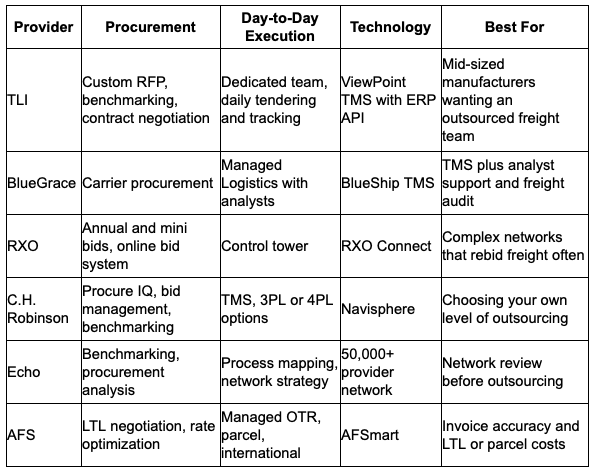
Side-by-Side Comparison
Questions to Ask Before You Sign
A short list of questions will tell you a lot about how a provider will work with your plant:
Who will manage our account each day? Ask whether you get a named team or a shared queue.
How are carriers selected and rebid? A provider should explain how often it benchmarks your rates against the market.
What does integration with our ERP involve? Get a realistic timeline, not just a yes.
How are invoices audited and claims filed? Find out who chases damaged freight and overcharges.
What reports will we see, and how often? Regular business reviews with cost trends keep the program honest.
Are there volume minimums or long contract terms? These matter most for mid-sized shippers with seasonal swings.
Conclusion
The right managed transportation provider depends on your size and where your freight costs leak. Large manufacturers with complex networks may lean toward providers with big carrier networks and control towers. Shippers focused on billing accuracy may favor an audit-led partner. Mid-sized plants that need a full freight team without hiring one should look closely at programs designed for their scale.
Whichever route you take, start with your own data. Pull a year of freight invoices, list your main lanes and modes, and bring that to every provider conversation. With rates rising, a clear picture of where your money goes is the fastest way to find a partner that can lower it.
Stay up to date with our latest ideas!