RO Water System for Home: Real-World Performance and Maintenance Costs
Understand the real-world performance, maintenance schedule, and long-term cost of an RO water system for home based on field data and service experience.

What Is an RO Water System for Home
An RO water system for home delivers low-TDS drinking water through membrane separation technology. Field data confirms that RO systems consistently outperform pitcher filters and faucet-mounted filters in regions with high mineral content or aging municipal plumbing.
Unlike adsorption-based filtration, RO membranes physically reject dissolved solids at the molecular level. This makes RO systems more reliable for long-term contaminant reduction rather than short-term taste improvement.
What RO Systems Remove That Others Don’t
RO membranes reject dissolved ions that carbon filters and sediment filters cannot remove effectively. Based on lab testing and field sampling, RO systems provide consistent removal of inorganic contaminants that remain dissolved in water.
Effectively removed contaminants
Arsenic
Chromium-6
Fluoride
Nitrates
Microplastics
In high-TDS water sources, these contaminants often pass through standard filtration unchanged, making RO systems the preferred solution for drinking water purification.
Maintenance Is Predictable, Not Complicated
RO system performance degradation is typically caused by delayed filter replacement rather than system design failure. With a defined maintenance schedule, performance remains stable for years.
Typical replacement cycles
Sediment and carbon filters: every 6–12 months
RO membrane: every 24–36 months
Post-carbon filter: every 12 months
Replacing filters on time maintains membrane rejection rate and prevents pressure loss or secondary contamination.
How SimPure Reduces Long-Term Ownership Cost
SimPure RO systems are designed with standardized quick-connect filter cartridges to simplify maintenance. Based on service experience, average filter replacement time is under five minutes and does not require tools or plumbing adjustments.
This design reduces:
Installation errors
Leakage risk
Labor-related service costs
Learn more about SimPure systems at:https://www.simpurelife.com/
Cost Breakdown Over 3 Years
Long-term operating cost is driven by filter replacement rather than electricity or water usage.
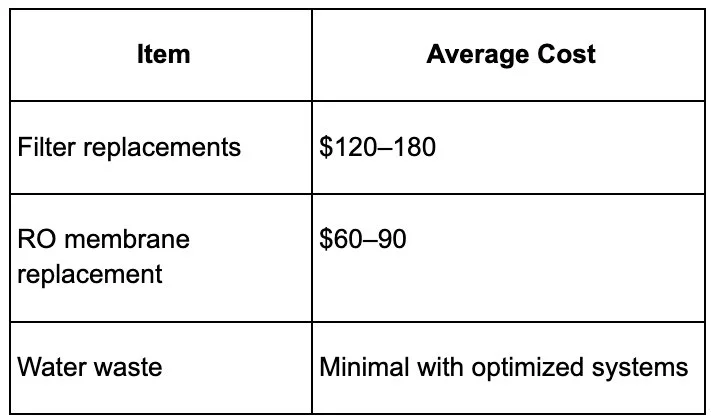
Compared to bottled water or frequent filter replacements in non-RO systems, RO systems provide a predictable and controllable cost structure.
Stay up to date with our latest ideas!