Learn the best ways to upgrade insulation in an existing metal building, from spray foam and rigid panels to reflective barriers and cost-effective improvements.
Upgrading insulation in an existing metal building is usually less about starting over and more about fixing the parts of the building envelope that leak performance first. In most cases, that means identifying where heat gain, heat loss, condensation, and air leakage are actually happening, then choosing improvements that give the biggest operational return without forcing a full rebuild.
That matters because many older metal buildings were not originally designed for today’s expectations around energy efficiency, temperature control, occupant comfort, or conditioned storage. A building may still be structurally sound and operationally useful, but perform poorly because the roof, walls, doors, or internal thermal barriers are under-insulated or inconsistently sealed.
For owners looking at retrofit options in 2026, the best upgrade path usually depends on how the building is used. A warehouse, workshop, agricultural structure, commercial unit, or temperature-sensitive storage space will not all have the same priority. Still, the strongest insulation upgrades tend to follow the same logic: improve the biggest weak points first, reduce uncontrolled air movement, and choose retrofit solutions that fit the existing structure rather than fighting it.
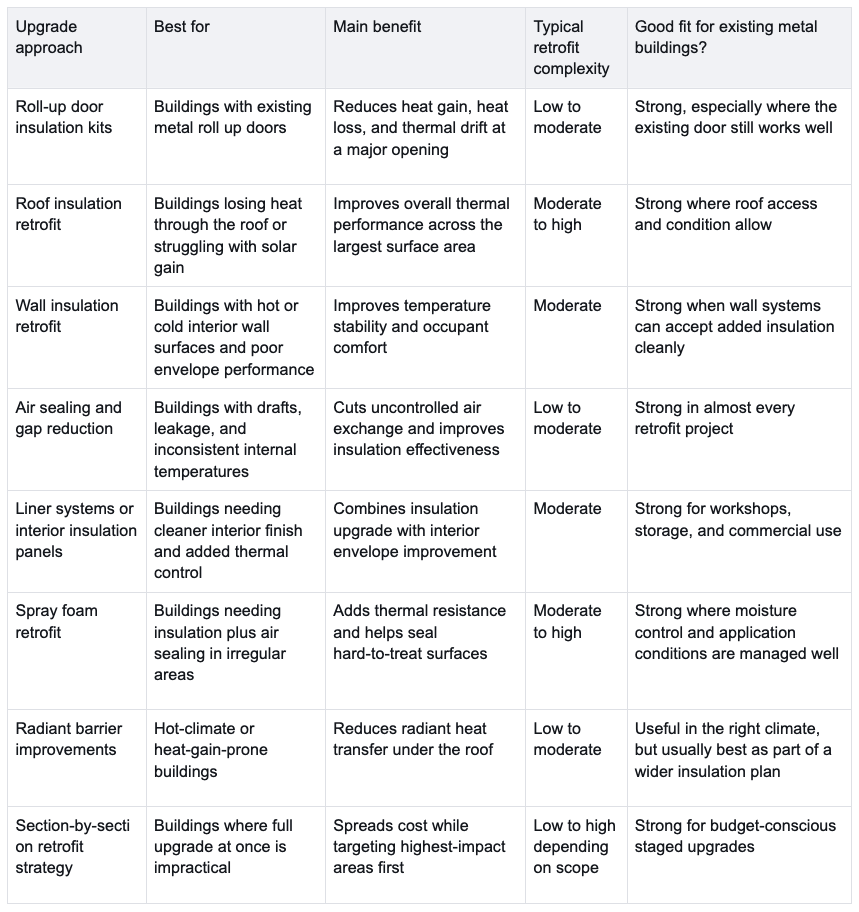
Comparison table
Where existing metal buildings usually lose insulation performance
Before choosing products, it helps to be clear on what is actually failing. In many metal buildings, poor performance does not come from one dramatic defect. It comes from several smaller weak points working together.
The most common problem areas are:
Roof systems with little insulation or ageing insulation layers
Metal wall panels that transfer outside temperatures quickly
Roll up or overhead doors with little thermal resistance
Gaps around frames, penetrations, and service openings
Poorly insulated interior partitions in partially conditioned spaces
Condensation-prone surfaces where warm and cool air regularly meet
That last point is often underestimated. Once condensation becomes part of the building’s daily cycle, insulation upgrades are no longer just about comfort or efficiency. They become part of moisture control and long-term building protection too.
Best ways to upgrade insulation in an existing metal building
Add insulation to existing roll up doors
For many metal buildings, the door is one of the weakest thermal points in the whole structure. That is especially true in warehouses, workshops, storage buildings, and commercial units with large metal roll up doors that open regularly and offer very little built-in insulation.
That is why door insulation is often one of the smartest first upgrades. Instead of replacing a functional door, owners can improve the opening with a retrofit insulation kit designed for existing roll up doors. In buildings where the door still works mechanically, this can be a more practical and cost-conscious improvement than full replacement.
Why it works
Targets one of the biggest sources of heat transfer
Helps reduce thermal drift at a frequently used opening
Can improve comfort and energy efficiency without changing the full door system
Often easier and less disruptive than replacing the entire door
Good fit for
Warehouses
Storage units
Workshops
Agricultural buildings
Commercial and industrial metal buildings with existing roll up doors
Retrofit roof insulation
Once the opening is addressed, the next major area is usually the roof. In many metal buildings, the roof is the largest exposed surface and one of the biggest drivers of heat gain in warm conditions and heat loss in cooler ones.
That makes roof insulation one of the most powerful upgrades available, although it is usually more involved than door insulation. Depending on the building, retrofit options may include adding insulation beneath the roof deck, upgrading existing blanket systems, installing insulated liner assemblies, or combining insulation work with wider roof refurbishment.
Why it works
Improves thermal performance across a large surface area
Helps reduce solar heat gain in warmer months
Supports more stable indoor temperatures year-round
Can lower pressure on heating and cooling systems
Good fit for
Buildings with poor summer performance
Conditioned warehouses and workshops
Older metal buildings with minimal roof insulation
Retrofit projects already planning roof access or refurbishment
Upgrade wall insulation
After the roof, wall systems often become the next logical focus. Metal wall panels transfer outside temperatures quickly, and in older buildings they may offer very little thermal separation at all. That can make interiors harder to condition and less comfortable for staff, stock, or equipment.
Wall retrofits vary by building type. Some projects add insulation internally with liner systems or insulated panels. Others upgrade cavity or framed wall assemblies where the structure allows. The right option depends on how much space can be given up, how the interior is used, and whether appearance matters alongside performance.
Why it works
Reduces heat transfer through exposed wall areas
Improves comfort near perimeter zones
Helps the building envelope work more consistently with roof and door upgrades
Supports better temperature stability in conditioned spaces
Good fit for
Workshops and production spaces
Commercial units with occupied interiors
Warehouses storing temperature-sensitive materials
Buildings with large exposed wall runs and poor internal comfort
Improve air sealing around gaps and penetrations
Not every insulation problem comes from missing insulation. In many existing metal buildings, uncontrolled air leakage is a major part of the issue. Even decent insulation performs poorly if outside air moves too freely through joints, edges, penetrations, and service gaps.
That makes air sealing one of the highest-value supporting upgrades in almost any retrofit plan. It is rarely the most visible improvement, but it often makes every other insulation investment work better.
Why it works
Reduces drafts and uncontrolled air exchange
Helps existing and new insulation perform more effectively
Supports more stable internal temperatures
Can help limit condensation risk in vulnerable areas
Good fit for
Older metal buildings with obvious drafts
Buildings with pipe, cable, or vent penetrations
Partially conditioned units with temperature inconsistency
Any project combining insulation upgrades with envelope improvements
Install liner systems or insulated interior panels
Some buildings need more than added R-value alone. They also need a cleaner internal finish, better separation from metal surfaces, or a more controlled interior environment. In those cases, liner systems or insulated interior panel systems can be a strong retrofit move.
This approach can be especially useful in commercial, workshop, and storage environments where the building needs to feel more finished while also performing better thermally.
Why it works
Adds insulation while improving the interior envelope
Can help reduce condensation on exposed metal surfaces
Improves appearance and usability in occupied spaces
Useful where basic insulation alone does not solve the operational problem
Good fit for
Workshops and trade units
Commercial storage buildings
Agricultural or utility buildings being upgraded for broader use
Metal buildings needing both insulation and interior finish improvement
Use spray foam in targeted areas
Where buildings have awkward geometry, hard-to-reach surfaces, or multiple small leakage points, spray foam can play a useful role. Its main advantage is that it combines insulation and air sealing in one application, which can be effective in retrofit conditions that are difficult to treat with rigid or blanket insulation alone.
That said, it is usually best viewed as part of a wider strategy rather than a universal answer. Application quality, moisture management, and compatibility with the building assembly all matter.
Why it works
Helps insulate irregular surfaces and junctions
Adds air sealing along with thermal resistance
Useful in targeted retrofit zones that are hard to address otherwise
Can support condensation control in certain assemblies
Good fit for
Buildings with irregular details or service-heavy areas
Retrofit projects with difficult-to-seal leakage paths
Targeted upgrades rather than simple broad-surface retrofits
Owners working with contractors experienced in metal building applications
Add or improve radiant barriers where heat gain is the issue
In hotter climates or buildings with strong solar exposure, radiant heat transfer can be a major part of the problem. In that context, radiant barriers can help reduce heat gain, particularly under roof systems.
They are usually not the best standalone answer for a poorly insulated building, but they can be useful when paired with broader roof or envelope upgrades.
Why it works
Helps reduce radiant heat load from roof exposure
Can improve comfort in hot-weather conditions
Supports wider roof insulation strategy rather than replacing it
Good fit for
Hot-climate metal buildings
Warehouses and workshops struggling with summer heat
Roof retrofit projects already being upgraded for thermal performance
Upgrade in phases if a full retrofit is not practical
By this point, the pattern is clear: the best insulation retrofit is usually the one that addresses the building’s real weak points first. Not every owner can upgrade the whole envelope at once, and in many cases there is no need to.
A phased retrofit often makes more sense. Start with the biggest performance gaps, then build from there. For many metal buildings, that means beginning with roll up doors, roof weaknesses, or obvious air leakage before moving on to walls or more complete interior envelope work.
A practical sequence often looks like this:
Start with major openings such as uninsulated roll up doors
Fix air leakage around gaps, penetrations, and edges
Upgrade the roof system if heat gain or loss remains high
Improve wall insulation where interior comfort or thermal stability still lags
Add interior liners or targeted spray foam where function or finish requires it
Final thoughts
The best way to upgrade insulation in an existing metal building is usually not to rebuild the whole structure. It is to improve the building envelope in the places where performance is being lost most heavily.
For many owners, that starts with the roll up door. In real buildings, doors are often one of the biggest weak points for heat transfer, temperature drift, and energy loss. That is why retrofit door insulation can be such a practical first step. From there, roof insulation, wall upgrades, air sealing, and interior envelope improvements can build a stronger and more stable overall result.
The right sequence depends on how the building is used, but the logic stays the same. Fix the weakest openings first, support the wider envelope, and choose retrofit solutions that improve performance without creating unnecessary replacement cost.
FAQ
What is the best way to insulate an existing metal building?
The best approach depends on the building’s weak points. In many cases, the most effective strategy is to improve major openings first, reduce air leakage, and then upgrade roof and wall insulation where needed.
Can you add insulation to an existing metal building without replacing it?
Yes. Many insulation upgrades can be retrofitted onto an existing metal building, including door insulation, roof upgrades, wall improvements, liner systems, and air sealing work.
Should I insulate the roof, walls, or doors first?
That depends on where the building is losing the most performance. In many commercial and storage buildings, roll up doors and roof systems are among the first areas worth addressing.
Is spray foam the best insulation for metal buildings?
Not always. Spray foam can be useful in targeted retrofit areas, especially where air sealing matters, but it is not the only option and may not be the best first upgrade for every building.
Are roll up door insulation kits worth it for metal buildings?
In many cases, yes. If the existing roll up door still functions well, a retrofit insulation kit can improve thermal performance more cost-effectively than replacing the whole door system.
Stay up to date with our latest ideas!