Discover how to design a more sustainable and efficient home kitchen with smart appliances, durable materials, energy-saving features, water efficiency, and better layouts.
Before choosing cabinet colors or adding another appliance to your renovation plan, think about what happens in your kitchen on an ordinary evening. Where do you prepare ingredients? Which kitchen tools do you actually use? What gets forgotten in the refrigerator, and what makes cleanup harder than it needs to be?
These questions offer a practical starting point for a more sustainable kitchen. The goal is to make thoughtful choices about what you keep, what you replace, and how the space supports everyday cooking.
Whether you are planning a full renovation or making smaller improvements, focus on a kitchen that works well beyond the day it is photographed.
Start With What You Can Keep
Begin with an assessment, not a demolition plan.
Ask a contractor or cabinet specialist to distinguish structural problems from cosmetic ones. Sound cabinet boxes might need repaired hinges, refreshed fronts, or better internal storage rather than complete replacement. A functional layout may need more preparation space, not an entirely new arrangement.
Preserving useful materials and salvaging components for reuse can reduce renovation waste and the demand for new materials. The Environmental Protection Agency prioritizes preventing construction waste before managing it through reuse or recycling.
Build your design around the elements worth retaining. Existing wood cabinets could become the starting point for a warmer color palette, while familiar hardware or a well-made table might work with updated lighting.
Evaluate appliances separately. Consider their condition, repair options, and operating efficiency rather than replacing them for appearance alone—or assuming that keeping every older appliance is always the better choice.
Arrange the Kitchen Around Everyday Tasks
Sketch how you move through preparing a familiar meal. Mark where you take out ingredients, wash produce, chop, cook, plate, and clean up. Then look for the places where the process becomes awkward.
Try grouping tools around those tasks. Keep cutting boards and preparation utensils near your main work surface. Place everyday dishes close to where you unload them. Consider moving the coffee setup away from the main cooking area so someone can make a drink without interrupting dinner.
Protect a useful stretch of clear countertop. Before adding an island or extra seating, check whether appliance doors and drawers can open comfortably and whether people can move through the room while someone cooks.
Include countertop appliances in the layout from the beginning. Plan for opening baskets or doors, setting down hot cookware, and accessing parts for cleaning. Have an installer check outlet placement, ventilation, and manufacturer-required clearances before finalizing cabinetry.
A more efficient layout starts with fewer obstacles, not necessarily more square footage.
Choose Cooking Equipment Around Your Actual Meals
Look at the meals you prepare most often before deciding which appliances deserve space.
The U.S. Department of Energy recommends using appropriately sized small appliances for smaller meals rather than automatically using a large stove or oven. Its examples include air fryers, toaster ovens, microwaves, and multicookers.
Make the comparison around the whole meal. Account for preheating, cooking time, and the number of batches required. An appliance that suits dinner for two may be less practical when several dishes need cooking at once.
For homeowners exploring countertop options, Typhur offers air fryers, countertop ovens, and food thermometers. Consider these tools in relation to your usual portions, preferred cooking methods, and temperature-checking needs—not simply the number of functions available.
Before buying, check usable cooking dimensions, cleaning instructions, warranty terms, and replacement-part availability. Ask whether the appliance fills a genuine gap or duplicates equipment you already use comfortably.
For appliances carrying an EnergyGuide label, compare the stated energy use and estimated operating costs with similar models. ENERGY STAR certification can also help identify efficient products in eligible categories; assess the specific model rather than assuming that every product from a brand has the same credentials.
Select Materials You Can Maintain and Repair
A material’s appearance should be only part of the decision. Ask how it will handle your cooking habits, what maintenance it requires, and what happens if one area becomes damaged.
For example, investigate reclaimed shelving, salvaged cabinet hardware, or products with documented recycled content. Check their condition and suitability for the intended location rather than treating the word “reclaimed” as a complete specification.
Apply the same thinking to new cabinetry and surfaces. Ask whether hinges, drawer runners, individual fronts, or other components can be replaced without removing a much larger assembly. EPA’s design guidance highlights durable materials, accessible connections, and planning for adaptation and repair as ways to extend usefulness and reduce waste.
For the visual scheme, choose permanent finishes you genuinely enjoy. Put seasonal color and experimentation into smaller, movable elements such as artwork, textiles, or objects you already own. There is no requirement for a sustainable kitchen to follow a particular palette.
Make Food Storage Part of the Design
Storage should help you use food, not merely hide it.
EPA recommends checking existing supplies before shopping, planning quantities around meals, labeling stored food, and freezing items that will not be eaten in time. These practices help prevent food waste and preserve the resources used to produce and distribute that food.
Translate those habits into physical space. Reserve a visible refrigerator area for leftovers and ingredients that need using soon. Keep reusable containers and their matching lids together, with a pen or labels nearby.
In the pantry, organize foods so you can see what is already open before reaching for another package. Test the arrangement with existing shelves and containers before ordering a complete storage system. Pull-out fittings may be worth considering where deep cabinets are genuinely difficult to use.
Do not decant everything solely for a uniform appearance. Keep preparation instructions and relevant date information accessible when transferring food.
The useful test is simple: Can you quickly identify what you have, what needs using, and where the next meal will come from?
Improve Lighting Where You Work
Plan lighting around preparation, cooking, and cleanup rather than choosing decorative fixtures first.
Consider focused lighting above work surfaces, with separate lighting for dining or general movement through the room. Test where shadows fall when you stand at the counter, not just how the kitchen looks from the doorway.
Replacing older incandescent bulbs with suitable LEDs can reduce lighting energy use. Compare brightness in lumens, select a light color you find comfortable, and check compatibility with existing fixtures and dimmers.
Before replacing a fixture you like, investigate whether it can safely accommodate an appropriate LED bulb. During the day, experiment with window coverings that provide the privacy you need while letting useful daylight reach the workspace.
The design objective is adequate, comfortable light where it is needed—not maximum brightness throughout the room.
Make Water-Saving Habits Easier to Follow
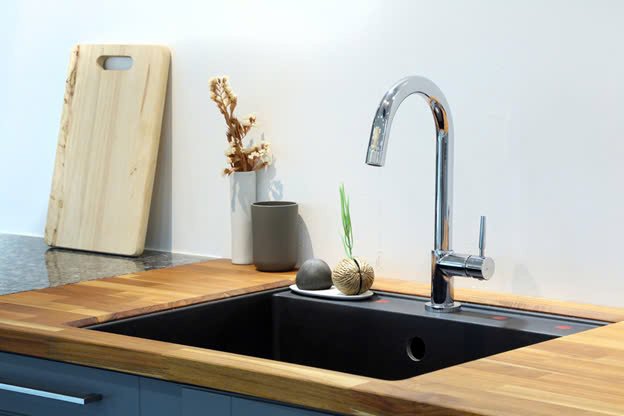
Begin at the sink. Check for dripping faucets and moisture around pipe connections rather than waiting for a visible problem to become part of a larger renovation.
When replacement is necessary, compare kitchen faucet flow rates as well as finish and style. EPA’s home-maintenance guidance recommends monitoring leaks and choosing kitchen faucets with flow rates between 1.5 and 1.8 gallons per minute.
For dishwashing, ENERGY STAR recommends scraping food off plates instead of pre-rinsing and running full loads whenever possible.
Support that routine with the layout. Put the appropriate waste bin within easy reach of the loading area, leave space to organize dirty dishes, and keep cleaning supplies accessible. Check local collection requirements before planning a separate food-scrap bin.
A coordinated sink area does not need to be elaborate. Prioritize a setup that makes everyday cleanup straightforward and gives you access for maintenance.
Improve the Kitchen in a Practical Order
You do not need to make every change at once.
Start with the problems you notice repeatedly: the leaking faucet, the cabinet you cannot reach into, the dark preparation area, or the food that disappears behind newer groceries. Test smaller adjustments before committing to larger replacements.
For a renovation, write a brief that separates what must change from what can remain. Include storage, appliance access, maintenance, and daily routines alongside materials and colors.
A more sustainable and efficient home kitchen is not defined by a particular finish or a countertop full of technology. It is shaped by considered decisions: keeping useful materials, choosing equipment for real tasks, and making everyday cooking easier to manage.
Stay up to date with our latest ideas!