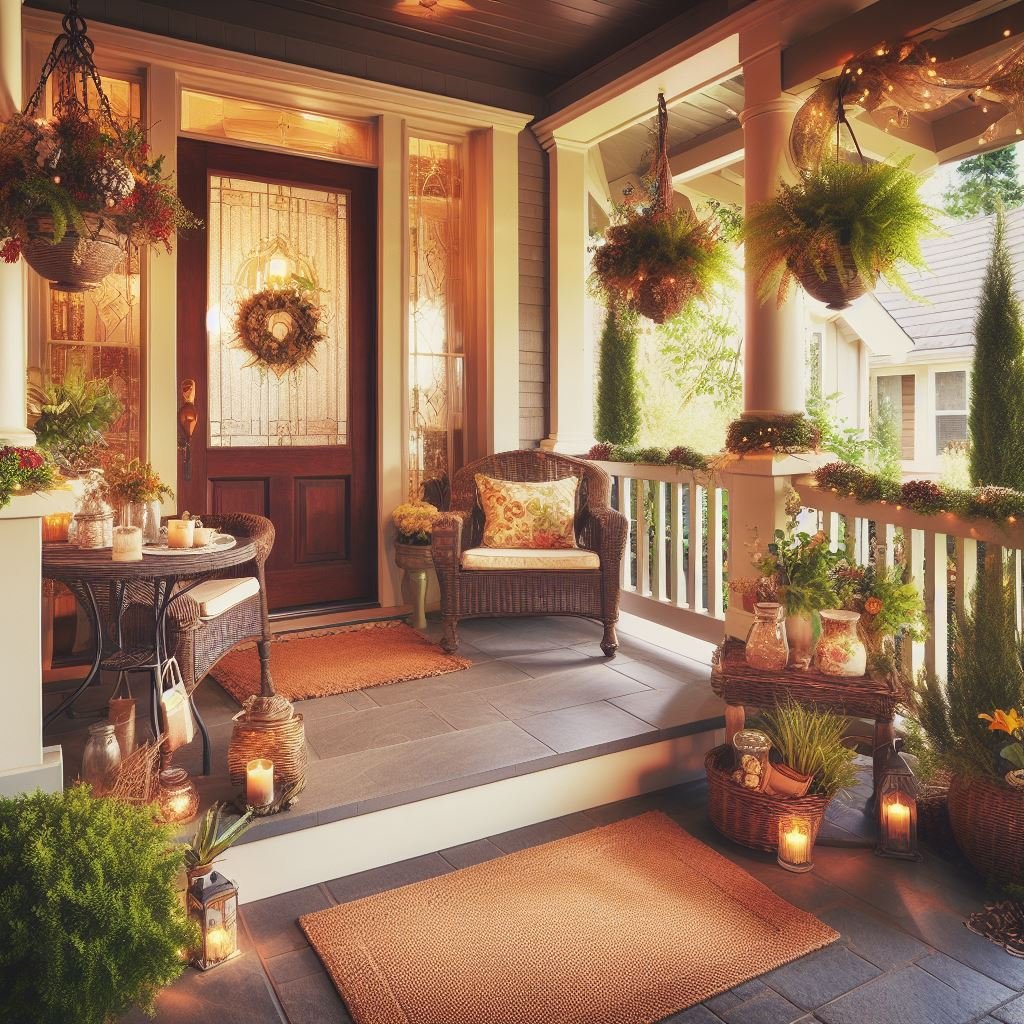
How to Decorate a Porch for a Welcoming and Stylish Entrance
Discover how to decorate a porch for a welcoming, stylish entrance with thoughtful furniture, lighting, plants, colors, and inviting finishing touches.

A porch can feel empty, cluttered, or oddly disconnected from the house when the furniture, lighting, plants, colors, and accessories are all chosen separately. A good entrance comes from balancing looks with the practical side: the space you have, how people move through it, weather exposure, comfort, and how it all reads after dark. This guide shows how to build a porch in layers, one choice at a time.
How do you decorate a porch? Build it in layers. Start by measuring the space and deciding how you'll use it, then choose furniture that fits the footprint. Pull a color palette from your home's exterior, add plants for texture, and light the entrance for both day and night. Finish with weather-resistant textiles and a few personal details, and confirm every material suits your climate.
1. Start with your porch size, layout, and purpose
Before buying any decor, work out how the porch will actually be used. Look at the porch dimensions, the way the front door swings, the natural walking route to it, how much seating you want, your home's architectural style, weather exposure, and your budget.
A 4-foot-wide entrance stoop may have room only for a wall light, a planter, and a doormat, while a 10-foot covered porch can hold a full seating area with a rug and a low table.
Decide on a look before you shop
Choosing a loose style up front keeps every later decision consistent. A few directions to anchor to:
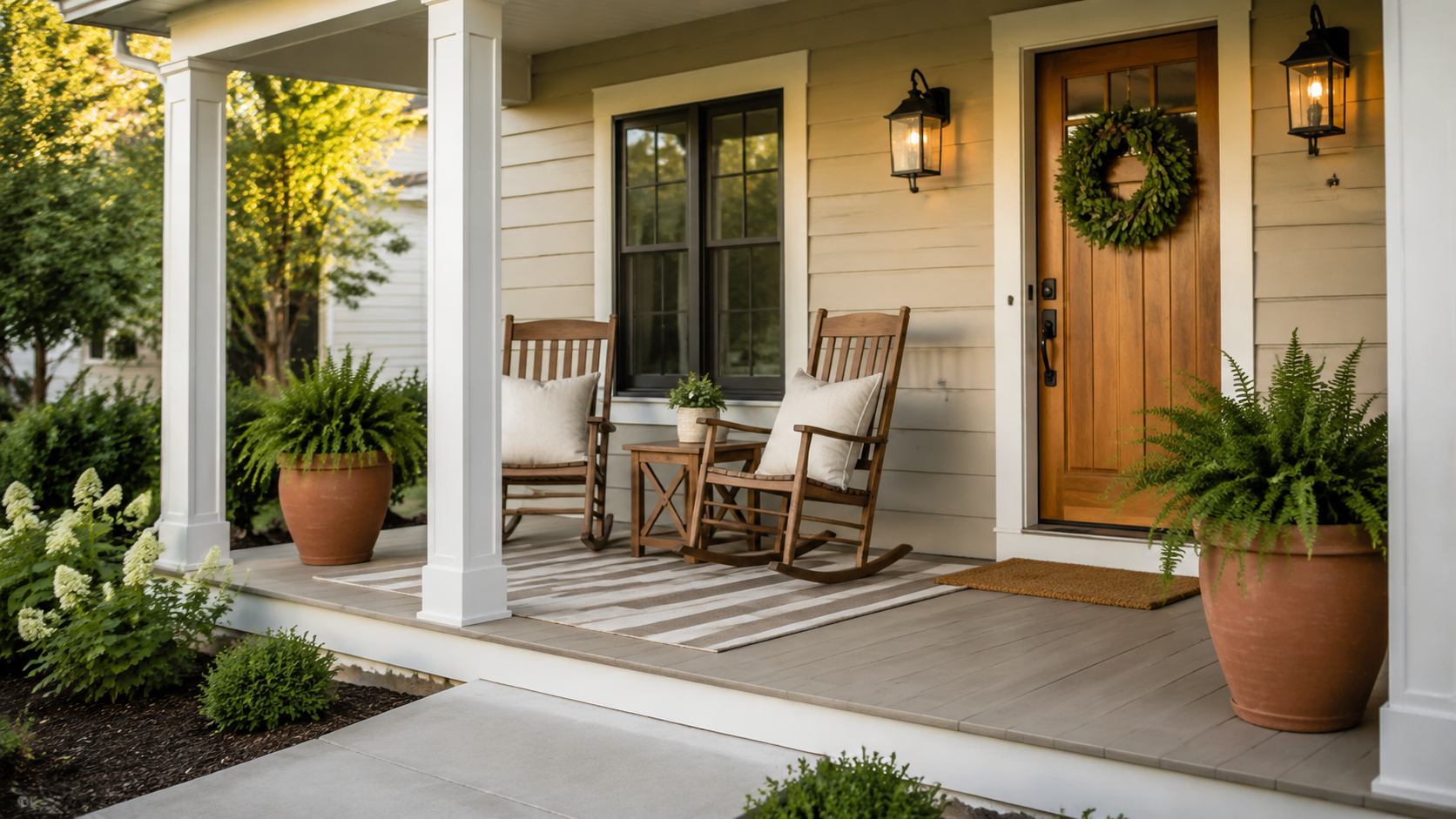
Farmhouse: rocking chairs, lantern-style sconces, ferns, and a woven doormat in warm, muted tones.
Modern: clean-lined seating, a monochrome palette, linear or geometric fixtures, and one sculptural planter.
Coastal: light woods, blue-and-white textiles, rope or rattan textures, and airy greenery.
Cottage or boho: layered cushions, mixed pots at varied heights, trailing plants, and patterned outdoor rugs.
You don't have to follow a style rigidly, but naming one gives you a filter for every purchase that follows.
View the porch from a distance
Step back and look at the porch from the sidewalk, driveway, or street. From there you can see whether the entrance stands out, whether the furniture looks the right size, whether one side feels heavier, and how the porch adds to your curb appeal.
2. Choose porch furniture that fits the space
Furniture should be proportional to the space it sits in. On most porches that means rocking chairs, compact outdoor armchairs, a bench, a porch swing, or a small side table instead of bulky indoor-style sofas.
On a larger porch, furniture can define a conversation area, with chairs turned toward each other around a low table. Whatever you choose, keep a clear route between the porch steps and the front door.
3. Choose a color palette that complements your home
Build the porch palette around the permanent exterior elements you can't easily change: the siding, brick, stone, trim, roof tones, front door, and any existing metal finishes. Begin with a restrained base of one or two main colors, then layer in one or two smaller accent colors through cushions, planters, or a doormat.
Repeating tones from the house through furniture, textiles, or accessories helps the porch feel connected to the architecture, so it looks deliberate before you add a single piece.
For example, a red-brick facade pairs cleanly with charcoal, cream, and a single warm accent like mustard or terracotta; gray siding takes cool blues, white, and soft greens; a bold front door in navy or forest green can become the accent the rest of the palette echoes.
4. Use outdoor Poarch lighting to make the porch welcoming after dark
A porch should look good by day and after sunset, so plan the lighting alongside everything else. Good porch lighting frames the entrance, makes the front door easy to find, improves nighttime curb appeal, and brings out architectural details. How a fixture looks matters as much as how it lights.
Add exterior wall lights around the entrance
Wall mounted fixtures work on either side of the door where the architecture and electrical layout allow. Consider the fixture's scale relative to the door, its placement, the direction it casts light, and its suitability for outdoor use.
Well proportioned outdoor porch lights can frame the doorway while reinforcing the architectural character of the entrance. As a rough guide, a single fixture should be about one-third the height of the door; when you flank the door with two, size each a little smaller.
For outdoor entrances, fixtures with an IP44 rating are a good choice for areas that receive some exposure to moisture and splashing water. They offer a practical level of protection against rain and outdoor conditions
Consider how the fixture looks during the day
Porch lights stay visible even when switched off. Their shape, finish, scale, material, and relationship to your door hardware all affect how the entrance looks by day, so choose one you're happy to see unlit as well as lit.
5. Add plants and planters for color and texture
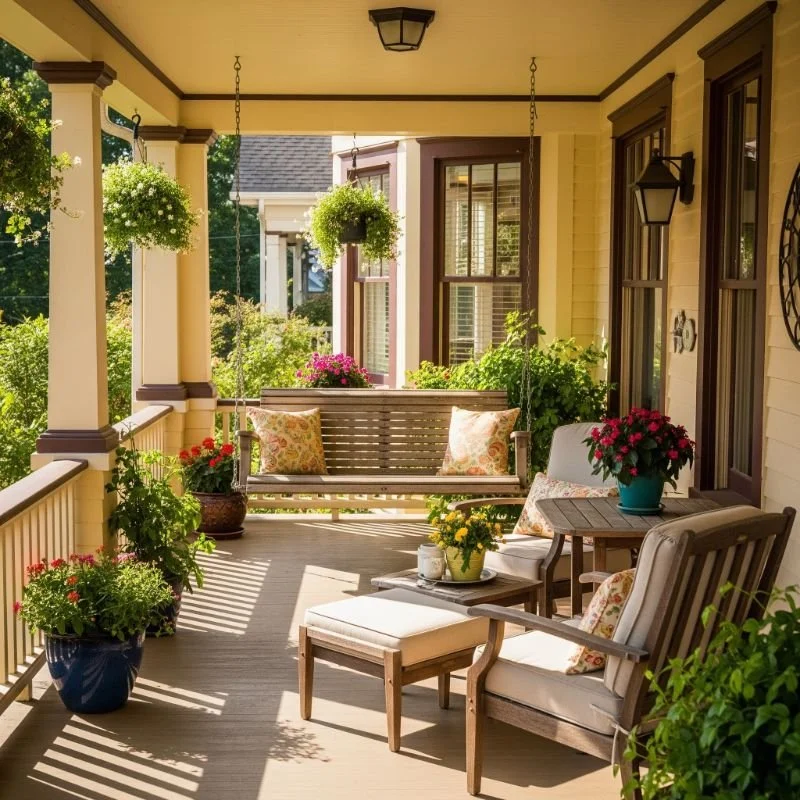
Plants soften hard architectural surfaces and bring in natural color, height, and texture. Consider planters beside the entrance, container plants, hanging baskets, seasonal flowers, and evergreens. Vary the height and scale of your pots for a natural, layered look instead of lining up several identical ones.
Match plants to the conditions they'll actually live in:
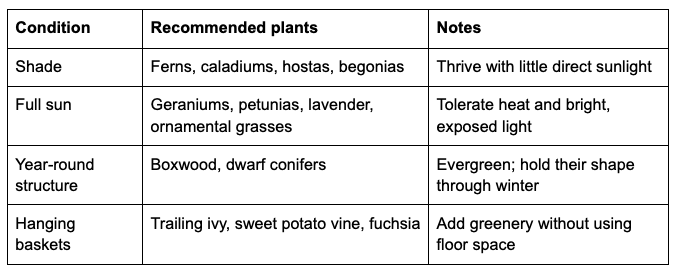
Also factor in your local climate, the season, and how much upkeep you can realistically manage. On a small porch, hanging baskets or a vertical planter add plants without taking up the room you need to move through.
6. Make the front door the main focal point
The front door is the visual anchor of the porch, so let it lead. Give attention to the door's color or finish, the hardware, the house numbers, and a wreath or other restrained door decor, keeping the surrounding area calm rather than busy. A fresh coat of paint in a confident color is one of the highest-impact, lowest-cost changes you can make.
Balance does not always mean perfect symmetry
Matching elements on both sides of the entrance can look formal and polished when the architecture supports it. But don't force symmetry onto an offset or narrow porch.
An asymmetrical arrangement still feels intentional when the visual weight of the furniture, plants, and lighting is distributed evenly across the space. Aim for even visual weight, not identical objects on each side.
7. Add comfort with an outdoor rug and textiles
Textiles soften a porch and make a seating area feel finished. Look at weather-resistant outdoor rugs, seat cushions, and pillows in coordinated patterns and accent colors, and favor washable, fade-resistant materials such as polypropylene or solution-dyed acrylic.
On a larger porch, an outdoor rug helps define the seating area. On a compact porch, one or two cushions may add all the softness you need. Keep patterns in the same family pair a large-scale print with a simple stripe or solid instead of combining several unrelated ones.
8. Finish the porch with a few personal details
Bring in smaller decorative pieces only once the major elements are in place. Good finishing touches include a doormat, a decorative basket, one or two weather-resistant objects, restrained seasonal accents, or personalized house details, added sparingly so they look considered, not cluttered.
Make seasonal updates easy
You don't need to redesign the whole porch for every season. If the major furniture, lighting, and base palette stay fairly neutral, smaller elements are quick to swap:
Spring: a pastel or dried-flower wreath, fresh annuals, and a lighter doormat.
Summer: bright cushions, a citronella lantern, and lush hanging baskets.
Fall: mums, small pumpkins, a plaid or rust-toned throw, and a warmer wreath.
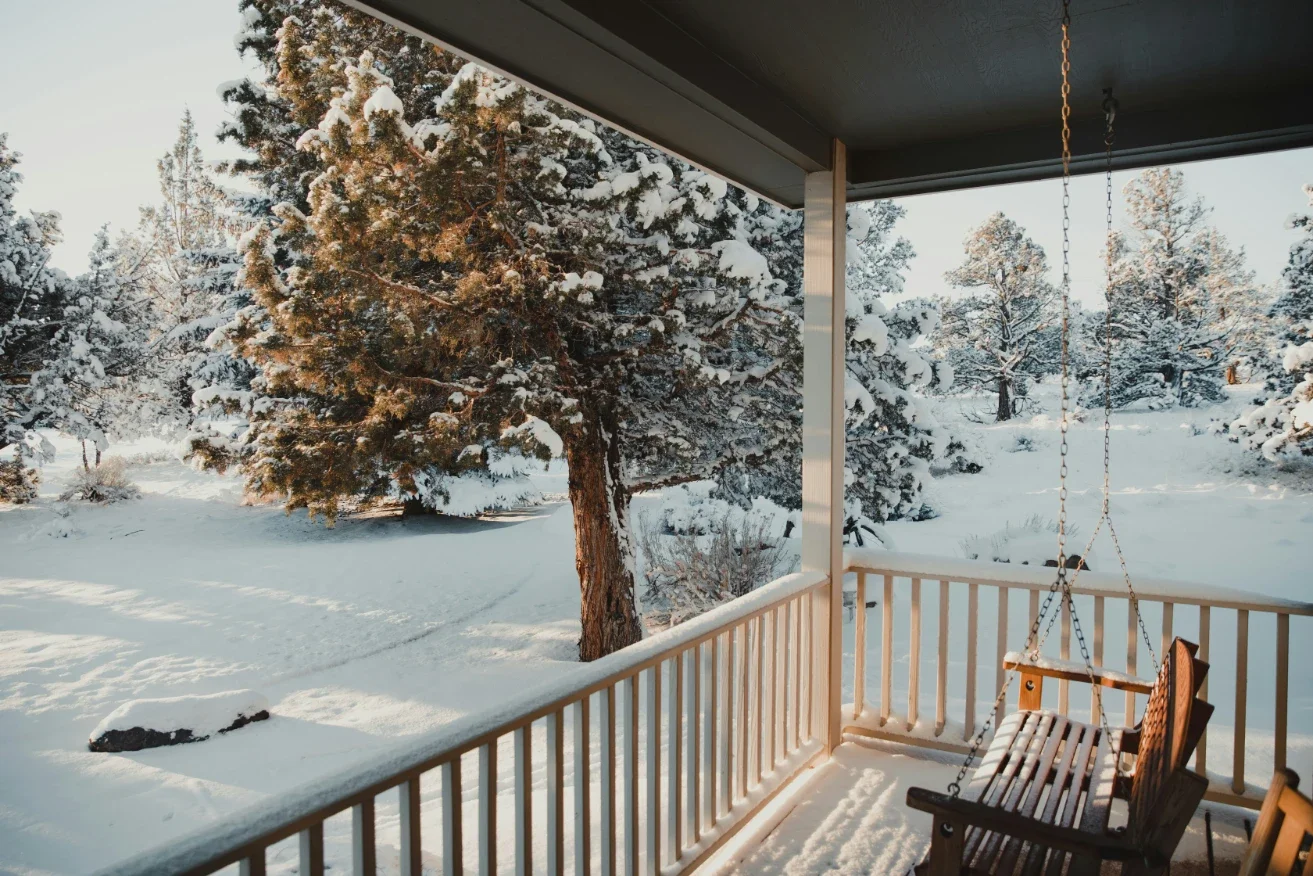
Winter: an evergreen swag, a lantern with a warm bulb, and a chunky knit throw.
Think of it as editing the porch through the year, so it stays fresh without becoming crowded.
9. Choose materials that can handle outdoor conditions
Even covered porches face moisture, humidity, UV exposure, dust, wind, and temperature changes. Choose outdoor-rated fabrics, weather-resistant finishes, easy-clean surfaces, and exterior-rated lighting suited to the location.
In humid or coastal areas, corrosion-resistant materials are especially important. Material quality, finish, exposure, and maintenance all affect how well porch decor holds up over time.
Common porch decorating mistakes to avoid
Overcrowding a small porch. It feels tight and hard to use. Keep to a few functional pieces and leave the route clear.
Blocking the path to the door. It makes the entrance awkward. Keep the route from steps to door open.
Furniture that's out of scale. It overwhelms a small porch or gets lost on a big one. Match the size to the space.
Forcing symmetry. It looks strained on an offset porch. Balance the visual weight instead of matching both sides.
Too many unrelated colors. The porch feels unplanned. Use a restrained base with one or two accents.
Forgetting the after-dark look. A porch planned only for daylight disappears at night. Plan the lighting from the start.
Conclusion
A well-decorated porch isn't about filling every corner; it's about working in order and letting each choice build on the last. Handle space, scale, color, greenery, lighting, comfort, and durability as connected layers, and the entrance will feel like a natural part of the home rather than a collection of separate pieces.
When you are ready to complete the look, explore 7Pandas for stylish outdoor lighting designed to add warmth, character, and function to your porch and other exterior spaces.
Stay up to date with our latest ideas!