Discover how zoned mattress support works, how different zones affect comfort and spinal alignment, and what to consider when choosing the right mattress.

"Zoned support" appears on spec sheets as a number — 3 zones, 5 zones, 7 zones — and the number tells you almost nothing until you know two things: what the zones map to, and whether the structure behind them actually pushes back differently in each zone. Real zoning is a physical mechanism that resists in one region and yields in another. The zone counts map to actual body regions; DeRUCCI's T11 line spans all of them — the T11 SE at three zones, the T11+ at five, the T11 PRO at six with dual-drive adjustment — and two checks make zoning visible instead of asserted.
Zoning Is Physics, Not a Software Label
Genuine zoned support is a structure that pushes back differently by region — firmer where the body needs holding, more yielding where it needs room. It is not a uniform surface with "zones" written on top. The engineering basis: load arrives in bands, and a uniform surface answers them all alike.
Body load does not arrive evenly. Lie down and the heaviest regions — shoulder, hip, pelvis — press hardest, while the spaces between, like the waist of a side sleeper, barely press at all and leave a gap. A single uniform structure gives one response to all of it: either firm enough to hold the waist and therefore pressing hard under the shoulder, or soft enough to welcome the shoulder and therefore collapsing under the pelvis.
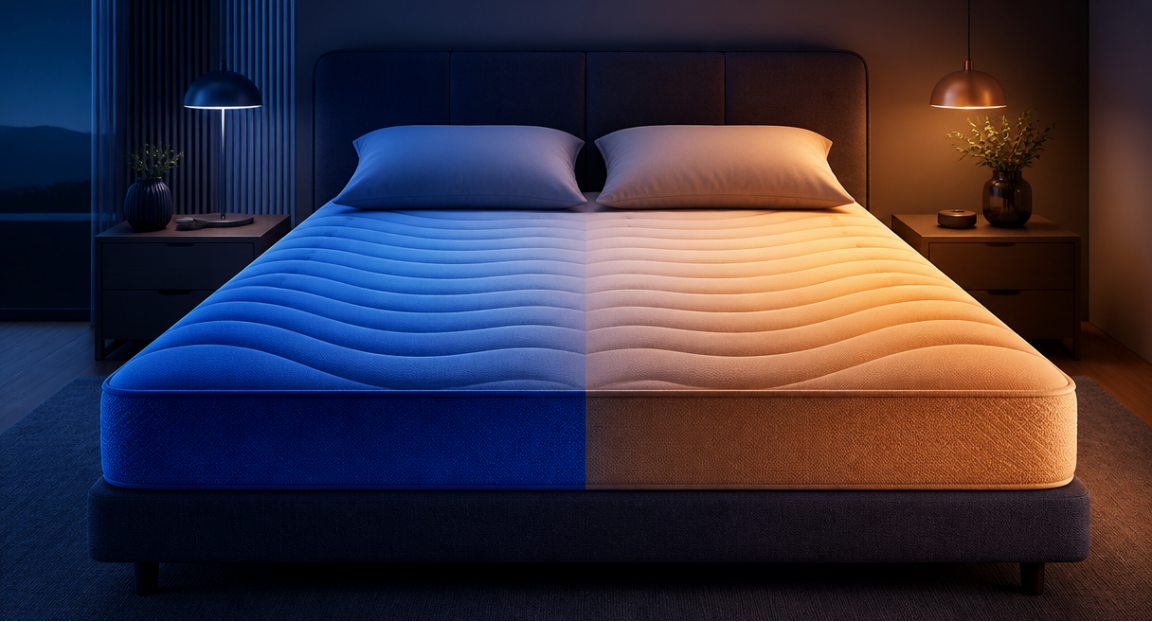
Zoning splits that compromise. Different regions are built — or set — to different firmness, so the shoulder meets a surface that yields while the lumbar region meets one that holds. That is the physical claim, and it stands or falls on whether the zones truly can act differently.
On the durability of exactly that, the DeRUCCI line's adjustment air sacs — high-elasticity rubber with a double-layer TPU composite fabric — were flexed 10,000 times under a 280 kg load in a CNAS-accredited laboratory. Laboratory testing, not a comfort result: what it certifies is that the structures doing the zone-by-zone work can keep doing it.
The Full Zone Map: What 3, 5 and 6 Zones Actually Cover
The three zone counts map to different bodies and positions. Three zones — shoulder, waist, hip — align directly with side-sleeping load but leave a back sleeper's lumbar only indirectly supported. Five zones add dedicated back and leg regions, correcting that gap. Six split thigh from calf. More is not automatically better; the test is whether the map matches your load.
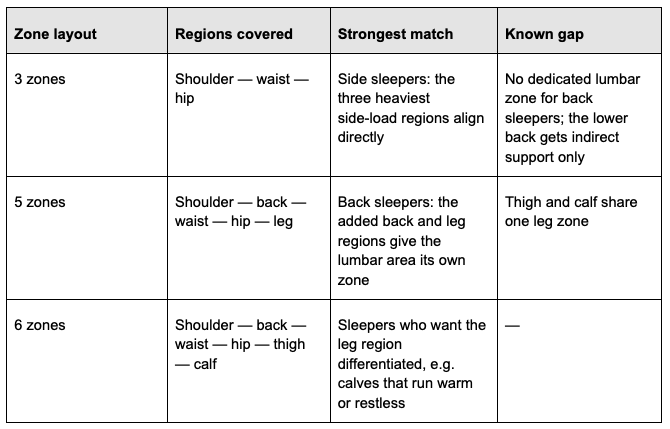
The jump from three to five is about sleeping position: a three-zone layout maps its zones onto the side sleeper's load path, and a back sleeper's lower back sits between zones, supported indirectly through neighboring regions. The back and leg regions a five-zone layout adds are exactly where a back sleeper's load concentrates. The jump from five to six is finer-grained — separating thigh from calf — useful where that distinction is felt.
How the zones sense and adjust — the mechanism that animates the map in real time — is a separate matter from the map itself, covered in How Adaptive Firmness Technology Works.
The Six-Zone Benchmark: T11 PRO's Dual-Drive Architecture
At the top of the range, the T11 PRO runs six zones per side — shoulders, back, lumbar, hips, thighs, calves — through 18 flexible units, nine per side, under two control boxes adjusting both sides at once, independently. Below the PRO, one side adjusts first while the other waits. Structural facts, not claims; two-drive means both maps take effect together.
Six zones per side, per DeRUCCI's official product specifications.
The machinery underneath: each side runs its adjustments through its own control box, so the left and right support maps form at the same time rather than in sequence. For two sleepers with different preferences, that simultaneity is the practical difference: both maps are in effect from the first minute, with no waiting.
Below the PRO tier, the T11 line works differently: one side adjusts first, then the other — a sequencing difference, not a verdict.
One behavioral figure from certification testing: the CAICT certification — attached to the T11 SE tier — recorded a 27.5% reduction in nighttime position changes, a certification-class figure, not a clinical one.
How to See Zoning Work: Two Verifiable Checks
Zoning is verifiable, and both checks are practical. In the DeRUCCI AI App, paired over Bluetooth, per-zone adjustment states display in real time — the zones stop being a claim and become something you watch. In a store, staff can trigger zone adjustments while you feel the shoulder yield against the lumbar hold. What you feel depends on your body.
- Check it in the app. Pair the mattress with the DeRUCCI AI App over Bluetooth and open the per-zone display. Which zones are adjusting, and by how much, shows as it happens — the abstract claim "six zones" turns into six visible states. On dual-drive models both sides display independently.- Check it in the store. Ask staff to trigger zone adjustment while you lie down in your real sleep position for several minutes. The contrast to notice is regional: the shoulder area yielding while the lumbar area holds. For two sleepers, ask for a demonstration of both sides adjusting independently, and feel whether your side changes while your partner's stays put.
Which models are on the floor varies by region, so confirm locally what is available to test.
Once you know your zone map — your position, your load regions — the tier specifications are on the T11 smart mattress product page, listed as sold.
FAQ
Are more zones always better?
No. Zone count is a mapping question, not a ranking. Three zones align directly with side-sleeping load; a back sleeper's lower back is better served by five or more; the sixth zone differentiates thigh from calf. A well-matched three-zone layout serves a side sleeper better than a poorly matched six-zone one.
Is zoned support the same thing as adjustable firmness?
No, and the difference matters. Zoning is structural — regions built or set to different firmness, which can be fixed. Adjustable firmness is dynamic — sensing and adjustment layers that change support in real time. DeRUCCI's T11 line combines the two: zoned layouts whose zone-by-zone support can adjust.
How can I verify that zoning is actually working?
Two ways. The app route: pair over Bluetooth and watch the per-zone states change as the mattress works. The store route: have a staff member run the zones while you lie there and register the regional contrast — shoulder yielding, lumbar holding — through your own body.
What is the difference between the T11 zone tiers?
Zone count and drive architecture. The SE carries three zones, the T11+ five, and the PRO six per side; the PRO alone runs two control boxes, so each side's nine units answer for their sleeper at the same time rather than in sequence.
Stay up to date with our latest ideas!