Fix plaster cracks, sticking doors and old anchors before you paint an older Chicago home: drying times, lead paint rules and the right order of work.

Brick bungalows, about 80,000 of them by the Great Depression according to the Chicago Architecture Center, were the typical new house in Chicago while the city added more than a million residents between 1910 and 1930. Today they account for about one-third of its single-family houses, set in an arc 4 to 7 miles from downtown known as the Bungalow Belt. The Chicago Metropolitan Agency for Planning (CMAP) puts 38.8% of the city's housing before 1940, compared with 27.8% in Cook County, and its median year at 1953.
Walls First: Plaster Cracks, Nail Holes and Old Anchors
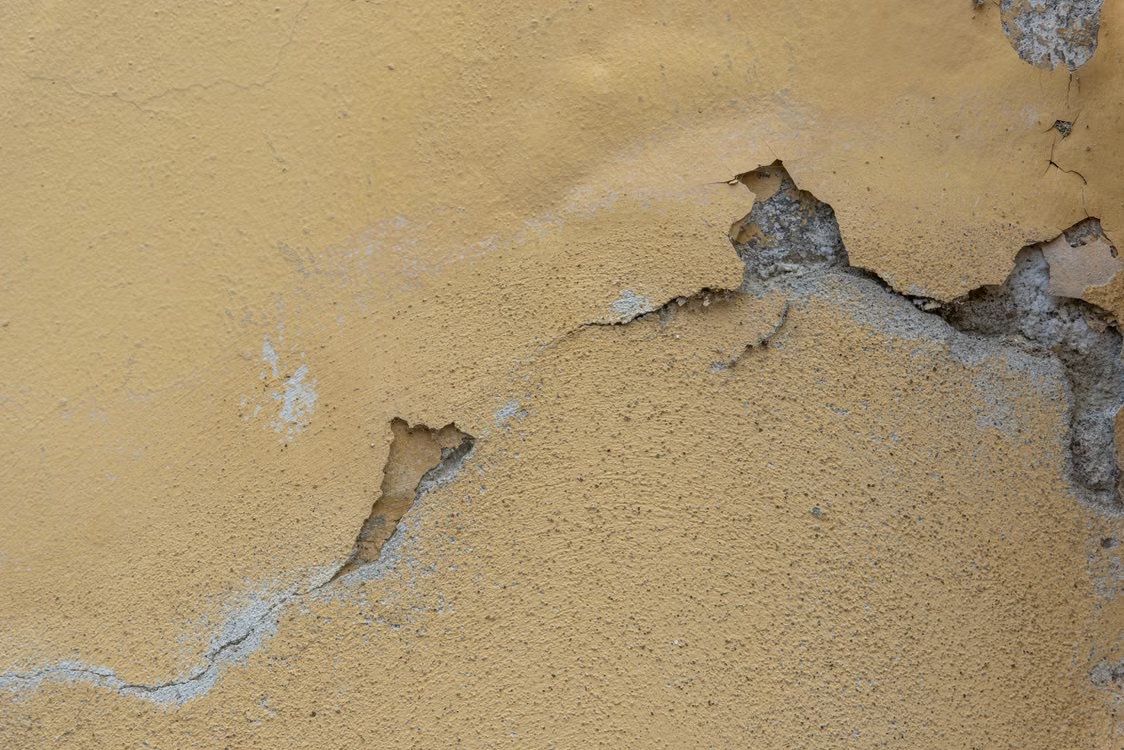
Preservation Brief 21, a National Park Service publication of 1989, gives three-coat plaster a minimum thickness of 7/8 inch over wood lath, built from two base coats of about 3/8 inch each under a finish coat of about 1/8 inch. The brief attributes diagonal cracks that begin at a door or window frame to stress, and horizontal cracks to wood lath moving with the humidity of the room. Gypsum, it notes, was used as a plastering material from around 1900. Over metal lath the same brief accepts 5/8 inch, and over rock lath 1/2 inch.
Four entries from USG product pages and Preservation Brief 21 apply to the holes left by old anchors and to cracked plaster.
Sheetrock All Purpose joint compound, named by USG for interior plaster cracks.
In Brief 21, a sharp pointed tool widens the crack a little before the fill.
Easy Sand 20 by USG gives 20 minutes of working time before its 35-minute set.
Flat-head wood screws and plaster washers reattach plaster that has come loose.
Joint compound needs 24 hours to dry at 75°F and up to 71% relative humidity by USG's drying chart, and 48 hours at up to 88%, a difference of a full day on a muggy Chicago afternoon. HandyBandi, a handyman in Chicago, handles such repairs on requests taken 24/7 and gives a 90-day workmanship warranty. The materials, filler and primer above all, are bought by the owner or arranged in advance.
Doors, Trim and Hardware That Throw Off a Room
Mortise latches, a type in residential use for more than a hundred years according to Old House Online in 2018, preceded the tubular latch, which became popular in houses only in the early 1950s. Walter Schlage's US patent 1,456,041, issued on May 22, 1923, covered the bored cylindrical lock that took over as the American standard on cost and ease of fitting. Europe, which never adopted it widely, still uses the mortise lock as the norm. Its patent was assigned to the Schlage Manufacturing Company.
Allegion, summarizing the ANSI/BHMA standards, rates a Grade 1 bored lock at 1,000,000 test cycles under A156.2, while a Grade 1 butt hinge reaches 2,500,000 cycles under A156.1. Lower lock grades fall to 400,000 cycles for Grade 2. Grade 3, the residential entry level, is tested to 200,000. Tubular latches, Old House Online reports, are fitted in the vast majority of homes built in the last 60 years.
Four further figures from the residential code and the hardware standards apply to old doors and their trim.
IRC 2021 section R311.2 requires 32 inches of clear width at the egress door.
A clear height of 78 inches, under the same section.
Grade 2 butt hinges, tested to 1,500,000 cycles under A156.1.
Residential doors are bored for a 2.375-inch backset, per Wikipedia's entry on the cylindrical lock.
Hanging Heavy Decor on Plaster and Brick
Old House Online, describing the picture rail, dates it from the 1840s to the 1940s and places it about half an inch below the ceiling in houses of the 1920s and 1930s, with heavy pieces hung from two hooks and most cords rated at about 60 pounds. Furniture and televisions present a separate risk, about 17,800 emergency room injuries a year in 2020 to 2022 being attributed to tip-overs by the Consumer Product Safety Commission. The commission's 2023 report adds that 155 of the 217 tip-over deaths from January 2013 to July 2023 were children under 18.
Anchor and tip-over data offer four entries for mirrors and televisions in plaster and brick rooms.
The STURDY stability standard for clothing storage units, mandatory since September 2023.
A SNAPTOGGLE BA in 1/2-inch drywall reaches 238 pounds of ultimate pull-out.
Tapcon screws need 1 inch of embedment in brick at a minimum, by Confast's technical data.
Toggler lists plaster as an application but gives it no load values.
Old Paint: The Lead Rule Before You Sand
A home built before 1978 predates the Consumer Product Safety Commission ban announced on September 2, 1977, which lowered the lead permitted in paint from 0.5% to 0.06%. Paid work in such a home falls under the EPA Renovation, Repair and Painting Program, and an EPA-certified firm is required once more than 6 square feet of painted surface per room is disturbed inside, or more than 20 square feet outside. Window replacement and the demolition of painted surfaces are included at any size, under a rule in full effect since April 22, 2010.
Four figures from federal and city sources measure old paint and lead exposure.
Some lead-based paint is present in 87% of homes built before 1940, according to EPA.
24% of homes built from 1960 to 1978 contain it as well.
In 2021 the CDC lowered its blood lead reference value to 3.5 micrograms per deciliter.
Chicago children with elevated lead fell from one in four tested in the late 1990s to fewer than one in 100.
The Order of Work: Repair, Paint, Decorate
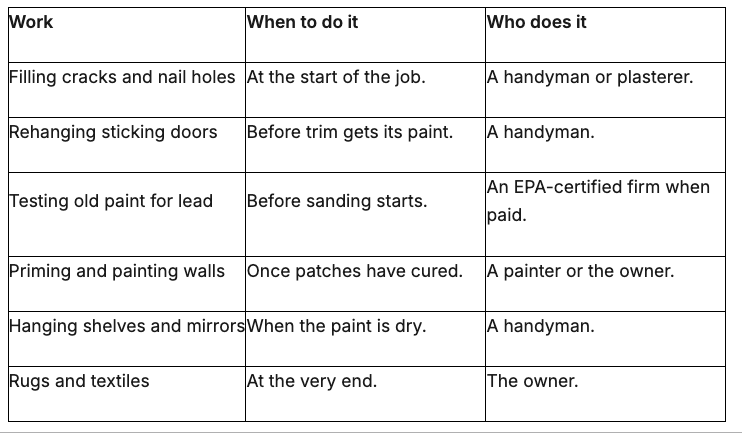
Curing and drying times decide the sequence below, with new plaster given two to three weeks in Preservation Brief 21 and Sherwin-Williams Emerald Interior Latex dry to the touch in 1 hour and recoatable after 4 hours at 77°F and 50% relative humidity. The table sets out six stages of work from repair to decor. A gallon of the paint covers 350 to 400 square feet, its data sheet states, with two coats specified at temperatures above 50°F. Primer and paint therefore wait for the plaster.
Stay up to date with our latest ideas!