Learn the key differences between antique and vintage rugs, including age, craftsmanship, materials, value, and how to choose the right style for your home.

The words antique and vintage appear everywhere rugs are sold, from specialist dealers and auction houses to online marketplaces. They are often treated as interchangeable, but they do not mean the same thing.
The simplest distinction is age. An antique rug is generally more than 100 years old. A vintage rug is older than a contemporary rug but has not yet reached the antique threshold. That sounds straightforward, but identifying a rug’s actual age can be difficult. Labels disappear, family histories become uncertain, and many traditional patterns have been reproduced for generations.
Understanding the difference matters because age can affect how a rug is valued, cleaned, insured, restored and sold.
What Is Considered an Antique Rug?
In the antiques trade, the widely accepted benchmark is approximately 100 years. Under that definition, a rug does not become antique simply because it looks old or has visible wear. Its estimated date of production must place it beyond the 100-year threshold.
Antique rugs may include hand-knotted Persian, Turkish, Caucasian, Chinese and Indian rugs, as well as European carpets, kilims and other flatwoven textiles. However, “antique” describes age, not a particular origin or construction. A Persian rug can be new, vintage or antique, and an antique rug is not necessarily Persian.
Likewise, not every antique rug was handmade. Machine-produced carpets existed during the 19th and early 20th centuries, so it is possible for a machine-made rug to be old enough to qualify as an antique.
Dealers sometimes use additional descriptions such as “semi-antique,” but these terms do not have one universally enforced definition. Whenever the exact age matters, ask for an estimated production date rather than relying only on a category name.
What Is a Vintage Rug?
“Vintage” is a less precise term. There is no universal legal age requirement that determines when a rug becomes vintage. In the rug market, the word is commonly used for older rugs that have recognizable age and design history but have not reached the 100-year antique benchmark.
Many rugs described as vintage were produced during the middle or later decades of the 20th century. They may include hand-knotted Persian rugs, Turkish rugs, Moroccan rugs, Scandinavian flatweaves, Chinese Art Deco rugs and machine-made European or American carpets.
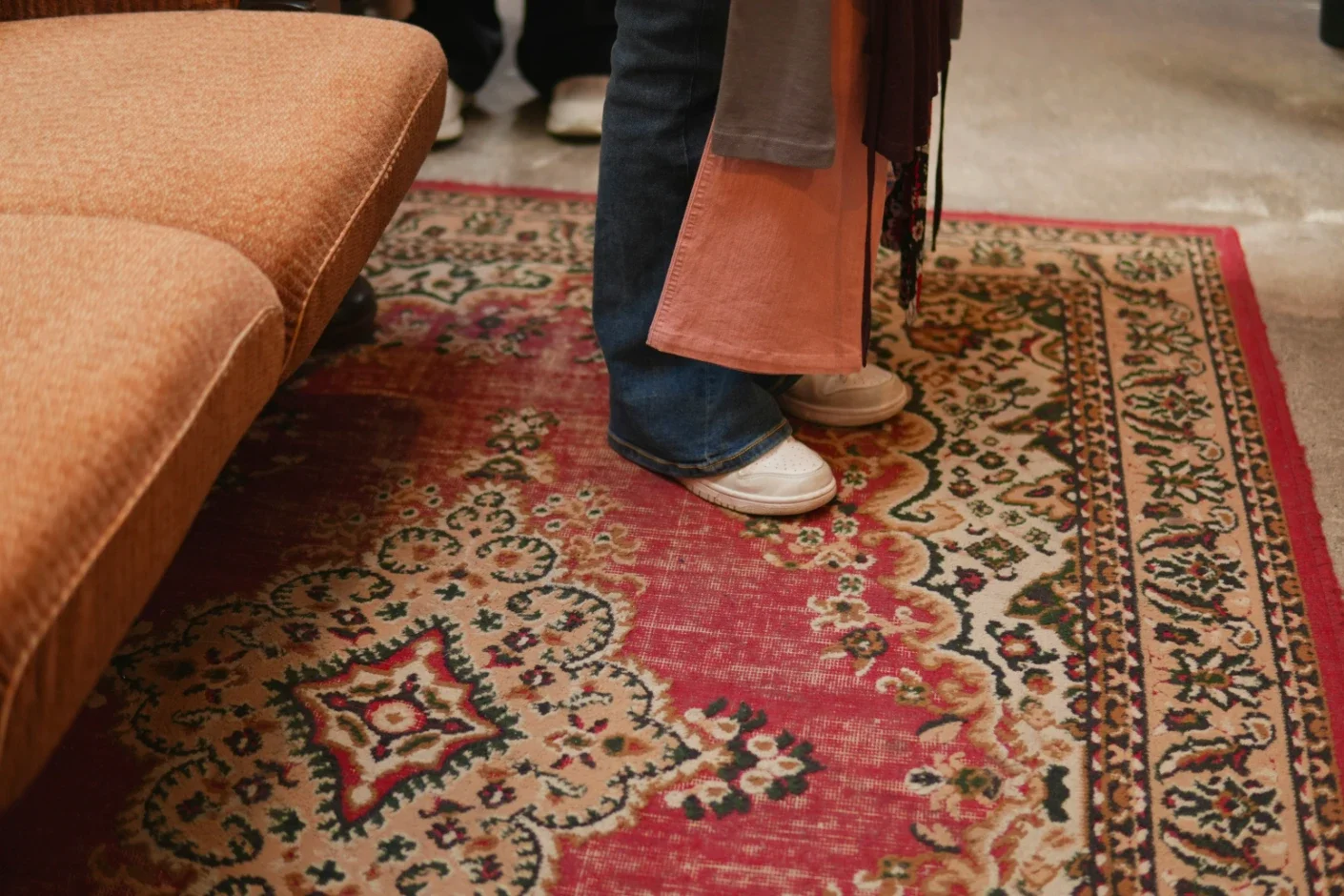
A vintage rug does not need to look worn. Some survive in excellent condition because they were kept in low-traffic rooms or stored for long periods. Conversely, a newer rug may be intentionally faded, washed or distressed to create a vintage appearance. Surface wear alone cannot establish age.
If the difference matters for insurance, resale, inheritance or restoration, a professional rug appraisal in Los Angeles can provide a documented assessment of the rug’s estimated age, origin, construction, condition and current value.
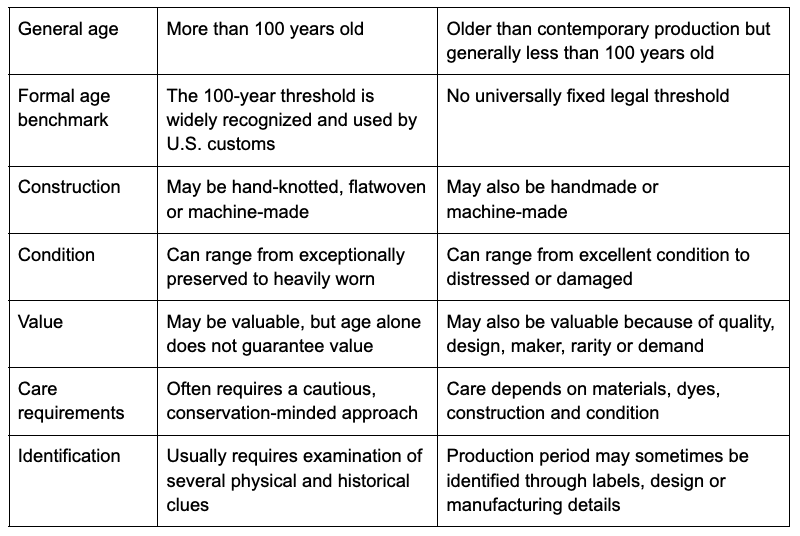
Antique vs. Vintage Rugs at a Glance
How Do Experts Estimate a Rug’s Age?
Most handmade rugs do not carry a clear production date. Even when a date is woven into the design, it may commemorate an event, repeat a traditional inscription or have been added later. Specialists therefore examine several characteristics together.
Materials and foundation
The pile and foundation materials can provide useful clues. Wool, cotton and silk have been used in rugmaking for centuries, but their preparation, spinning and combination may correspond with particular periods or weaving traditions.
An expert may examine whether the wool appears hand-spun or mechanically spun, how the yarn was twisted and what material was used for the warp and weft. No single material proves age on its own.
Weaving structure
Knot type, knot density, weft arrangement, edge construction and finishing methods can help identify a rug’s weaving region and production period. Changes in manufacturing practices may also distinguish older work from later commercial production.
Knot count should not be used as a clock. A finely knotted rug is not necessarily old, and many valuable tribal rugs were intentionally made with coarser weaves.
Colors and dyes
Color can help with dating, but it must be interpreted carefully. Synthetic dyes entered textile production during the 19th century, meaning some genuine antiques contain synthetic colorants. Natural dyes are also used in some modern rugs.
Fading is equally inconclusive. Sunlight, cleaning, storage and chemical exposure can alter color at any age. Deliberate distressing can make a recently manufactured rug appear much older than it is.
Design and regional characteristics
Patterns, borders, motifs and color combinations may be associated with certain weaving areas or historical periods. However, successful designs are frequently copied. A traditional Persian-style pattern does not prove that a rug was made in Iran or that it is antique.
The Metropolitan Museum of Art explains that scholars study materials, dyes and weaving structure when investigating where and when historic carpets were produced. Visual style is useful, but technical construction provides essential evidence.
Wear, repairs and oxidation
Wear can support an age estimate when it is consistent with the rug’s materials and construction. Specialists may look at pile loss, foundation exposure, oxidation, edge wear and older repairs.
These signs still require interpretation. A rug placed in a busy entrance can develop heavy wear relatively quickly, while a much older rug used only for display may show little damage.
Provenance and documentation
Receipts, previous appraisals, photographs, exhibition records, family inventories and correspondence can help establish when and where a rug was acquired. Strong provenance is especially important for rare or historically significant pieces.
A family statement such as “this belonged to my great-grandmother” is a useful starting point, but it does not establish a production date by itself. The rug could have been new when it entered the family or already several decades old.
Is an Antique Rug Always More Valuable Than a Vintage Rug?
No. Age is only one part of valuation.
An antique rug may have modest market value if it is a common type, badly damaged, heavily altered or no longer sought by buyers. A younger vintage rug by a recognized designer or workshop may be more valuable because it is rare, well documented and in strong condition.
Appraisers typically consider:
Origin and weaving tradition
Estimated date or production period
Materials and construction
Artistic and technical quality
Size and design
Rarity
Condition
Previous repairs or alterations
Provenance
Current market demand
Comparable sales
Age can add historical interest and scarcity, but it cannot compensate automatically for major structural damage or weak market demand.
It is also important to distinguish an asking price from a confirmed sale. Online sellers can list rugs at any price they choose. An appraisal should rely on relevant market evidence, including comparable rugs that have actually sold, rather than a single advertised price.
How Condition Affects Antique and Vintage Rugs Differently
Some degree of wear is expected in an old rug, and limited, even wear may be acceptable to collectors. Damage that threatens the rug’s structure is a different matter.
Condition problems that may affect value include:
Large holes or missing sections
Extensive moth damage
Dry, brittle or weakened foundations
Loss of original ends or borders
Severe pile loss
Permanent stains or odors
Dye bleeding
Uneven sun fading
Poorly matched repairs
Glued patches or unsuitable backing
Resizing that removed part of the original design
Restoration is not automatically negative. Skilled work may stabilize a rug and improve its appearance or usefulness. The effect on value depends on how much was restored, the quality of the work and how much original material remains.
Before undertaking major repairs, it can be a good idea to establish the rug’s identity, condition and value. The cost of extensive reweaving may be justified for an important antique but exceed the market value of a more common rug.
Do Antique Rugs Require Different Care?
Age alone does not dictate the cleaning method. A rug’s fibers, dyes, foundation, construction, previous repairs and current stability all need to be considered.
Antique rugs frequently require extra caution because their foundations may have weakened and their dyes may react unpredictably to moisture or cleaning agents. Aggressive vacuuming, scrubbing, steam cleaning, and household stain removers can cause irreversible damage.
For routine care:
Vacuum gently and avoid pulling at the fringe.
Keep the rug and the floor beneath it free from accumulated dust.
Rotate it periodically to distribute traffic and light exposure.
Blot spills instead of rubbing them.
Avoid prolonged dampness.
Check dark, undisturbed areas for signs of moth activity.
Do not apply bleach, laundry detergent, or an unknown carpet cleaner.
Ask a rug specialist to inspect fragile or high-value pieces before deep cleaning.
Vintage rugs may sometimes be more structurally robust, but that should never be assumed. A mid-century rug can have unstable dyes, weakened latex backing, old repairs or delicate fibers that require specialist treatment.
Questions to Ask When Buying an Antique or Vintage Rug
Before relying on a seller’s description, ask:
What is the estimated production date?
How was that date determined?
Where was the rug made?
Is it hand-knotted, flatwoven, tufted or machine-made?
What are the pile and foundation materials?
Has the rug been repaired, reduced or altered?
Are there areas of moth, water or chemical damage?
Is the fringe original or added?
Is any documentation or provenance available?
Is the stated value based on comparable sales?
Ask for photographs of the entire front and back, along with close-ups of the edges, ends, damaged areas, and any labels or inscriptions. The reverse often reveals construction details that are difficult to see from the pile side.
The Difference Comes Down to More Than Appearance
An antique rug is generally more than 100 years old. A vintage rug is an older piece that has not yet reached that recognized threshold, although the term “vintage” has no universally fixed age definition.
Neither label guarantees that a rug is handmade, rare, valuable or in good condition. Those conclusions require a broader examination of construction, materials, origin, age, condition, provenance and demand.
When buying, selling, insuring, or restoring an older rug, an estimated date is more useful than a loosely applied label. A rug should be judged by what it actually is—not simply by how old a seller says it looks.
Stay up to date with our latest ideas!