How Much Does a Moving Company Cost? A Practical Guide to Moving Budgets
Learn how much a moving company costs and how to plan your moving budget, including key pricing factors, extra fees, and ways to control expenses.

How Much Does a Moving Company Cost? (Quick Answer)
A moving company can cost a few hundred dollars for a small local move or several thousand dollars for a long distance or full service relocation. Local movers usually charge by the hour, running roughly $85 to $210 per hour depending on crew size and market, while long distance moves commonly land between $2,700 and $10,000. Three things drive almost every quote: the distance your belongings travel, how much they weigh or how much space they take up, and how many labor hours the job requires.
This guide is for anyone building a moving budget before requesting quotes. Averages give you a sensible ballpark, but they are a starting point, not a price. The real number comes from a written estimate after a moving company reviews what you actually own. Knowing the average cost for your move type helps you spot a quote that runs unusually high or suspiciously low, and it gives you a reference point when you sit down to compare professional movers side by side.
2026 Average Moving Costs at a Glance
Here is what recent 2026 cost data shows across a few well-known consumer sources. Treat these average moving costs as benchmarks, since datasets differ.
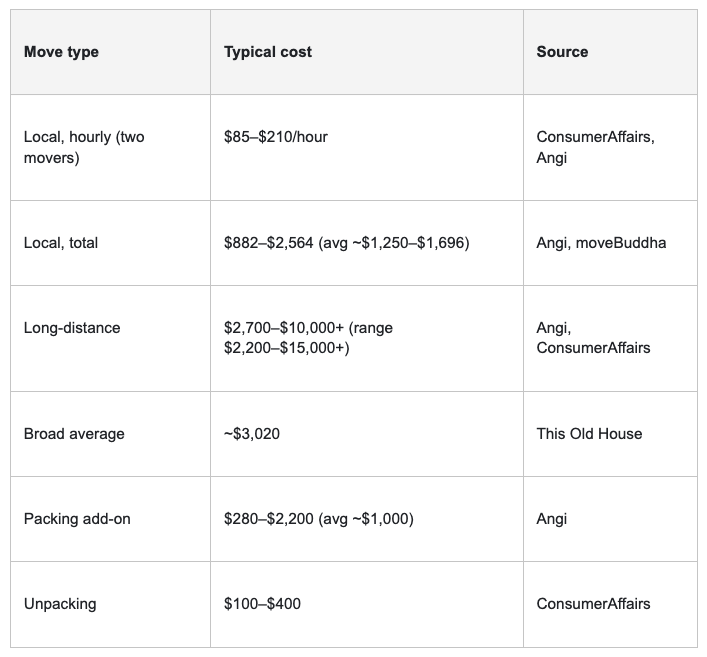
For scale, a two-bedroom long distance move often runs around $4,500, and a 1,000-mile move averages roughly $4,890. These figures help you set expectations, but every real price still needs a written quote tied to your inventory. Keep in mind that the average cost blends easy jobs with hard ones, so a home with heavy furniture, a long carry, or a tight delivery window can sit well above the midpoint even when the mile count looks ordinary.
The Core Concepts: What You're Actually Paying For
Two pricing models cover nearly every move, and understanding them makes the rest of this guide easier to follow.
Local moves are priced by labor time. You pay an hourly crew rate multiplied by the hours worked, plus travel and fuel. More stuff and harder access mean more hours, which means a bigger bill. Because the hourly rate is the engine of the bill, local labor costs swing with crew size, so a four-person team finishes faster but costs more per hour than a pair. This hourly pricing rewards an organized home where the crew never has to wait.
Long distance moves are priced by weight and distance. The core charge is the line-haul: the fee for transporting your shipment from origin to destination, calculated on how much it weighs and how far it goes. Heavier shipments cost more. Some long distance moving companies will offer a flat rate once they have surveyed your inventory, which locks the transportation charge as a fixed price so it cannot creep upward on delivery day.
Two other terms show up on quotes. Accessorial charges are extras for specific conditions or other services, like carrying items a long distance from the truck or navigating stairs. Valuation is the mover's liability coverage for your goods, which is different from insurance and something you choose a level for.
Why Do Moving Company Prices Vary So Much?
No two moves cost the same because so many variables feed the quote:
Home size and how much stuff you own
Distance and route
Shipment weight or volume
Labor hours required
Stairs, elevators, and long carries
Truck access and parking
Packing and specialty items like pianos or safes
Time of year
Season matters more than people expect. Rates climb during peak moving season, roughly May through September, when demand is highest. Moving in the off season, roughly October through April, gives a moving company more open dates and often a softer hourly rate. Fuel is another moving target. The U.S. Energy Information Administration forecast retail diesel at $4.61 per gallon in 2026, up sharply from $3.66 in 2025, which is why long distance quotes carry fuel surcharges and higher line-haul fuel costs.
Labor drives local rates. Moving is physically demanding work, and the Bureau of Labor Statistics reports a median annual wage of $37,680 for hand laborers and material movers, with employment projected to grow 4% from 2024 to 2034. When crews are hard to book, hourly rates rise, and those labor costs are the single biggest reason two quotes for the same house can differ by hundreds of dollars.
How Much Do Local Movers Cost for a Move?
Local movers bill by the hour, and most quotes start with a crew of two to four people. Expect a two-to-four-hour minimum on most jobs, so even a quick move has a floor. The basic math looks like this:
Hourly crew rate × billable hours + travel/fuel + add-ons = estimated local move cost
Here is a rough sense of how home size translates into hours and total cost:
Studio or one bedroom apartment: often 3–5 hours, landing in the low-to-mid hundreds.
Two-bedroom: often 5–7 hours, commonly $700–$1,400.
Three bedroom home: often 7–10 hours with a larger crew, frequently $1,200–$2,500.
Total local labor typically falls between $882 and $2,564, with an average local move around $1,250. If you want a cheaper route, a truck rental for a local job runs about $200, though you supply the muscle and take on the risk yourself. That truck rental figure covers the moving truck only, so budget separately for fuel, pads, and a dolly. Travel time, a trip fee, or a fuel charge usually gets added on top of the hourly labor, so ask how each moving company bills those before you compare. When people ask how much movers cost locally, the honest answer is that the hourly rate is only half the story; the number of hours your specific home demands is what really moves the total.
How Much Does It Cost to Move Cross Country?
Long distance quotes are more individual because they hinge on your specific shipment and route. Most fall between $2,700 and $10,000, though the full spread runs from about $2,200 to well over $15,000 for large households. The factors that shape the number include:
Shipment weight or volume
Mileage and the specific route
Delivery spread (the window when your goods arrive)
Move date and season
How much packing you want done
Storage-in-transit
Valuation coverage
As a reference point, a two-bedroom interstate move often runs around $4,500, and a 1,000-mile cross country move averages roughly $4,890. Someone comparing a Chicago-to-Birmingham move, for instance, should price the carrier's transportation charge separately from destination expenses if they are moving to Alabama and need to coordinate lease dates, storage, and delivery windows. Long distance movers usually deliver on a spread rather than a single day, so ask how wide that window is before you sign; a tight guaranteed date can cost more but saves you from living out of boxes. For any interstate move, the FMCSA requires long distance moving companies to provide a written estimate, so never rely on a number given over the phone.
Hiring Movers vs. a DIY Move: What Should Your Estimate Include?
The written estimate is where the "will my bill be higher than the quote?" worry gets settled. Under FMCSA rules, a verbal quote is not an official estimate. A proper estimate should spell out transportation, accessorial, and advance charges, and it should come with an inventory of your goods and a bill of lading, which is the contract for the move. Whether you are hiring movers for a cross-country haul or booking local movers for an afternoon, that paperwork is what protects the price you were promised.
You should also see your valuation options. Interstate movers must offer Full Value Protection, where the mover is liable for repair or replacement value, and a lower-cost Released Value option at just 60 cents per pound per article. Released value is minimal coverage, so understand what you're accepting. If you are an active military member, ask whether the company handles government-arranged moves, since those follow separate procedures.
Binding vs. Non-Binding Estimates
A binding estimate locks the price for the listed goods and services. You cannot be required to pay more at delivery unless you add items or services before loading and agree in writing. A non-binding estimate is not a guaranteed final price, but FMCSA sets an important limit: the mover cannot require you to pay more than 110% of the non-binding estimate at delivery. Any remaining charges get billed later. Knowing which type you have tells you how much your total cost can move.
Common Additional Costs People Forget
The headline quote rarely captures everything. Watch for these extras and additional costs:
Packing materials and supplies
Packing and unpacking services ($280–$2,200 to pack, $100–$400 to unpack)
Stairs, elevators, and long carries
Shuttle service when a truck can't reach the door
Storage-in-transit or a storage unit
Bulky and specialty items like pianos or gun safes
Parking permits and tolls
Tips for the crew
Move-out cleaning
Utility deposits and housing overlap
The moving company bill is only one part of the relocation budget. Renters moving to Alabama may also need to plan for application fees, deposits, utility setup, temporary storage, and the timing between pickup and move-in. Building those destination costs into your plan early keeps the final week from turning into a scramble. Many of these add-ons are the difference between the quote you remembered and the invoice you actually pay, so ask which are included and which are billed as an extra cost. Some of these are the hidden fees that surprise first-time movers, so pin down every line before signing.
Shuttle Services: When They Add to the Bill
Sometimes the big trailer physically can't reach your home. When that happens, the mover uses a smaller truck to shuttle your goods between the trailer and the door, and that extra handling shows up as an accessorial charge. Narrow streets, low bridges, tight apartment complexes, HOA restrictions, and limited building access all trigger it. Shuttle services are common in dense urban neighborhoods and gated communities where a full-size rig simply cannot maneuver. If your street or building has access limits, mention them during the estimate so the shuttle isn't a surprise on moving day.
Is It Cheaper to Hire Movers or Do a DIY Move?
There are three broad tiers, and the right one depends on how you value your time against your money.
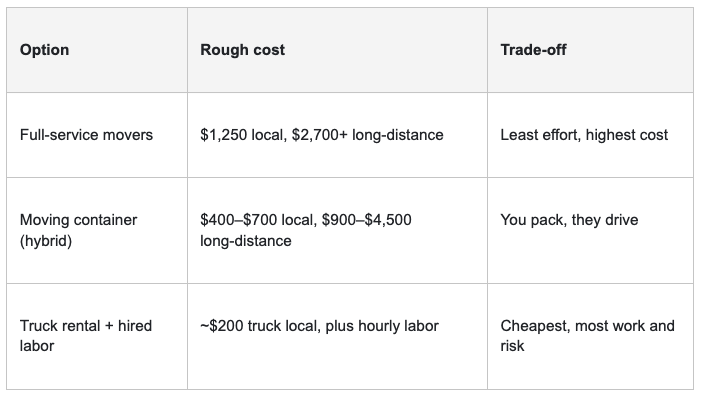
Containers sit in the middle: you load and unload, the company handles transport. Full service movers are the priciest but spare you the heavy lifting, and hiring professional movers for packing can save one to two hours of moving time while cutting the odds of breakage. If your budget is tight and your back is willing, a DIY move built around a truck rental wins on price, though you own every scratch and sore muscle that comes with it. Doing your own packing keeps that gap wide. The gap in cost between a full DIY move and full service movers narrows once you factor in the labor you would have hired anyway, so run the math on both before you decide.
How to Use a Moving Cost Calculator Wisely
Online moving cost calculators are handy for a first pass. Feed in your home size and distance, and a moving cost calculator will hand you a ballpark total in seconds. Just remember that number is an estimate, not a binding quote. A cost calculator can't see your specific inventory, your stairs, or your parking situation. Use one to set a realistic range, then confirm the real figure with a detailed inventory and a written estimate from an actual moving company. Treat the calculator's output as a floor for your moving costs rather than a promise, because the on-site survey almost always surfaces details a form never captures.
How to Compare Moving Quotes Without Getting Misled
FMCSA advises getting at least three estimates and comparing services, not just the bottom-line price. Two quotes can differ by hundreds of dollars simply because one includes packing or better coverage. Gathering multiple estimates can save you thousands. As you compare:
Make sure each quote covers the same inventory
Ask whether the company is a mover or a broker
Compare valuation coverage side by side
Ask what specifically could trigger additional charges
Don't default to the lowest number
The most accurate estimate comes after a detailed inventory survey, done in person or over video. A quote given without one is closer to a guess, and guesses have a way of climbing on delivery day. When you line up quotes from several long distance moving companies, put them in a simple table so the differences in coverage, packing, truck space, and delivery spread are obvious at a glance.
Moving Company Red Flags to Watch For
The FMCSA and the DOT Office of Inspector General flag several warning signs of a problem mover:
No written estimate
Demands cash or a large deposit up front
No in-home or virtual survey before quoting
No U.S. DOT number for an interstate move
A generic greeting instead of a company name on the phone
Blank or incomplete paperwork
A rental truck showing up instead of a marked fleet truck
A sudden price jump after the truck is loaded
For any interstate move, verify the company's FMCSA registration and confirm the U.S. DOT number before you sign anything. A few minutes of checking protects you from the classic hostage-load scam. Legitimate long distance movers will welcome the questions and hand over their DOT number without hesitation.
How to Cut Costs and Save Money on Your Upcoming Move
You have more control over the final bill than you might think, and a few habits can cut costs on your upcoming move:
Move off season. Avoiding the May-to-September rush and choosing mid month dates can trim 20% to 30% and is one of the simplest ways to save money.
Declutter first. Less weight means a lower long distance quote and fewer hours locally. For long distance renters, selling bulky low-value furniture can cost less than shipping and storing it.
Pack the easy stuff yourself. Handling non-fragile items can save the $280 to $2,200 you'd pay for packing services.
Source free moving boxes from grocery stores and liquor stores instead of buying new cardboard boxes.
Compare tiers. Weigh full service movers, container, and truck rental options against each other.
Skip unnecessary storage and reserve parking or elevators ahead of time to avoid delays.
Be accurate about your inventory so the mover doesn't revise the estimate upward.
Also plan to tip movers. Tips aren't required, but many people budget a line for the crew, especially on a long or difficult move. Borrowing supplies from friends and family stretches a tight budget further, and small habits like emptying dresser drawers and breaking down beds before the crew arrives shave billable minutes, which helps keep the overall cost in check. If your move is job-related, ask a tax professional whether any portion qualifies as a tax deduction, since rules vary by situation.
A Simple Moving Budget Worksheet
Turn your quote into a realistic all-in budget for your next relocation by filling in each line:
Base moving quote: ______
Packing services and packing materials: ______
Supplies: ______
Valuation coverage: ______
Storage: ______
Parking/permits: ______
Travel/lodging: ______
Housing overlap: ______
Utility deposits: ______
Emergency buffer: ______
Add up these moving expenses, and you'll see the number that actually matters instead of the headline quote. Most moving companies will walk you through each line if you ask. Use averages as a starting point, verify FMCSA registration for interstate movers, and get everything in writing before moving day.
Frequently Asked Questions
How much does it cost to move a 2,000 sq ft house?
Long distance, a home that size often lands in the mid-to-high thousands, driven by shipment weight and distance. Locally, the cost of movers depends on labor hours, but a full three-bedroom move commonly runs $1,200 to $2,500 or more, and most companies will confirm the number after a survey.
How much does it cost to pack a 2,000 sq ft house?
Professional packing scales toward the upper end of the $280 to $2,200 range for a larger home, and that's usually before packing supplies. Handling non-fragile boxes yourself is the easiest way to cut that cost.
What are the red flags with movers?
Be wary of any company that skips a written estimate, demands cash or a big deposit, won't do a survey, has no U.S. DOT number for an interstate move, or hands you blank paperwork.
How do two-people-and-a-truck-style movers calculate cost?
They bill an hourly crew rate, usually with a two-to-four-hour minimum, then add travel or fuel fees and any charges for stairs, long carries, or heavy items. Your total is the rate times the hours worked plus those extras, which is roughly what you can expect to pay on a typical local job.
Stay up to date with our latest ideas!