See what car shipping costs by distance, vehicle size and season, why quotes change after booking, and how to lower your price before you pay.
Shipping a running sedan on an open carrier typically costs about USD 400 for a short local move and about USD 1,400 for a coast-to-coast trip. Enclosed transport adds roughly 40% to 55% on top of that. Your exact price depends on the route, your vehicle, the season, and how much flexibility you give the carrier.
Below, we break down real sample prices by distance, transport type, and vehicle size, explain why per-mile averages can mislead you, and show how to read a quote before you pay a deposit.
Quick facts about car shipping costs
Short trips cost the most per mile. A 94-mile open-carrier shipment averaged about USD 4.30 per mile, while a 3,038-mile cross-country shipment averaged about USD 0.46 per mile.
Enclosed transport costs about 42% to 55% more than open transport on the same route.
Pickup trucks cost about 38% more to ship than a standard car on the same 500-mile route.
Inoperable vehicles add roughly USD 100 to USD 300, since the carrier needs a winch to load them.
Season matters. Prices rise during summer moving season and on snowbird routes to Florida and the Southwest in the fall.
Your first quote isn't always your final price. Most online quotes are estimates until a carrier accepts the job.
Car shipping costs by distance and transport type
The table below uses sample averages from Move.org's most recent quote study, which priced a running 2025 Toyota Camry with a one-week lead time across four route lengths.
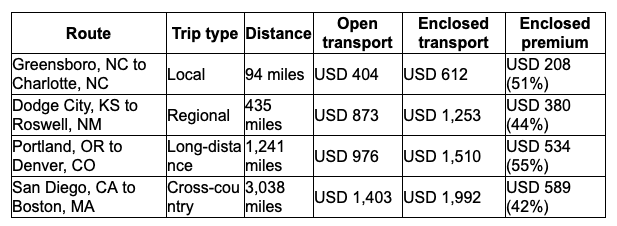
These are industry averages, not guaranteed prices. They're most useful for checking whether a quote you receive is in a realistic range.
Why a single per-mile rate can mislead you

Many cost guides quote one average per-mile rate. The problem is that per-mile pricing changes sharply with distance, so a single number will overstate long trips and understate short ones.
Here's what the same sample data looks like per mile:
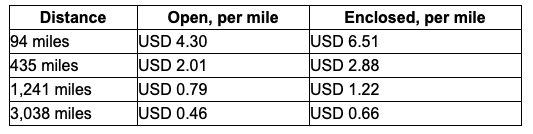
The reason is simple: every shipment carries fixed costs, such as loading, unloading, paperwork, and the driver's time getting to your pickup point. On a short trip, those costs are spread across very few miles. On a cross-country trip, they're spread across thousands.
The takeaway: If you want a quick estimate, compare your trip to the closest distance band above rather than multiplying miles by an average rate.
How your vehicle's size and condition affect the price
Bigger and heavier vehicles take up more space and weight on the trailer, which means the carrier can fit fewer cars on each load. Vehicles that don't run need special equipment to load.
Move.org priced three vehicles on the same 500-mile open-carrier route from Baltimore, MD, to Myrtle Beach, SC:
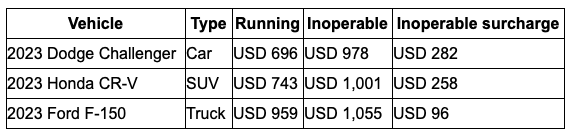
A few patterns stand out:
The SUV cost about 7% more than the car, while the pickup truck cost about 38% more.
Inoperable surcharges ran from about USD 100 to USD 280. A car that doesn't roll, steer, or brake normally needs a winch-equipped truck and more loading time.
Modifications count too. Lift kits, oversized tires, roof racks, and lowered suspensions can change which trailer spot or trailer type your vehicle needs. Mention them when you request a quote, or the price may change at pickup.
What a real car shipping quote looks like
Averages are a starting point, but route-level pricing from an actual shipper gives you a better sense of what you'll pay on popular lanes. For example, Cross Auto Transport publishes open-transport ranges for a standard sedan of USD 1,000 to USD 1,300 for Texas to California (about 1,400 miles, 3 to 5 days in transit) and USD 1,350 to USD 1,650 for Illinois to California (about 2,000 miles, 5 to 7 days). The company notes that the final price is confirmed before booking and that seasonal demand can affect rates.
Those ranges fall in the same general range as the long-distance and cross-country averages above. They also show something averages hide: two routes of similar length can price very differently depending on how many trucks already run that lane.
When you compare quotes, make sure each one lists:
The total price and whether it's a fixed rate or an estimate
Open or enclosed transport
Your pickup window and estimated transit time
Any deposit or broker fee, when it's charged, and whether it's refundable
How much you owe the carrier at delivery, and which payment methods the driver accepts
9 factors that set your car shipping price
Distance. Longer trips cost more in total but less per mile.
Transport type. Enclosed trailers carry fewer cars and protect against weather and road debris, so they cost more.
Vehicle size and weight. Trucks, large SUVs, and vans take up more room and weight on the trailer.
Vehicle condition. Inoperable vehicles need a winch and extra loading time.
Route popularity. Busy interstate corridors between major metro areas usually cost less than rural pickups, because more trucks already run those lanes.
Pickup and delivery locations. Narrow streets, low clearance, and gated communities may require meeting the truck at a nearby lot.
Season. Summer and snowbird migration periods push prices up on the busiest lanes.
Timing and flexibility. A wide pickup window gives carriers more options. Expedited or guaranteed pickup dates cost extra.
Number of vehicles. Shipping more than one car changes the total, so ask for a combined written quote rather than assuming a multi-car discount.
When to ship: how the calendar changes your price
Car shipping runs on supply and demand. When more people need trucks on the same routes, carriers can charge more.
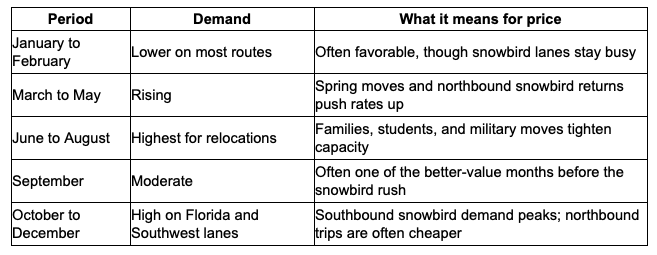
Industry estimates for the peak-season premium on Florida-bound lanes range from roughly 10% to 40%, depending on the route and how close to the rush you book. If your dates are flexible, shipping a few weeks earlier or against the direction of seasonal traffic can make a noticeable difference.
Why your car shipping quote can change after you book
Most car shipping companies you find online are brokers. A broker takes your order and posts it to a network of independent carriers, and a carrier accepts the job if the price works for its route. That's why the first number you see is often an estimate.
Move.org's research found that the final price can climb by about 25% after booking. It usually happens when:
The quote was set too low to attract your booking, and no carrier accepts it at that price
Details change, such as a modified vehicle, an inoperable car, or a different pickup address
Your dates tighten and the shipment needs priority dispatch
Two things protect you here. First, get the total price, deposit terms, and refund conditions in writing before you pay anything. Second, ask whether the price is locked once a carrier is assigned, or whether it can still change.
Payment timing also varies. Some companies take a deposit or broker fee when you book, others only after a carrier is assigned, and many carriers collect the balance at delivery. Some drivers accept only cash or certified funds, so confirm the payment method ahead of time.
Is shipping a car cheaper than driving?
It depends on what you count. For a cross-country move, the open-carrier average of about USD 1,400 often costs more than the fuel alone. But driving also means several nights of lodging, meals, time away from work, and thousands of miles of wear on your car.
Shipping usually makes more sense when:
The trip is long enough to require multiple overnight stops
You're moving more than one vehicle
You'd otherwise lose several workdays on the road
The car is a classic, exotic, or freshly restored vehicle you don't want to add miles to
If you're shipping as part of a home move, plan your pickup and delivery windows around your move-in date. These long-distance moving tips can help you line up the rest of the move.
How to lower your car shipping cost
Choose open transport unless your car is high-value, classic, or has fresh paint.
Book two to three weeks ahead. Early booking gives the broker more time to find a carrier at a fair price.
Keep your pickup window flexible. A few extra days can lower the price.
Avoid peak lanes and months when you can, especially southbound snowbird routes in the fall.
Meet the truck at an accessible spot. A large parking lot near a highway can be easier and sometimes cheaper than a tight residential street.
Disclose everything up front. Modifications or mechanical issues revealed at pickup can trigger a price change.
Compare at least three written quotes using identical vehicle and route details.
How to check a quote before you pay
A low price isn't a good deal if the company can't deliver. Before you pay a deposit:
Verify the company's registration. Brokers and carriers that arrange or perform interstate transport must register with the Federal Motor Carrier Safety Administration (FMCSA). Public users can search registration records in Motus, FMCSA's registration system.
Confirm broker bonding. Licensed auto transport brokers must maintain USD 75,000 in financial security, usually a surety bond.
Ask for the carrier's insurance certificate once a carrier is assigned, including coverage limits and any deductible.
Read the cancellation terms. Find out whether your deposit is refundable before and after a carrier is assigned.
Inspect at delivery. Note any new damage on the Bill of Lading before you sign it. Damage that isn't recorded at delivery is much harder to claim later.
The bottom line
For a running sedan on an open carrier, expect to pay roughly USD 400 for a short local trip and about USD 1,400 for a cross-country move, with enclosed transport adding 40% to 55%. Larger vehicles, inoperable cars, peak seasons, and tight timelines push the price higher.
The most reliable way to know your actual cost is to request several written quotes with the same details, check what each one includes, and confirm the payment and refund terms before you book.
FAQ about car shipping costs
How much does it cost to ship a car 1,000 miles?
Based on the sample data above, a 1,000-mile open-carrier shipment for a running sedan typically costs around USD 900 to USD 1,000. Enclosed transport on a similar distance runs closer to USD 1,300 to USD 1,500.
What is the cheapest way to ship a car?
Open transport with a flexible pickup window, booked a few weeks ahead and outside peak season, is usually the cheapest option. Meeting the truck at an easily accessible location can also help.
Is enclosed car shipping worth the extra cost?
Enclosed transport is worth it for classic, exotic, luxury, or freshly painted vehicles that need protection from weather and road debris. For most everyday cars, open transport is the standard and more affordable choice.
Does it cost more to ship a car that doesn't run?
Yes. Inoperable vehicles need a winch-equipped truck and more loading time, which typically adds about USD 100 to USD 300.
Why do car shipping quotes vary so much between companies?
Quotes vary because most companies are brokers estimating what a carrier will accept. Some quote low to win the booking and adjust later. Comparing written quotes with identical details, and asking whether the price is locked, helps you spot unrealistic offers.
How long does car shipping take?
Transit time depends on distance. Shorter regional trips can take a few days, while cross-country shipments often take about a week or longer. Pickup windows and seasonal demand can add time, and transit times are estimates rather than guarantees.
Stay up to date with our latest ideas!