Learn how window orientation affects your choice of blinds, shutters and awnings for Australian homes, improving comfort, privacy and energy efficiency.

The new blinds look right, but by late afternoon the living room is still uncomfortably hot. Or perhaps your bedroom stays gloomy all winter, even though you chose a covering specifically to improve comfort. The problem may not be the product itself. It may be that the covering was chosen without considering which way the window faces.
In Australia, window orientation changes when sunlight enters, how directly it strikes the glass and whether you want to keep that sun out or welcome it in. That makes orientation a practical starting point for choosing blinds, shutters and awnings, not simply an architectural detail.
This guide uses Australian sun paths. Northern-hemisphere readers should reverse north and south while considering local conditions.
Why the direction of a window changes the answer
Start with the job the window needs to do. One opening may need protection from afternoon sun; another may need privacy without losing winter warmth. Treating both with the same blind can solve one problem while leaving the other untouched.
The Australian Government's YourHome shading guide notes that effective shading can block up to 90% of unwanted direct solar heat. The important distinction is where sunlight is intercepted: outside the glass, at the glass, or after it enters the room.
Orientation also interacts with climate. A home in humid northern Queensland may prioritise year-round shade and breezes, while one in inland Victoria may need protection from summer heat without sacrificing welcome winter sunshine. Neighbouring buildings, trees and roof overhangs can change the actual exposure.
Before buying anything, note which windows get morning sun, which catch the low afternoon sun and which rooms feel cold after sunset. Use true north rather than assuming the street-facing wall is north-facing.

North-facing windows: control summer sun without losing winter light
Across much of Australia, north-facing windows are relatively straightforward to shade. The summer sun is higher in the sky, while the lower winter sun can enter beneath a correctly designed overhang. This is why eaves and horizontal awnings often work well on northern elevations.
If a north-facing living room already has suitable eaves, an internal roller blind or curtain may mainly need to handle glare and privacy. If it has exposed glass, consider a correctly sized overhead awning or adjustable horizontal shading rather than automatically installing a permanent deep shade that blocks winter light.
YourHome gives an eave-sizing rule of thumb of roughly 45% of the vertical distance from the windowsill to the underside of the eave. That is a starting point for relevant southern Australian conditions, not a universal measurement. Latitude, window height, climate and the building's design matter, so structural shading should be sized for the specific site.
East and west windows: tackle low-angle sun before it reaches the glass
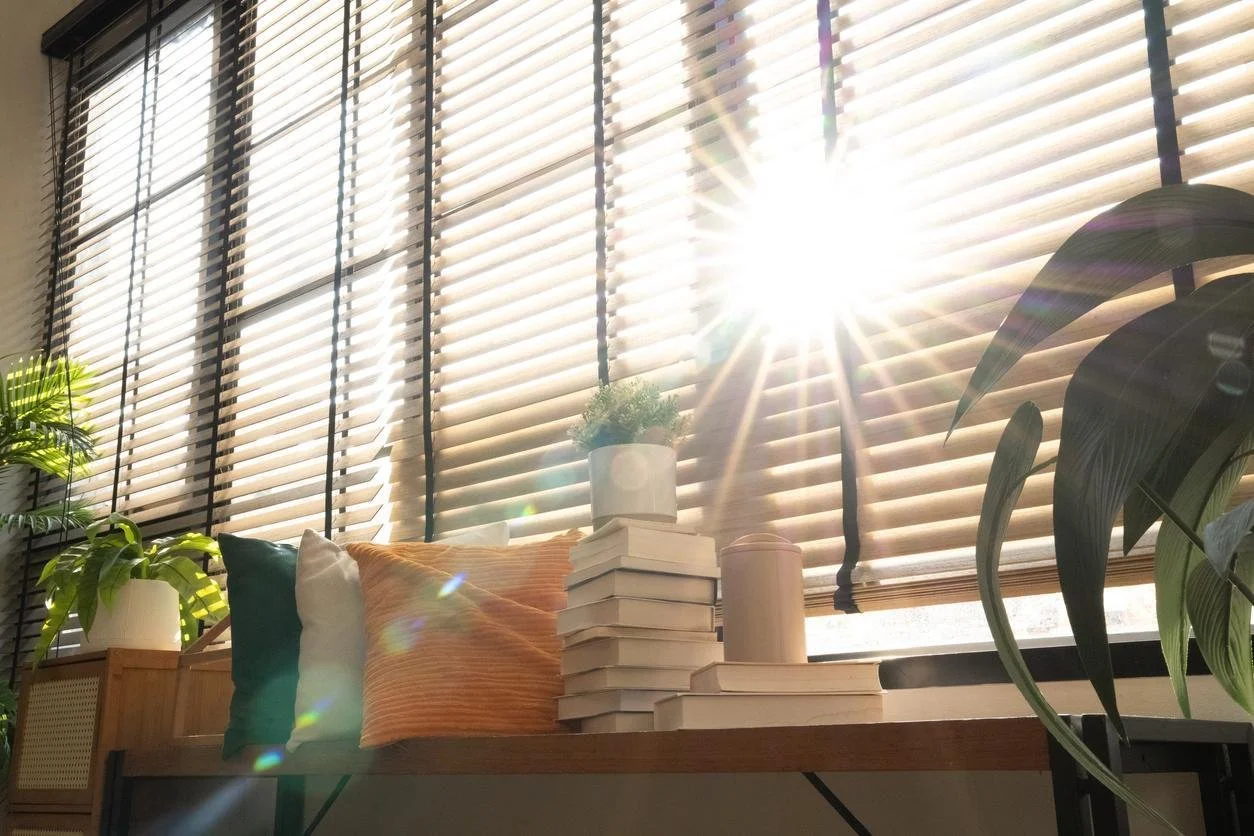
East- and west-facing windows are often the hardest to keep comfortable in summer. Morning sunlight strikes east-facing glass at a low angle. The west side receives low afternoon sun, sometimes when the building has already warmed throughout the day. Ordinary roof eaves may not block either effectively.
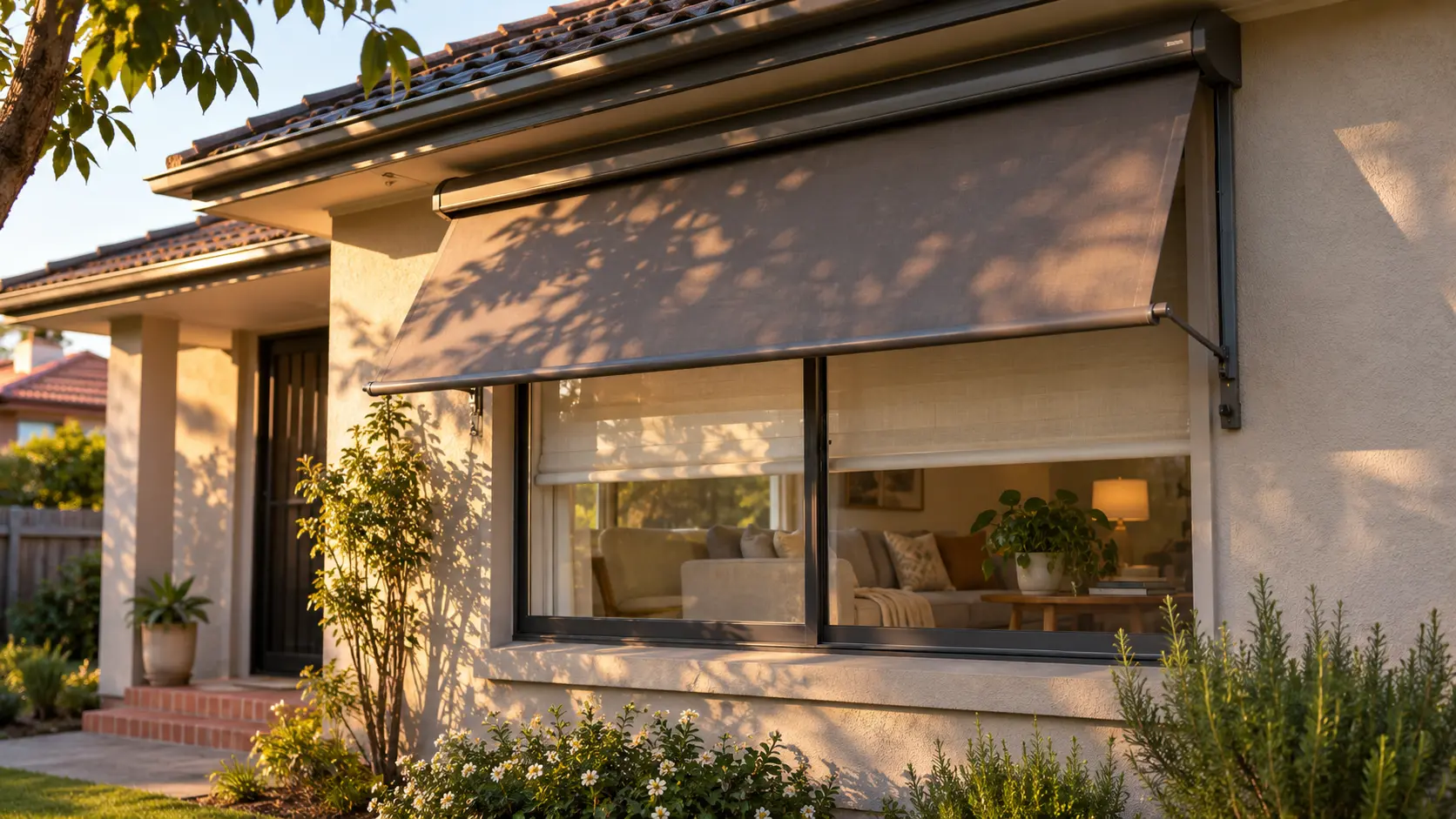
YourHome recommends adjustable vertical shading for these elevations, including external blinds, shutters and louvre screens. The key advantage is that the covering can stop direct sunlight before it passes through the glazing, then be opened when daylight, a view or winter warmth is more useful.
For west-facing rooms, compare external roller blinds, adjustable shutters, vertical screens and awnings. Ranges of external blinds and awnings show the formats, but correct positioning against low-angle sun matters more than the label. In exposed locations, check wind ratings and operating limits.
The east side deserves attention too. Sun coming through an east window in the morning can begin a build-up of warmth that becomes noticeable later. In warmer regions, don't wait until the afternoon to think about the window that received the first direct sun of the day.
Exterior shading can also help with adjoining patios and verandas. If those areas are part of the problem, Lord Decor's discussion of outdoor blinds for alfresco areas provides a useful companion perspective on outdoor comfort.
Don't forget skylights. YourHome says unprotected roof glazing can admit almost twice the heat of an unprotected west-facing window of the same area. Consider compatible external roof-window blinds or louvres where overheating is an issue.
Is an internal blind enough for a hot window?
Internal blinds and curtains still have a useful role, but they are not always the first solution for solar heat. Once direct sunlight crosses the glass, some of its energy is already in the room. An exterior shade can intercept it earlier; an interior covering is often better at managing glare, privacy and additional insulation.
Not every hot room needs an awning. Climate, glazing and access to the exterior affect the choice. In a mildly sunny room, a well-fitted interior blind may suffice. For large west-facing glass, it may disappoint.
The Australian Government's energy.gov.au window guidance recommends close-fitting lined curtains or blinds and pelmets for year-round temperature control. It advises choosing coverings that fit around the opening rather than leaving large gaps, with tightly woven material and suitable backing where appropriate.
Consider the room's other needs as well:
For daytime glare with a view, a sunscreen or mesh blind can filter light, although its privacy performance may change after dark when interior lights are on.
For sleeping spaces, a well-fitted blockout treatment can control unwanted light, with side gaps considered during measuring.
For large sunny windows, an adjustable outdoor layer paired with an indoor blind can separate heat control from privacy and glare control.

South-facing windows and rooms that feel cold
South-facing windows generally receive less direct winter sun across much of Australia. Rather than treating every south window as an overheating problem, consider whether the priority is retaining warmth, reducing draughts or improving privacy without making the room darker.
Close-fitting lined curtains, suitable blinds and pelmets can help limit unwanted heat transfer around windows. Floor-length curtains that extend beyond the frame may be useful where the layout allows; a poorly fitted treatment with large edge gaps is less effective. The existing window and frame condition also matter, especially if you can feel air movement around them.
Operation matters too. On cold sunny days, open coverings where beneficial sunlight reaches the room, then close them once it disappears. In permanently shaded rooms, choose materials that preserve daylight without losing the practical function.
Renting or living in an apartment? Start with what you can change
Exterior awnings and shutters may require approval from a landlord, owners corporation or building manager. YourHome's orientation guidance notes that apartment rules can restrict external modifications, including shading. Check permission and applicable building requirements before arranging work on an exterior wall or balcony.
If outdoor changes are not possible, prioritise removable or approved internal coverings, better fitting around the window and sensible daily operation. In a hot west-facing apartment, you may not eliminate solar heat with an indoor blind, but you can still improve glare, privacy and some aspects of comfort.
Corded blinds and curtains: check Australian safety requirements
Whatever the window faces, cords deserve a separate safety check. Australia regulates corded internal window coverings through mandatory product-supply and installation standards. These requirements are not a blanket ban on corded blinds, but they do address potentially dangerous loose loops.
According to ACCC Product Safety's mandatory-standard guidance, an installed loose cord must not be able to form a loop 220 mm or longer below 1,600 mm above floor level. A cleat used to secure a cord must not be fitted lower than 1,600 mm above the floor. Cord guides have specific requirements, including limited exceptions, so installers should follow the full standard rather than treating those two numbers as the entire rule.
When reviewing a corded product, check for the required packaging warning, cord warning label or swing tag, and installation instructions. Use the specified safety components and keep cots, beds and climbable furniture away from accessible cords. Consider cordless operating systems where suitable, particularly in spaces used by young children.
For an existing home, look closely at older coverings left in place. Don't assume they are compliant simply because they are already installed. Qualified advice is worthwhile if you cannot establish how a cord should be secured.
Putting it together: match each window to its real problem
The most useful choice is rarely a single 'best blind' for the whole house. Work from the window's direction, the hours it receives sun and the reason the room feels uncomfortable. Then consider the internal finish you want.
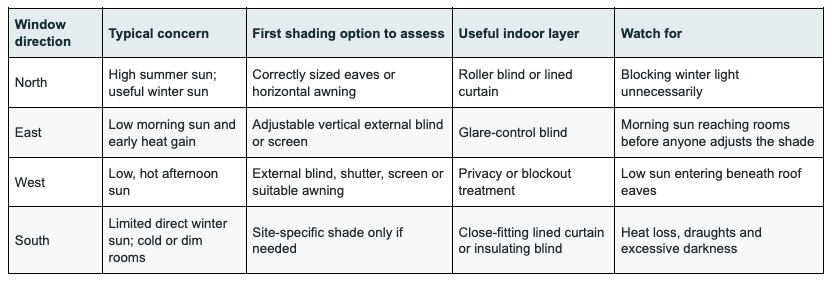
Treat this table as a shortlist, not a specification. A north-west window receives different sun from one facing due north, and surrounding trees, neighbouring walls and roof shapes can change the result. Your climate and the amount of glass may matter as much as the compass point.
For a practical first pass, stand in each affected room at the time the problem occurs. Note the sun's position, whether the glass feels exposed and whether the issue is heat, light, privacy or draughts. Measure each window separately, then check installation constraints before paying for a custom fitting.
For a product overview, U Blinds Australia lists internal blinds, shutters, curtains and exterior options. Compare the categories against each window's needs. If you are furnishing a new home in stages, Lord Decor's guide to which window coverings to buy first offers a room-priority perspective.
The right covering starts with the window, not the catalogue
Window coverings for Australian homes work best when their purpose matches the sun. North-facing windows often benefit from seasonal control with horizontal shade; east- and west-facing glass usually calls for closer attention to low-angle sun and exterior protection. Interior blinds and curtains can then handle privacy, glare and winter comfort.
Start with the window that causes the most trouble, observe it at the right time of day and choose the simplest safe treatment that addresses the real cause. The result is a more considered room, not just a better-dressed window.
Stay up to date with our latest ideas!