An industrial floor coating faces the same concrete in a hangar, a warehouse and a garage. See which slab tests and traffic loads decide the build you need.
Quick Answer
Aircraft hangars, warehouses and garages sit on the same material, and concrete carries point loads, absorbs spills and moves with temperature wherever it is placed. That shared substrate is why one industrial floor coating method serves all three. Crews grind the surface open, bond a primer into it, and add a wear layer that takes the traffic. Chemistry, film thickness and downtime are what differ.
Introduction
Coating failures on concrete usually start below the film, in a slab nobody tested. The owner then pays twice, once to strip the dead material and again to put down its replacement. Water vapour migrates up through the pore network, pressure builds under the cured film, and an industrial floor coating separates from the surface in blisters.
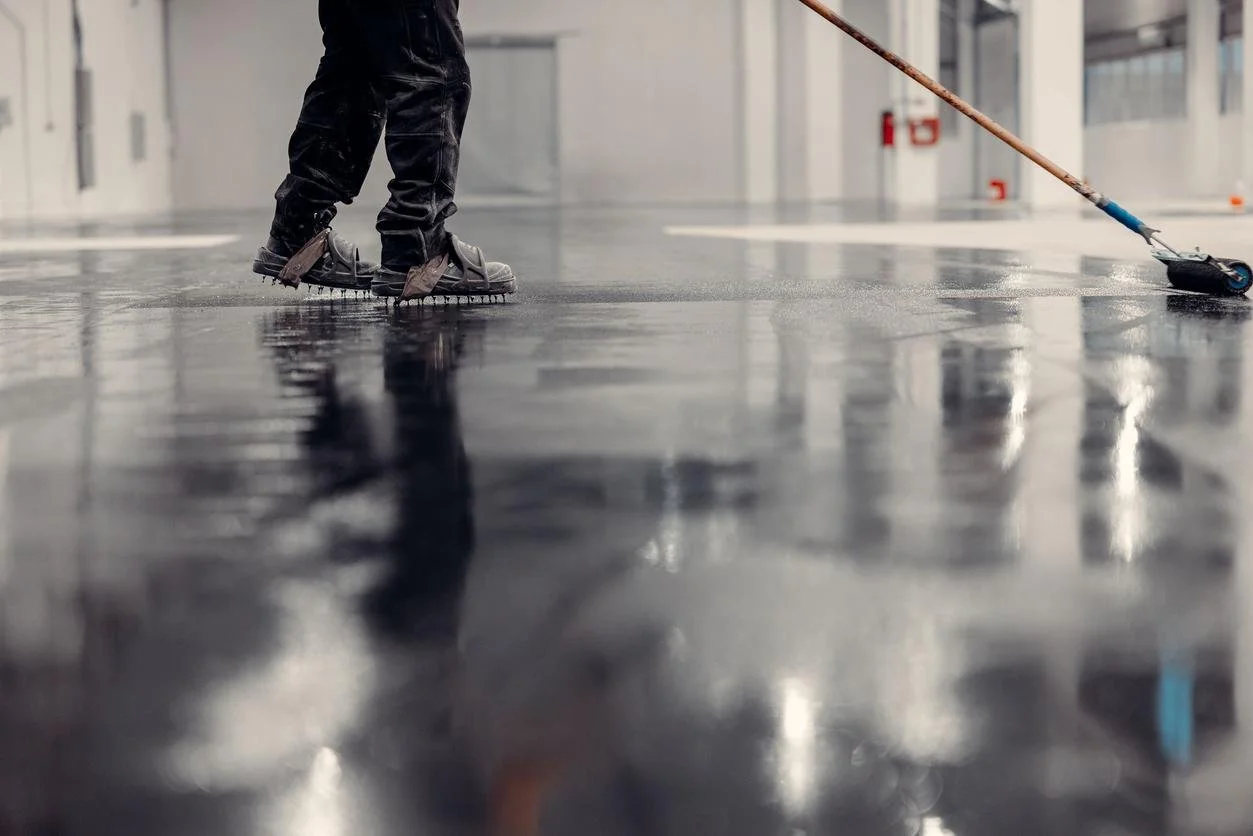
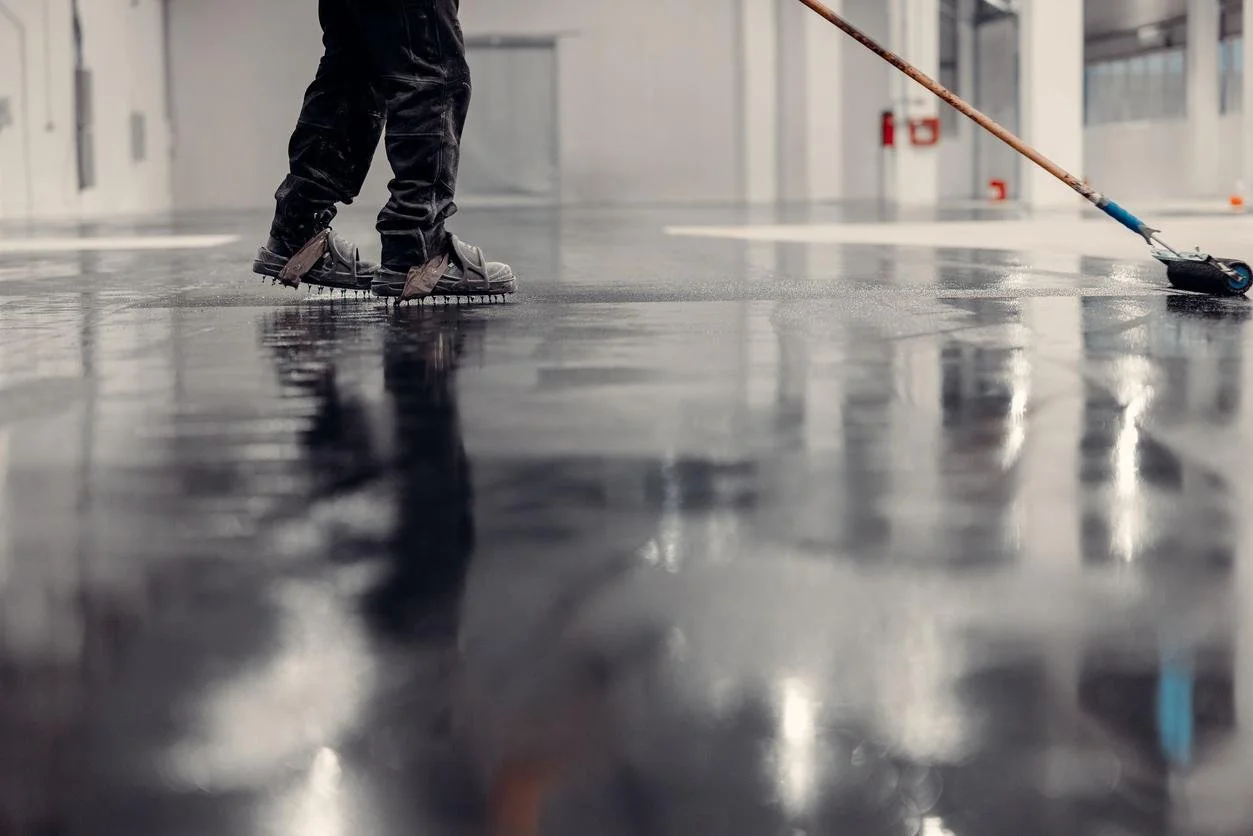
Grinding to open the pores, an epoxy base coat rolled out wet, a decorative flake broadcast and a UV-stable polyaspartic topcoat describe a garage job from any Calgary epoxy flooring company. The same four steps describe a hangar rebuild, with different products in each pail and a thicker film on the ground.
How Concrete Protection Begins With the Slab Itself
The specification starts with what concrete does on its own, long before anyone chooses a resin.
The Substrate Behaves the Same in Every Building
Concrete is porous and alkaline, and it changes dimension as temperature changes. It pulls oil into its pore structure and wicks groundwater upward from the ground it sits on. A floor under a business jet and a floor under a family sedan differ in area and reinforcement, yet they break down through the same short list of causes.
Those causes repeat across all three building types.
Vapour drive. Moisture rising from the subgrade collects under the film and forces it off.
Abrasion. Grit carried in on wheels grinds the wear layer down at entries and turning zones.
Chemical attack. Oils, fuels and hydraulic fluids soften resin that was not specified to resist them.
Thermal movement. Film and concrete expand at different rates, loading the bond line with every temperature swing.
Point loading. Concentrated wheel loads crush any weak layer between the film and the slab.
Where the Local Climate Sets the Outer Limit
Chloride arrives on tires every winter and stays in the pore network long after the snow is gone. The City of Calgary’s own climate projections put the historical count at roughly 16 freeze-thaw cycles across December, January and February alone, and city crews have reported winters well past 30. Water that reaches the capillaries expands as it freezes, lifting film from below and scaling the surface above.
How Epoxy Flooring Systems Are Matched to Load and Chemistry
Two measurements sit between surface preparation and product selection, and they decide whether anything above them holds.
The Moisture Reading That Comes First
Moisture vapour emission testing under ASTM F1869 and in-situ relative humidity testing under ASTM F2170 measure what the concrete is releasing. Coating manufacturers commonly set the ceiling at about 15 grams per square metre over 24 hours, with internal humidity at 75 to 80 percent.
A building sitting over a degraded or missing vapour retarder can run well above both figures, and the film then lifts in osmotic blisters inside the first year. Industrial epoxy flooring that was specified correctly for traffic still fails this way.
Four steps keep that risk off a project.
Condition the building to service temperature and humidity for 48 hours before testing.
Run three emission tests across the first 93 square metres, then one more for every additional 93.
Read emission rate and internal humidity together, since a dry surface can sit above a saturated core.
Where either reading fails, the fix is a moisture mitigation primer, not a different topcoat.
Matching the Build to the Facility
Once the readings pass, the three buildings diverge in a predictable way. The table below sets out what each one asks for.
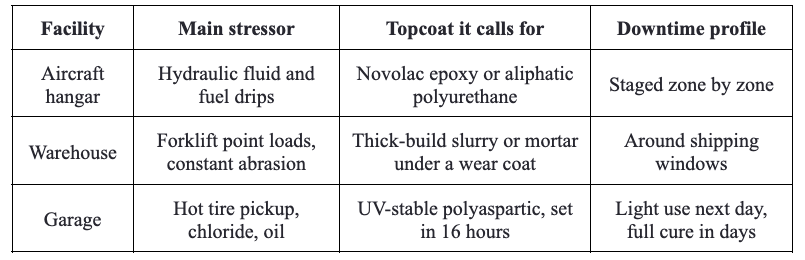
The result is one method with three endings, chosen by what spills on the floor.
What Keeps a Heavy Duty Floor Coating Working Past Year Ten
Wear shows up in the same places in every facility, which is what makes a maintenance plan worth writing.
Where Coated Floors Actually Wear
Tow paths and door lines go first in a hangar, forklift turning radii and rack ends in a warehouse, and tire contact patches in a garage. Four habits run through the ones that reach their design life.
Crews sweep grit off before it grinds in, because sand and chloride abrade under every wheel.
Spills get flushed rather than wiped, since hydraulic fluid and battery acid etch the film while they sit.
The wear layer gets renewed at the first dulling, well before the colour below shows through.
Solvent-based strippers and acidic cleaners stay in the cupboard, because they soften the topcoat faster than traffic does.
Pro Tip: Photograph the door line and the busiest turning zone each spring, then compare the two images a year apart. Patterns a walk-through reads as normal stand out side by side.
Why Recoating Beats Replacement
A fresh topcoat uses the bonded base layer that is already in place, so the work is a wear-layer job rather than a rebuild. A failed system costs the full sequence again, because the old material has to come off mechanically before preparation can start. Across a warehouse of thousands of square metres, that is the difference between a maintenance line item and a capital project.
What Owners Should Expect Over Twenty Years
Traditional epoxy on a concrete floor runs five to ten years before it needs reapplication, while a properly installed and maintained system reaches ten to twenty. At that point a well-kept floor carries one or two topcoat renewals, and the original preparation is still holding the whole build to the slab.
Why Hangar, Warehouse and Garage Floor Coating Choices Converge
The three building types run different risks and land on one method, because the material under all of them is identical. The decisions that matter happen before anyone opens a pail, in the moisture readings and the load assessment that fix the film thickness and the topcoat chemistry. An industrial floor coating earns its second decade on a slab that was tested, ground and primed the first time correctly.
Stay up to date with our latest ideas!