Blinds vs curtains comes down to light control, insulation and upkeep. Compare how each performs room by room, and the two measurements to take before ordering.

Neither option wins outright, because the answer changes from room to room. Blinds give precise daylight control and suit tight spaces, humid areas and windows with no spare wall beside them, while lined or blackout curtains insulate better against cold glass and absorb more sound. The blinds vs curtains decision follows two measurements: the depth of the recess and the clear wall on either side.
Introduction
Measurements sink more window treatment projects than taste ever does. A panel gets chosen for its colour, then the recess proves too shallow for the headrail to sit flush, or the wall beside it has nowhere to put the fabric once it is drawn back. In a climate like Calgary’s, where the same pane faces January cold and July sun, the blinds vs curtains choice carries a heating bill as well as a look.
The variables that decide it are all specifications: reveal depth, stack-back, lining weight, hardware wear and cleaning frequency. Workrooms producing custom curtains and blinds size every panel to the opening it covers, which is why made-to-measure work outperforms ready-made panels on fit, operation and insulation.
Light, Privacy and Heat Loss in the Curtains or Blinds Decision
Across a single day the same window makes competing demands on whatever covers it, and no one material answers them all equally well.
Daylight Arrives at an Angle
Slats redirect light while fabric filters or stops it. Horizontal slats tilted upward bounce daylight onto the ceiling, which lights a room without throwing glare across a monitor, whereas a sheer panel softens the whole window evenly and cannot direct anything. Low winter sun slides under a partly raised treatment, so tilting slats hold the advantage at any window a desk faces.
Privacy Reverses After Dark
Backlighting reverses the daytime picture after sunset: sheer fabric that screens a room at noon becomes a silhouette once lamps are on, and closed slats still leave a sightline through the tilt gap from above. Room use, more than style, sets the specification:
Street-facing bedrooms. Blackout lining or a room-darkening roller, since the problem is nocturnal.
Ground-floor bathrooms. Moisture-tolerant materials, never an unlined fabric panel.
Home offices. Street sightlines closed without surrendering the desk’s daylight.
South-facing living rooms. Layered sheers behind a heavier outer panel.
Kitchens and laundry rooms. Wipeable surfaces that tolerate steam and cooking residue.
Cold Glass Changes the Maths
The U.S. Department of Energy attributes roughly 30 percent of a home’s heating energy loss to windows, and reports that tightly fitted cellular shades cut that loss by 40 percent. Drapery only reaches its own best figures when the panel hangs close to the glass with sealed edges, because an open top lets warm air slide down the cold pane.
Set side by side, the trade-offs line up like this.
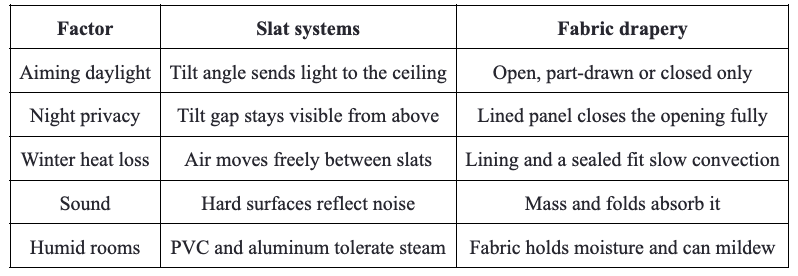
Taken together, precision favours slats while comfort favours fabric, which is why large openings are so often layered.
Reveal Depth and Stack-Back: Measuring for Window Coverings That Fit
Showroom choices come apart at installation when nobody has checked what the opening and the wall beside it can take.
The Reveal Decides the Mount
Every headrail carries a published minimum mounting depth, and the reveal has to clear it before an inside mount can sit flush. Thicker sashes on triple-glazed units can leave less usable depth than older glass did, so a short reveal pushes the installation onto the trim or the wall, which changes how the finished treatment reads in the room.
Three readings, top, middle and bottom, with the smallest governing, catch out-of-square openings early.
Stack-Back Claims the Wall Beside the Opening
A drapery pair parks on the wall whenever it opens. House Digest puts stack-back width at roughly 20 percent of panel width for pleated headings, so a 2.4 m opening carrying two 1.2 m panels needs about 25 cm of clear wall on each side. Where the wall gives less, fabric covers glass all day and the room loses daylight it was meant to gain.
Floor-to-ceiling condo glass in Calgary runs into that limit, which is why ceiling-mounted track across the full wall is now common.
At that point the measuring sequence is fixed:
Recess depth at three heights, smallest reading governing.
Clear wall each side, measured to the nearest obstruction.
Headroom above the frame, more for a motorized track than a manual rod.
Outlet position if motorization is planned.
Pro Tip. Run painter’s tape along the wall at the full stack-back width before ordering, since a sofa arm, a return wall or a light switch turns up as a conflict in seconds.
Motorization Moves the Specification Again
A carrier needs more depth than a rod bracket, and the track needs a power source it can reach. Concealed ceiling track spans wide openings without a centre support and works with Google Home, Apple HomeKit, Control4, Lutron and Somfy RTS.
Cleaning, Wear and Lifespan Across Curtains, Blinds or Shades
Specification work ends on installation day, while the running cost of a window treatment keeps accruing for as long as it hangs there.
Materials Set the Cleaning Routine
Fabric absorbs whatever the room produces, so kitchen grease, pet dander and winter dust work into the weave. A lined pleated panel usually has to be dry cleaned, because the face fabric and the lining shrink at different rates in water.
Vinyl and aluminum slats take a damp wipe, while wood warps once steam reaches it and belongs nowhere near a bathroom or laundry. Tom’s Guide reaches the same conclusion from the other side, recommending fabric only in low-moisture rooms.
Hardware Gives Out Before Fabric Does
Moving parts take the wear first, since tilt rods, clutches and track glides cycle thousands of times a year. A seized clutch on a cordless roller usually ends in replacement rather than repair, because the mechanism is sealed into the tube.
Canada’s corded window covering rules, SOR/2019-97, have capped reachable cords at 22 cm and loop perimeters at 44 cm since May 2021, which pushed the market toward cordless and motorized mechanisms.
Planning the Replacement Cycle
South-facing openings do most of the ageing, since UV fades dyes and weakens fibres along a panel’s leading edge, while vinyl slats grow brittle on the same exposure. A few habits stretch the interval:
Vacuum fabric panels with an upholstery head each season.
Check clutch and track operation twice a year.
Keep the lining intact, since it takes the UV load first.
Replace a seized mechanism early, before the fabric is scrapped with it.
Custom work runs on a multi-week lead time, so a replacement planned before the old treatment fails avoids the stretch where a window sits bare.
Matching Window Treatments to the Room and the Climate
None of this needs a showroom visit to resolve, because the opening supplies the answer: the depth of the recess, the clear wall on each side, the exposure the glass faces and the humidity of the room. A bedroom with 60 cm of bare wall beside the window can carry a drawn pair, while a shallow-reveal bathroom window cannot. Blinds vs curtains is settled by the window long before taste gets a say.
Stay up to date with our latest ideas!