Roofer SEO: What Actually Ranks a Roofing Company in 2026
Learn what actually ranks roofing companies in 2026, from local SEO and content to technical optimization, reviews, links, and search visibility.
Search "roofer near me" and Google shows three roofing companies on a map. Those three get most of the calls. Everyone else fights over what's left.
Roofer SEO is the work of getting into that map, and into the regular results under it. A lot of advice on the topic is generic. Write blogs and wait.
This guide is more specific. It uses the latest local ranking research and Google's own rules to show what moves a roofing company up, and what gets it suspended. Most of the fixes cost nothing but time.
Key takeaways
The top local ranking factor in 2026 is your primary GMB category, per Whitespark's survey of 47 local SEO experts. Proximity to the searcher comes second.
You can't move your office closer to every customer. So city pages and regular organic rankings matter for towns outside your map radius.
Extra keywords in your business name can lift rankings, but they break Google's rules and can get your listing suspended.
Google removed the Q&A section from GMB listings on November 3, 2025. AI answers now pull from your website, reviews and listing instead.
Google's spam policies name city pages that funnel users to one page as doorway abuse. Each city page needs real local content.
Review signals gained weight in the 2026 Whitespark report. Review count gaps close faster than most roofers expect.
Your listing's open status at the time of a search is now a top-five local factor. Accurate hours matter more than they used to.
Track calls and booked inspections by source. Rankings alone don't pay the bills.
1. How should you rank in the map pack when location matters so much?
Pick the right primary GMB category, then build relevance and reviews to stretch how far from your office you can rank. You can't beat proximity, but you can widen your reach.
Do not open a virtual office or use a fake address to rank in another city.
Step 1: Know what Google says it uses
Google says local results depend on three things. Relevance is how well your listing matches the search. Distance is how far you are from the searcher. Prominence is how well known your business is, which includes reviews and links.
You control relevance and prominence. Distance is mostly fixed by where your business is.
Step 2: Know what the research ranks highest
Whitespark publishes the largest survey of local SEO experts. Its 2026 report, released in November 2025, scored 187 factors with input from 47 experts.
The top five factors for the local map pack were:
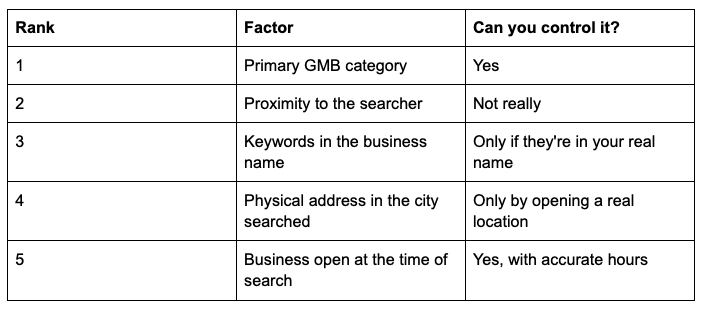
Look at that list closely. Two of the top five are mostly out of your hands. A third is only legal if it's already your real name.
That's why so many roofers are tempted to cheat. It's also why the ones who don't cheat need a plan for everything else.
Step 3: Understand your map radius
For a roofer with one office, map pack rankings usually fade as the searcher gets farther away. A company may rank first near its office and drop out of the top three a few miles out.
You can see this with a grid rank tracker. These tools check your ranking from many points across a map, like a 7 by 7 grid spaced one mile apart. That's 49 checkpoints.
A typical result for a single-location roofer looks like this:
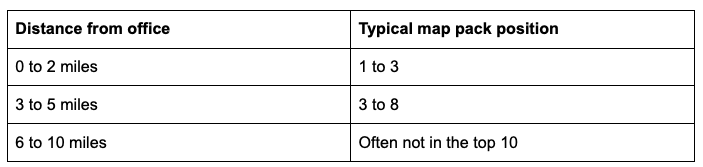
This is an example pattern, not a rule. Dense cities shrink the radius. Rural areas stretch it.
Step 4: Win the towns you can't reach on the map
For towns outside your map radius, regular organic results are your best shot. Those are the blue links under the map. They rely more on your website than on your address.
That's where service and city pages come in. Section 3 covers how to build them without breaking Google's rules.
Step 5: Skip the shortcuts that get listings suspended
Some tactics work until they don't. Google's guidelines are clear on these:
Your business name must match your real-world name. A tag like "Best Roof Repair Denver" isn't allowed unless that's your legal name.
Virtual offices and remote mailboxes aren't acceptable addresses.
You can't create more than one listing per location.
A suspended listing can take weeks to restore, and some never come back. For a roofer in storm season, that's months of lost calls.
2. How should you set up your GMB listing so it ranks and stays live?
Choose the most accurate primary category, fill every field, and keep your hours and services current. The listing itself is where most local ranking power sits.
Do not list hours you don't actually answer the phone.
Step 1: Get the category right
Your primary category is the top local factor. For most roofers, "Roofing contractor" is the right choice.
Add secondary categories only if they match real services. Good examples include gutter or siding contractor, if you do that work. Categories for services you don't offer can confuse Google and customers.
Step 2: Hide your address if you work from home
Many roofers run their business from home or a yard with no storefront. Google's guidelines say service-area businesses without a public location should hide their address. You then set a service area instead.
This is allowed and common. It won't hurt you. What hurts you is listing an address you don't really use.
Step 3: Add every service
Whitespark's 2026 report found that services on GMB listings mattered more than experts had thought. So list each one separately:
Roof replacement
Roof repair
Storm and hail damage repair
Roof inspection
Each roofing material you install
Gutters, if you offer them
Add a short description to each service. Plain language is best. Say what it is and who it's for.
Step 4: Set hours that match reality
Your open status at the time of a search is now a top-five factor. That's a new finding for 2026.
So if you really answer emergency calls at night, list that. If you don't, don't. A roofer who lists 24-hour service but sends every night call to voicemail will lose the customer and may get a bad review.
Update special hours for holidays. It's a small task that keeps you showing as open when you really are.
Step 5: Move your Q&A content to your website
Google shut down the Q&A section on GMB listings on November 3, 2025. Answers now come from AI that reads your website, reviews and listing.
A lot of roofing guides still tell you to "seed your Q&A." That advice is out of date.
Instead, build a real FAQ on your website. Cover the questions your staff hears most:
How much does a roof replacement cost here?
How long does a replacement take?
Do you work with insurance claims?
What warranty do you offer?
Do you pull permits?
Answer each in two or three plain sentences. The AI now draws on this, so accuracy matters.
Step 6: Handle phone numbers carefully
Google's guidelines say your number must connect to your business and stay under your direct control. Numbers that redirect callers to someone else's business are not allowed.
If you use call tracking, make sure the tracking number rings straight to you. Keep your main number the same on your website and in other directories. A mismatch across dozens of listings can cause more trouble than tracking solves.
3. How should you build city and service pages without getting flagged?
Build a page for each main service, and a page for each city only when you have real work and real details to show there. Thin city pages can do more harm than good.
Do not copy one page 50 times and swap the city name.
Step 1: Know where Google draws the line
Google's spam policies define doorway abuse as pages created to rank for similar searches that funnel users to one place. One of Google's own examples is having pages targeted at specific regions or cities that funnel users to one page.
Google's scaled content abuse policy also covers pages made in bulk to game rankings, including pages churned out with AI tools that add no value.
Many roofing websites have exactly this: 40 city pages with the same text and a different town name in the title.
Step 2: Do the page math before you build
Say you offer 6 services and serve 20 towns. If you build a page for every service in every town, that's 120 pages.
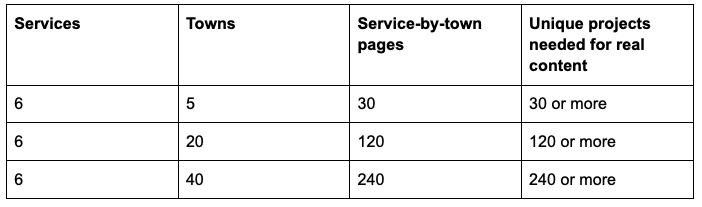
Few roofers have 120 local projects with photos to fill those pages. That's why most bulk city pages end up thin.
A smarter setup for most roofers is:
One strong page per service, like roof replacement or storm damage
One page per town you really work in, with real local details
Service-by-town pages only for your most valuable towns and services
That might mean 6 service pages, 10 town pages and a handful of combined pages. Around 20 strong pages usually beats 120 weak ones.
Step 3: Fill each city page with proof
A real city page should include things only you could write:
Photos of jobs you finished in that town
Streets or neighborhoods where you've worked, with permission
Local permit rules and how you handle them
Common roof types and ages in that area
Local weather, like hail seasons or high winds
Reviews from customers in that town
That's the difference between a doorway and a useful page. Good roofing marketing treats city pages as proof of local work, not as containers for keywords.
Step 4: Fix your site's crawl structure
This is the part almost no roofing guide covers. Google finds your pages by following links. Pages with no links pointing to them, called orphan pages, may never get found or ranked.
Common problems on roofing sites:
City pages that only appear in the footer, or nowhere at all
Project galleries that load photos with scripts Google can't read
Old storm-season pages left live after the event ended
Duplicate pages from site builders, like /roof-repair and /roof-repair-2
A simple fix is to link every city page from a "Service areas" page. Then link that page from your main menu. Each important page should be no more than three clicks from the homepage.
Step 5: Put the answer at the top of each page
Each service page should open with a plain answer. Say what the service is, where you offer it and a rough price range.
For example: "We replace asphalt and metal roofs across Boulder County. Most full replacements cost $12,000 to $25,000 and take two to three days."
That opening helps Google understand the page. It also helps AI tools that only read the top of a page when they build answers.
4. How should you earn reviews and links that move rankings?
Ask every customer for an honest review, and earn links from local businesses and groups you already work with. Reviews move the map pack, and local links help both the map and organic results.
Do not buy links from sites that sell them to anyone.
Step 1: Know why reviews matter more now
Whitespark's 2026 report found review signals gained weight compared to earlier editions. Review count, rating and how recent your reviews are all play a part.
Reviews also feed Google's AI answers now that Q&A is gone. A review that mentions "hail damage repair in Longmont" tells Google and its AI what you do and where.
Step 2: Do the review gap math
Say a top competitor has 300 reviews and you have 60. That gap looks huge. It isn't, if you ask every customer.
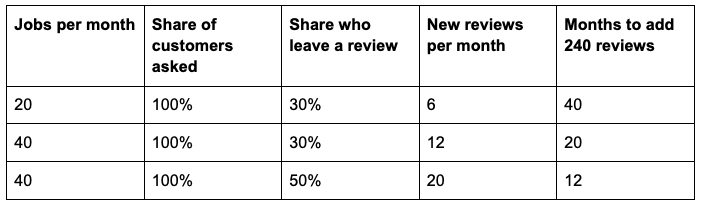
Your competitor keeps adding reviews too, so you may never match their total. But you don't need to. Recent reviews and steady flow count, not only the lifetime number.
The biggest lever is the ask rate. Many roofers ask only some customers, or only happy ones who bring it up. A habit of asking every customer, every time, often doubles the flow.
Step 3: Ask in a way customers will act on
Ask in person on the last day of the job, when the customer sees the finished roof
Send a text or email with a direct review link the same day
Follow up once, a few days later, if they haven't left one
Reply to every review, good or bad, within a few days
Keep the ask simple and honest. Rewards tied to a positive rating break the FTC's rules on reviews. Google's own review policies go further and bar incentives for reviews on its platform entirely.
Step 4: Earn local links from real relationships
Roofers already work with many local businesses. Most of those relationships can turn into links.
Good local link sources include:
Suppliers who list their contractor customers
Manufacturer contractor locators, if you hold a certification
Local chambers of commerce and trade groups
Youth sports teams and community events you sponsor
Local news coverage of storm recovery work
Real estate agents or home inspectors who share your name
These links are slow to build but hard for a competitor to copy. They also tie your site to your area, which helps local rankings.
Step 5: Keep your listings consistent
Directory listings, also called citations, show your name, address and phone number on other sites. Whitespark's 2026 report found three citation-related factors among the top five for AI search visibility.
So check your listings on the major directories and industry sites. Fix any old address, old phone number or old business name. The fix is dull but it helps both Google and AI tools trust your details.
5. How should you measure whether roofer SEO is working?
Track calls, form fills and booked inspections by source, then compare them to what you spend. Rankings are a means, not the goal.
Do not judge SEO on a single keyword ranking checked from your own phone.
Your own searches are skewed by your location and search history. A ranking you see at the office may not match what a homeowner sees across town.
Step 1: Use the free tools first
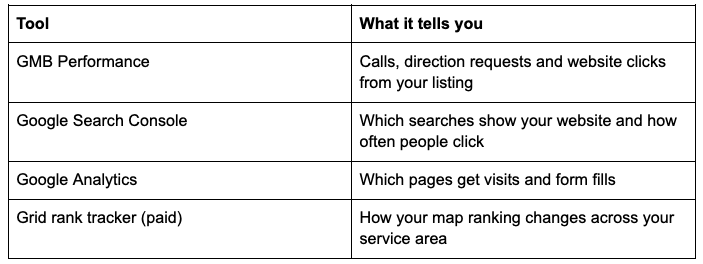
Most roofers can start with the first three for free. Add a grid tracker if you want to see your map radius grow over time.
Step 2: Do the revenue math
Say your website and GMB listing bring in 40 extra calls a month after a year of work. If 40% become inspections and 35% of inspections close, that's about 5 or 6 jobs a month.
At an average job of $14,000, that's roughly $78,000 in monthly revenue from organic search. Even with lower numbers, SEO tends to pay back well for roofers because each job is worth so much.
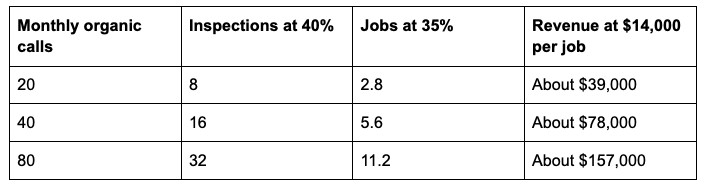
These rates are examples. Use your own close rates. But the table shows why a few extra calls a week can change a roofing company's year.
Step 3: Set realistic timelines
SEO takes time. Most roofers see GMB changes show up within weeks, while website rankings often take several months.
A fair review schedule:
Month 1: GMB fixed, key pages rebuilt, tracking set up
Month 3: first ranking gains near your office
Month 6: steady call growth from GMB and service pages
Month 12: city pages ranking in nearby towns
If nothing has moved by month six, look at what was actually done. Often the work stopped at the first round of fixes.
Roofer SEO checklist
Primary GMB category is "Roofing contractor" or the closest match
Business name matches your real name, with no added keywords
Address is hidden if you have no public storefront
Every service is listed separately on GMB, with a description
Hours are accurate, including special and emergency hours
Your website has a real FAQ now that GMB Q&A is gone
Each main service has its own page with a plain answer at the top
City pages exist only where you have real local work to show
Every city page is linked from a service areas page in your main menu
You ask every customer for an honest review
You reply to every review within a few days
You've earned links from suppliers, groups and sponsorships
Your name, address and phone match across major directories
You track calls and booked inspections by source each month
Rankings follow real local work
Roofer SEO rewards the basics done well. The right category, accurate hours, honest reviews and pages that show real local work beat most tricks.
In roofing accounts at Jives Media, a San Francisco digital marketing agency, the fastest ranking gains usually come from fixing the GMB listing, not from new content.
The shortcuts are tempting because the top ranking factors feel out of reach. You can't move your office, and you can't rename your company every month. But fake addresses and stuffed business names put your whole listing at risk.
Start with your GMB listing this week. Fix the category and hours, then list every service. Then build one strong page for your most profitable service, and one real city page for your best nearby town. Those changes alone move most roofers in the right direction.
Frequently asked questions
What is roofer SEO?
Roofer SEO is the work of getting a roofing company to show up in Google's map results and regular search results. It covers your GMB listing, your website, reviews and local links.
How long does SEO take for a roofing company?
GMB changes can show results within weeks. Website rankings usually take three to six months, and nearby-town rankings often take close to a year.
How much does roofing SEO cost?
Agencies that sell roofing SEO charge anywhere from about $500 to over $20,000 a month, based on published 2026 pricing. Most small and mid-size roofers pay somewhere in the low thousands per month.
Do city pages still work for roofers?
Yes, if each page shows real local work. Google's spam policies target city pages that copy the same text with a new town name.
Can I rank in a city where I don't have an office?
Yes, but mostly in regular organic results, not the map. The map pack favors businesses close to the searcher. Strong city pages help you rank in organic results for nearby towns.
What is the 25% rule for roofing?
The 25% rule is a building code rule, best known in Florida. It has required a full roof to meet current code if more than 25% is repaired or replaced within a year. Florida changed the rule in 2022, so check your local code.
Stay up to date with our latest ideas!