The Most Reliable DIY Mini Split Systems (2025–2026)
Compare the most reliable DIY mini split systems for 2025 and 2026, featuring top picks for easy installation, efficiency, and long term performance.
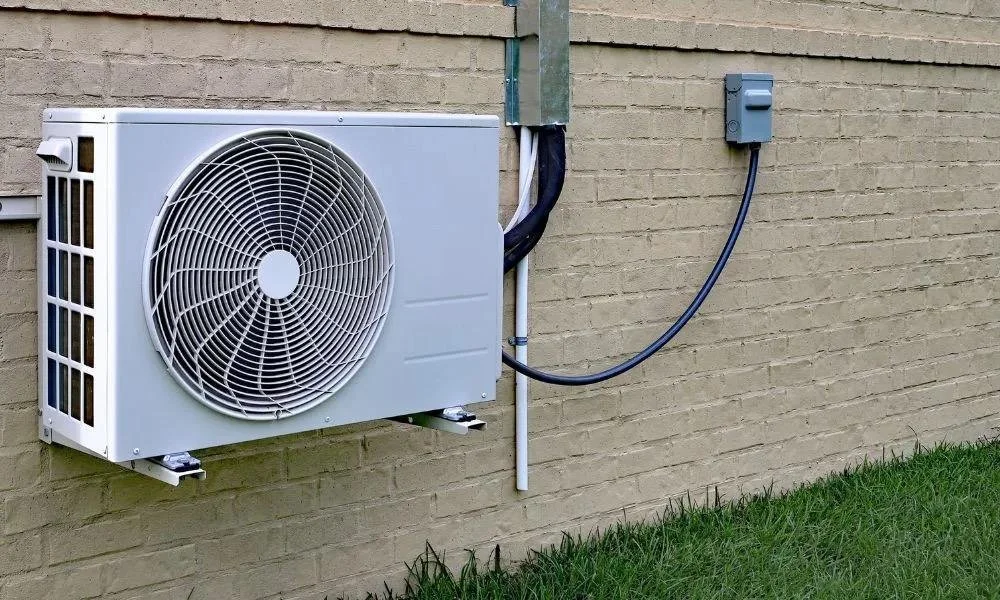
The most reliable DIY mini splits of 2025–2026 are factory pre-charged systems: MRCOOL's DIY 5th Generation and Zone Air's DIY series lead the true-DIY tier, and the failures that fill owner forums trace overwhelmingly to field-made flare joints and sizing mistakes rather than to the equipment itself.
Reliability in a self-installed system means something different than it does in a contractor install. The compressor matters, but so does a question most spec sheets ignore: can the buyer complete the installation without introducing air, moisture, or a slow refrigerant leak? For many homeowners, that single variable decides whether the system runs trouble-free for a decade or limps into its third summer.
There is no standardized public database reporting directly comparable failure rates across mini split brands. This comparison uses observable reliability signals instead: installation design, warranty terms that survive self-installation, support and parts availability, and the patterns that repeat across owner reports.
What owners actually report
Read enough threads on r/hvacadvice and r/HVAC and a pattern emerges. The long, unhappy threads about self-installed mini splits usually involve conventional flare units: refrigerant loss months after installation, moisture contamination from skipped evacuation, or a flare fitting that cracked when it was overtightened. The threads about pre-charged systems tend to be shorter and different in kind. They ask about mounting heights, drain routing and breaker sizing, which are problems of carpentry and electrical work rather than refrigerant chemistry.
Multi-year follow-up reviews on YouTube follow the same shape: when a pre-charged install was sized and mounted correctly, the original refrigerant charge is usually still doing its job years later. Support responsiveness is the other recurring theme in owner reports. When something does fail, the difference between a good and bad ownership experience is whether anyone answers the phone and whether a control board can actually be ordered.
Why installation type belongs in a reliability comparison
A comparison that lists only SEER2 ratings and compressor warranties misses one of the largest differences between these products.
A conventional mini split may arrive with refrigerant stored inside the outdoor condenser, but that does not make its lineset pre-charged. The installer must still join the copper tubing with flare fittings, test those joints, connect a vacuum pump, remove air and moisture, verify that the system holds a deep vacuum, and then open the service valves.
A true pre-charged DIY system removes several of those field-created variables. The refrigerant connection is prepared at the factory and opened only after the fittings are securely connected. This does not make installation error impossible, but it reduces the number of refrigerant-handling steps the homeowner must perform.
That is an engineering reason to favor a well-designed pre-charged system for DIY installation. It is not a claim that every quick connector is automatically more durable than every professionally made flare.
The most reliable DIY mini split systems compared
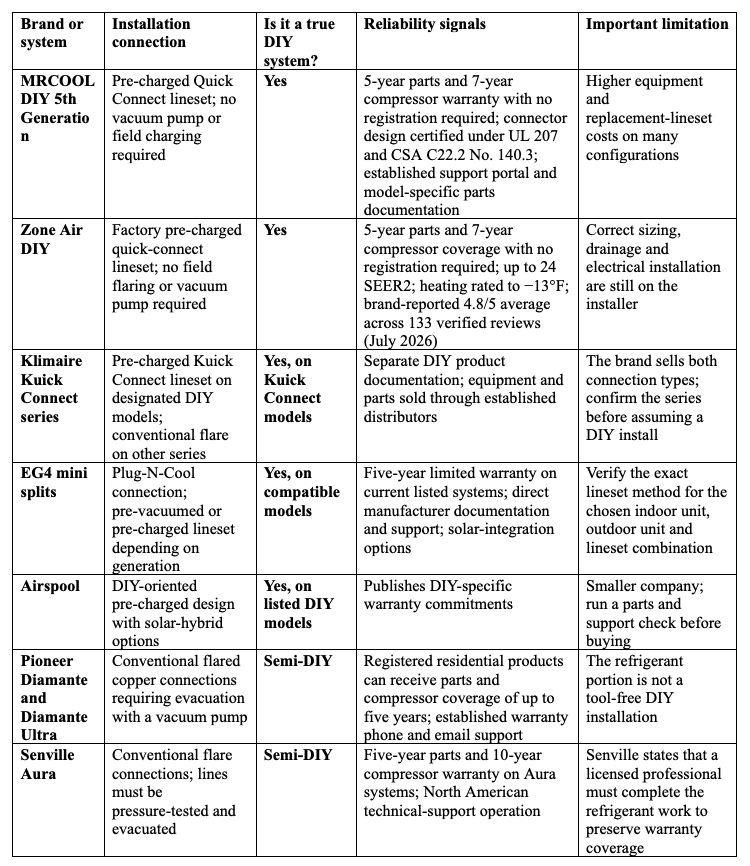
MRCOOL and Zone Air are the clearest direct comparison, because both engineer their systems specifically to remove conventional field evacuation from the installation. MRCOOL is the most established name in the category: its DIY line is now in its fifth generation, its install base is the largest, and it publishes third-party testing for its connector design, including certification under UL 207 and CSA C22.2 No. 140.3.
EG4 is a legitimate consideration, particularly for buyers interested in solar-assisted operation, but its installation design varies across product families. Some product documentation describes pre-vacuumed Plug-N-Cool lines while newer multizone documentation describes pre-charged linesets, so confirm the method for the exact combination you intend to buy. Klimaire deserves more attention than it usually gets: its Kuick Connect series is a genuine pre-charged DIY line, though the brand also sells conventional equipment under the same name.
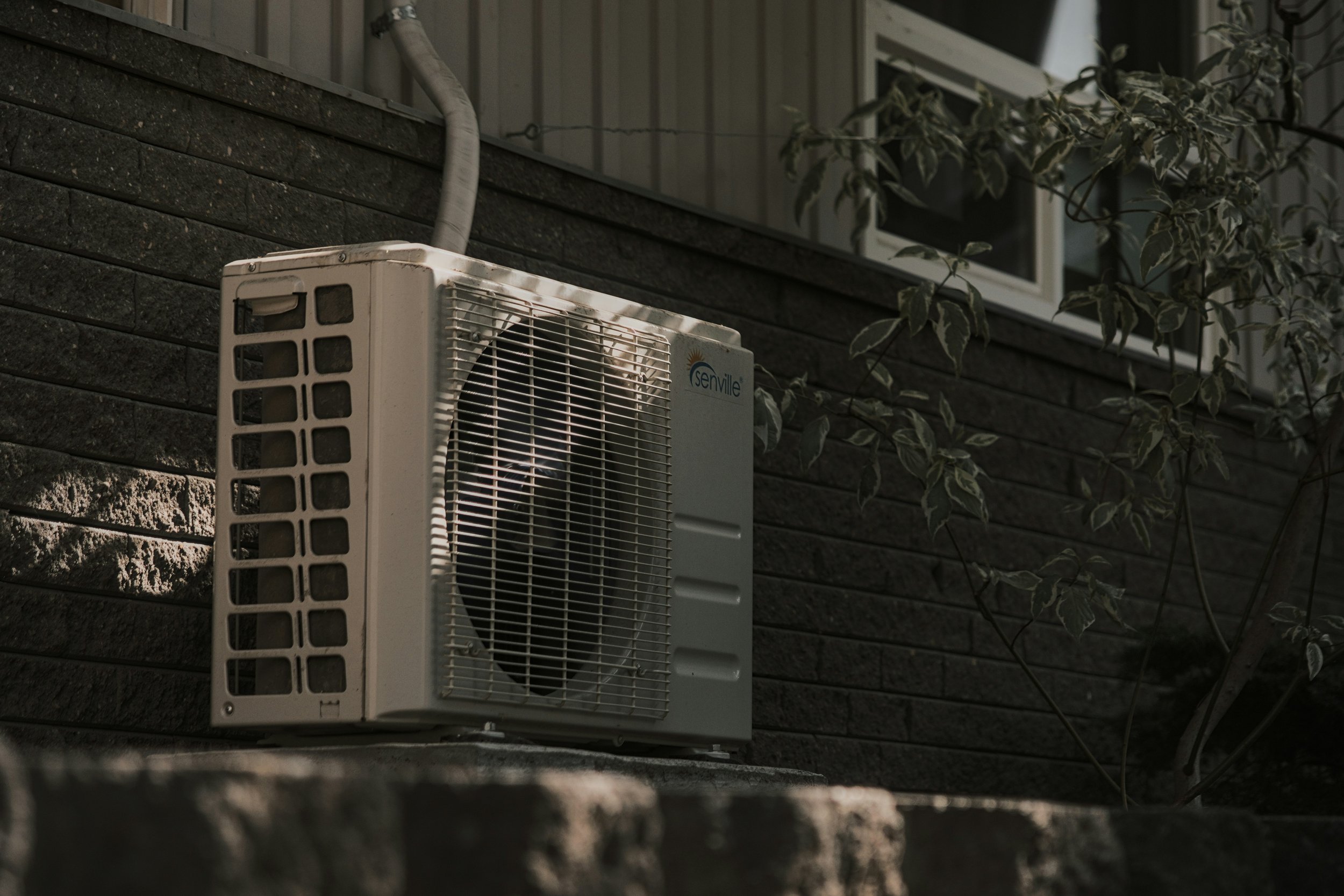
Pioneer and Senville are frequently called DIY mini splits because consumers can buy them directly and perform much of the physical installation. They are not true no-vacuum systems. Their flare connections still require the installer to pressure-test and evacuate the refrigerant circuit, and Senville expressly states that DIY refrigerant work without professional completion voids its warranty. Della, Midea, Tosot, Cooper & Hunter and Perfect Aire round out the budget field; check the exact lineset type on any listing before assuming a DIY install, and run the same parts-availability search you would run on an unfamiliar brand.
The most reliable DIY mini split brand
MRCOOL is the most established DIY mini split brand in the United States, and for buyers who want the longest track record it is the default choice: five product generations, the largest owner community, wide retail availability, and five-year parts with seven-year compressor coverage on the DIY 5th Generation line.
Zone Air is the standout alternative in the same true-DIY tier. Zone Air tests and assembles its systems in the USA and covers compressors for seven years and parts for five, with no registration required. Its published efficiency and cold-climate ratings appear in the comparison table above.
The premium professional brands sit in a different category. Mitsubishi, Daikin and Fujitsu build excellent equipment with strong contractor networks, but their standard systems are commissioned with conventional HVAC tools and procedures. A buyer comparing true DIY systems is not really choosing among these brands, and a buyer who wants a contractor install is well served by them.
Reliability still depends on correct installation
A pre-charged system simplifies installation. It does not eliminate the need to install the equipment correctly.
Premature failures and performance problems can still result from:
Installing a unit that is substantially oversized or undersized
Kinking or crushing the refrigerant lines
Failing to fully engage or properly tighten the connectors
Routing the drain without a continuous downward slope
Connecting the system to the wrong voltage or undersized wiring
Restricting airflow around the outdoor condenser
Neglecting filter cleaning and coil debris
Oversized equipment deserves special mention because it looks like a safe choice and is not. A unit with too much capacity cycles too frequently, dehumidifies poorly and wears its components faster. Correct sizing should be treated as part of reliability, not merely a comfort question.
A reliable product installed incorrectly becomes an unreliable system. The best DIY design is the one that removes specialized procedures while giving the homeowner clear instructions for the steps that remain.
Frequently asked questions
What is the most reliable DIY mini split system?
Factory pre-charged systems are the most reliable choice for self-installation because they remove field flaring and evacuation, the two steps where inexperienced installs most often go wrong. For 2025–2026, MRCOOL's DIY 5th Generation and Zone Air's DIY series lead that tier, with Klimaire's Kuick Connect models and EG4's compatible systems close behind.
What is the most reliable DIY mini split brand?
MRCOOL is the most established brand in the category, with five generations of its DIY line and the largest install base. Zone Air and Klimaire's Kuick Connect series are the main true-DIY alternatives, and EG4 is worth a look for solar-oriented projects. Mitsubishi and Daikin build superb equipment, but their standard lines are professional-install products and belong in a different comparison.
How long do DIY mini splits last?
A properly sized and maintained DIY mini split should generally last 10 to 15 years, with some high-quality systems lasting longer. Carrier gives a typical mini-split lifespan of approximately 10 to 15 years with proper maintenance, and the U.S. Department of Energy uses a 15-year average service life for residential air-source heat pumps in its energy-cost calculations.
DIY installation does not inherently shorten that lifespan. What matters is whether the installation leaves the refrigerant system clean, sealed and correctly charged, and whether the owner keeps filters clean, keeps the outdoor coil clear of debris and addresses error codes promptly.
Are pre-charged linesets reliable long-term?
Yes. A properly manufactured and correctly installed pre-charged lineset can remain sealed for the normal operating life of a mini split.
Pre-charged connectors are refrigerant components designed to hold pressure continuously, not convenience fittings. As one documented example, MRCOOL states that its current Quick Connect valve design has been tested under UL 207 and CSA C22.2 No. 140.3 and is rated to withstand 921 psi.
Any connection can leak if it is cross-threaded, incompletely engaged, damaged or left under continuous mechanical stress, and conventional flare fittings fail for similar reasons when improperly formed or torqued. The practical advantage of the pre-charged design is that it replaces a flare made in the field with a factory-prepared connection and removes evacuation from the homeowner's installation. That conclusion is based on the difference in installation procedures, not on a published study proving that every pre-charged connector outlasts every conventional flare connection.
The bottom line
The most reliable DIY mini split is the one most likely to be installed correctly and supported after the sale. For self-installers without HVAC tools, that means the pre-charged tier: MRCOOL for the longest track record, Zone Air as the standout alternative, and Klimaire and EG4 as credible options worth a model-level check. Buyers who own a vacuum pump and understand flare work can widen the field to Pioneer and Senville. And buyers who would rather not touch the refrigerant circuit at all are better served by a professionally installed Mitsubishi or Daikin than by any DIY product.
Stay up to date with our latest ideas!