Traditional vs. Infrared vs. Hybrid: Choosing the Right Sauna for Your Home (+ Best-Selling Saunas in 2026)
Compare traditional, infrared, and hybrid saunas to find the right fit for your home, with key features, benefits, and top sauna options for 2026.

Shopping for a home sauna gets confusing fast.
Traditional saunas promise the classic hot-room experience with stones and steam. Infrared cabins heat differently, usually at lower air temperatures, and are often easier to add to an existing room. Hybrid saunas try to give you both.
So which one should you buy?
For most homeowners, the answer comes down to the experience you want, where the sauna will go, and how much installation work you are comfortable taking on.
Some homeowners want the high heat, stones and steam associated with traditional Finnish-style home saunas. Others prefer the convenience and lower operating temperatures of infrared. Hybrid models give homeowners another option by combining different heating approaches in the same cabin.
If you want the familiar Finnish-style experience with high heat, sauna stones and the ability to add water for steam, choose a traditional sauna. If you want a compact indoor unit with simpler electrical requirements and gentler air temperatures, infrared is often the easier choice. A hybrid sauna makes sense when you genuinely want access to both styles and do not want to choose between them.
That sounds simple enough. The details are where people get tripped up.
Traditional vs. Infrared vs. Hybrid Sauna at a Glance
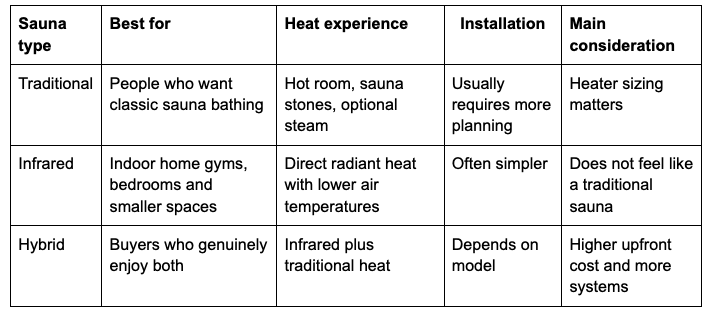
The biggest mistake is assuming one type is simply better.
It isn't.
Someone who grew up using traditional saunas may step into an infrared cabin and immediately feel that something is missing. Another person may love being able to walk into an indoor infrared sauna without dealing with a separate high-powered sauna heater.
Both reactions are reasonable.
What Is a Traditional Sauna?
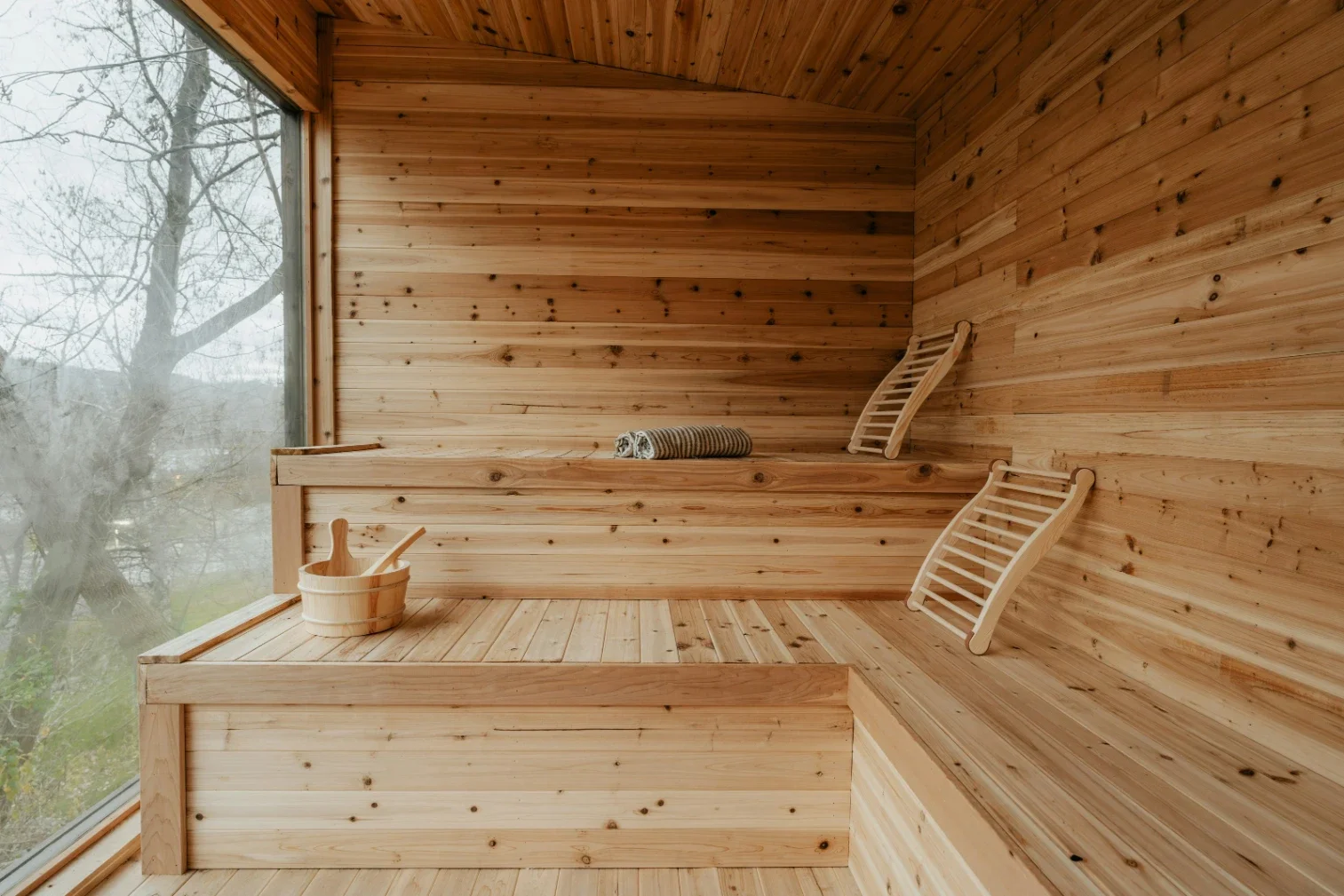
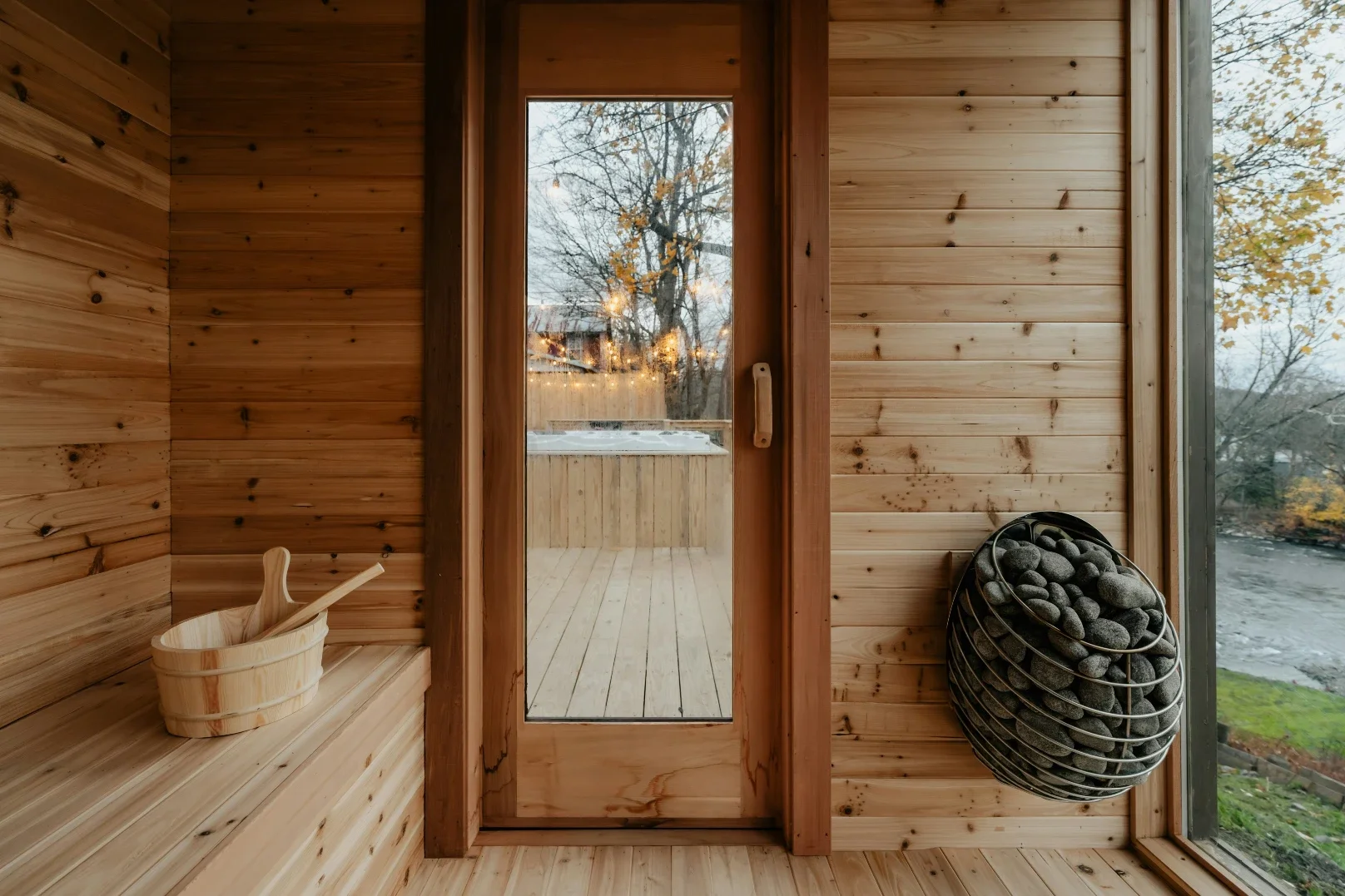
A traditional sauna heats the air inside the sauna room, typically using an electric or wood-burning heater surrounded by sauna stones.
Once the stones are hot, water can be poured over them to create a burst of steam called löyly in Finnish sauna culture.
That ability to control the feel of the room is one of the reasons people become attached to traditional sauna bathing. The room may feel dry one minute and noticeably softer and more humid after water hits the stones.
There is also something pleasantly uncomplicated about it.
Hot room. Wood benches. Stones. Water.
For many sauna enthusiasts, that is the experience they are trying to recreate at home.
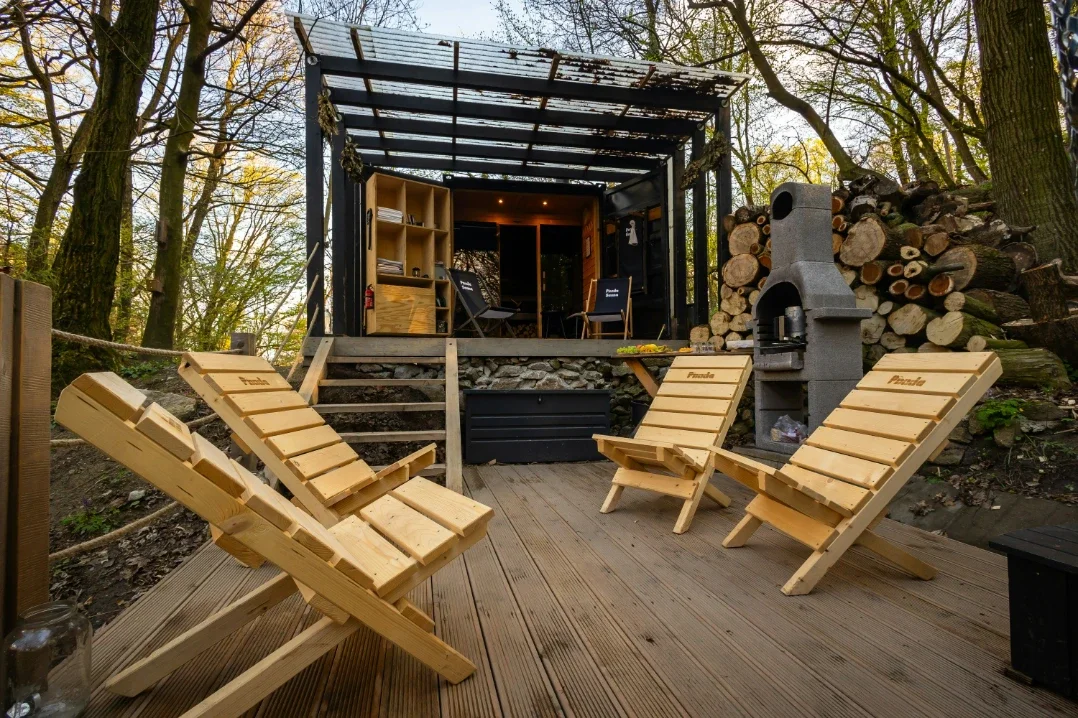
Traditional saunas are especially well suited to outdoor cabins and custom-built sauna rooms. They can also be built indoors, but the room, heater, ventilation and electrical requirements need to work together.
And this is where buying a traditional sauna becomes more involved than buying a piece of furniture.
The sauna cabin and the sauna heater are a system.
A heater that is too small may struggle to heat the room properly. Simply buying the most powerful heater available is not the answer either. Heater selection should match the actual sauna volume, construction and manufacturer's recommendations.
Large glass areas deserve particular attention because glass does not insulate like a properly insulated sauna wall.
Who Should Buy a Traditional Sauna?
Choose traditional if the actual sauna experience matters more to you than having the easiest possible installation.
Traditional is probably the right direction if you picture yourself sitting on a wood bench, pouring water over stones and adjusting the humidity to suit your mood.
It also makes sense for larger backyard saunas where the sauna becomes a destination in its own right.
If you are building a pool area, outdoor wellness space or dedicated backyard retreat, a traditional sauna often feels more at home there than a compact indoor infrared cabin.
There is a downside.
You have more decisions to make.
You may need to select the sauna cabin, heater, controls and stones separately. Depending on the heater, a licensed electrician may need to provide an appropriate dedicated electrical circuit.
For some homeowners, that extra planning is worth it. For others, it is precisely what they would rather avoid.
What Is an Infrared Sauna?
An infrared sauna approaches heating differently.
Instead of relying primarily on heating the air in the cabin to high temperatures, infrared heating elements emit radiant energy that warms the body and surrounding surfaces.
The air still gets warm, of course, but the experience is different from sitting beside a traditional sauna heater and a large mass of hot stones.
Infrared cabins generally operate at lower air temperatures.
Some people prefer that.
You can sit in a warm cabin and sweat without experiencing the intense room temperature associated with a traditional sauna. For people who find very hot air uncomfortable, infrared may simply be more enjoyable.
There is another reason infrared saunas have become common in homes: convenience.
Many compact residential infrared models are designed for indoor installation and use standard residential electrical service. That can make them relatively easy to incorporate into an existing home gym, basement or spare room.
The tradeoff is straightforward.
Infrared is not a substitute for a traditional sauna if what you really want is the traditional experience.
There are no heated stones to throw water on. You do not get the same changes in humidity. The way the heat feels is different.
Buying infrared because it seems easier, when you actually want traditional sauna bathing, is likely to leave you disappointed.
Who Should Buy an Infrared Sauna?
Infrared is particularly attractive when practicality comes first.
Maybe you already have a home gym and want to put a sauna in the corner. Maybe you live in a colder climate but do not want to walk outside to a backyard sauna at night. Perhaps you simply don't want a larger electrical and construction project.
A compact infrared cabin can make a lot of sense in those situations.
It can also be a good fit for someone who expects to sauna alone most of the time. There is little reason to dedicate a large section of your backyard to a six-person cabin when almost every session will involve one person.
Buy for your actual life, not for the photo you have in your head.
What Is a Hybrid Sauna?
Hybrid saunas exist for the person who gets halfway through this comparison and thinks, "I want both."
Depending on the model, a hybrid sauna can combine infrared heating with a traditional heater and sauna stones in the same cabin.
That changes the buying decision considerably.
On one day, you can use infrared heat. On another, you can heat the stones and have a more traditional sauna session. Some models allow the technologies to be used in combination.
It sounds like the obvious answer. Sometimes it is.
But hybrid is not automatically the best choice simply because it has more features.
If you know you love traditional sauna and have almost no interest in infrared, there is little reason to pay for a technology you will rarely turn on. The reverse is also true.
Hybrid makes the most sense for households where preferences vary or for buyers who know they genuinely enjoy both experiences.
The Question We Ask Homeowners First
Ryan Williams, Resident Sauna Expert at SaunaHeaters.com, says product selection often becomes easier once customers stop starting with the product itself.
"We talk to homeowners every day who start out focused on a particular sauna they like, but the right choice really comes down to how they plan to use it, where it's going, and the kind of sauna experience they want. A great home sauna should fit naturally into your space and your routine, not the other way around."
That is useful advice because sauna shopping can become specification-heavy very quickly.
Instead, imagine a normal Tuesday night six months after installation.
Are you walking out to a backyard sauna with your spouse?
Are you stepping into a small infrared cabin after working out in your basement?
Do you want friends to join you?
Will you actually pour water over sauna stones?
The answers tell you more than a feature sheet.
Best-Selling Sauna Recommendations for 2026
Once you know which format fits you, choosing a model becomes much easier.
These recommendations cover very different buyers rather than pretending six similar saunas can all be "best."
SaunaLife Cube CL7G: Best Traditional Sauna for a Larger Backyard
If the goal is to make the sauna a centerpiece of the backyard, the SaunaLife Cube CL7G is an easy model to understand.
It is a six-person outdoor sauna with a modern Scandinavian-style cube design, Thermo-Spruce construction and a broad glass front. Inside, two-tier seating gives it the capacity that couples and families often want once they realize sauna bathing may become a shared activity.
The size changes the experience. This is not something tucked into the corner of a home gym. It is a backyard room.
That also means buyers need to think beyond the cabin itself. The CL7G does not include the sauna heater as standard. The heater is selected separately, which gives the homeowner more choice but makes proper heater sizing and electrical planning part of the project.
Who is it for? Someone with enough outdoor space who wants a genuine traditional sauna rather than the simplest possible installation.
SaunaLife Cube CL3G: Best Compact Outdoor Traditional Sauna
The CL3G is almost the opposite proposition.
It gives you an outdoor traditional sauna without asking you to dedicate as much backyard space to it.
The cabin is designed for two people and retains the modern Cube look, including Thermo-Spruce construction and the glass front. Because it is smaller, it can fit into spaces where a larger family sauna simply would not make sense.
I particularly like this format for couples.
A lot of buyers instinctively look at four-person and six-person saunas because bigger sounds better. Then they admit that nearly every sauna session will involve one or two people.
The CL3G is the more honest answer for that buyer.
Like the CL7G, its heater is sold separately. That should be included in the budget from the beginning rather than discovered after the cabin has been ordered.
Finnmark FD-4 Trinity: Best Hybrid Sauna
The Finnmark FD-4 Trinity is for the person who refuses to choose.
And in this case, that is not necessarily a bad thing.
It combines infrared heating with a traditional Harvia heater and sauna stones. It also incorporates red-light technology, although the real reason to consider this model is the ability to switch between two very different sauna experiences.
Use the infrared system when you want that style of heat. Fire up the traditional heater when you want hot stones and steam.
The cabin uses cedar inside and Thermo-Aspen on the exterior, and the traditional heater is integrated into the package rather than being something you need to choose later.
There is a premium attached to all of that versatility. Someone who only wants traditional sauna has cheaper and simpler ways to get it.
For a household divided between infrared fans and traditional-sauna loyalists, though, the FD-4 solves a real problem.
Golden Designs Maxxus 2-Person: Best Value Two-Person Infrared Sauna
The Maxxus makes sense for a completely different buyer.
It is a two-person indoor far-infrared sauna built from Canadian Hemlock and designed to operate from standard residential electrical service.
That last point matters.
For someone adding a sauna to an existing home gym, it can make the project much less intimidating. You are buying a self-contained infrared cabin rather than designing a traditional sauna room around a separate heater.
The interior is roomy enough for two without turning the sauna into a large piece of architecture.
If your priorities are indoor use, lower upfront complexity and enough space for a couple, the Maxxus is one of the more practical options in the group.
Dynamic Barcelona Elite: Best Sauna for a Small Space
Some buyers do not need "two-person capacity" in anything other than marketing copy.
They need a sauna for themselves.
The Dynamic Barcelona Elite is compact enough to make sense in situations where every inch matters. It uses far-infrared heating, Canadian Hemlock construction and standard residential electrical service.
That makes it easy to picture in a bedroom, basement or home fitness room.
The Barcelona is not trying to recreate a Finnish sauna cabin. That's the point.
It is for someone who values easy access and a small footprint more than stones, steam or room for friends.
If you are the only person in the house who wants a sauna, this kind of model can be a smarter purchase than something twice the size.
Dynamic Gracia: Best Full-Spectrum Infrared Choice
The Dynamic Gracia sits a step above a basic far-infrared cabin for buyers specifically interested in a fuller infrared setup.
It combines far-infrared carbon panels with near-infrared heating elements in a compact indoor cabin.
Physically, it remains closer to the Barcelona than to a large traditional sauna. It is designed for indoor use, runs on standard residential electrical service and fits the sort of space where a larger custom sauna would be difficult.
The Gracia makes most sense after you have already answered the bigger question.
If you know you want infrared, then choosing between a simpler far-infrared model and a full-spectrum configuration becomes relevant.
If you are still wondering whether you actually want hot stones and steam, solve that question first.
How to Choose Between Traditional, Hybrid and Infrared Without Overthinking It
There are dozens of specifications you can compare. Start with a few practical questions.
Where will the sauna go?
An outdoor backyard location naturally opens the door to traditional sauna cabins.
An upstairs bedroom does not.
If you already know the location, you may have eliminated half the options before looking at a single product.
What do you think a sauna should feel like?
This matters more than people expect.
If your idea of a sauna involves intense heat, stones and throwing water for steam, buy traditional.
If you prefer a warm indoor environment and like the way infrared feels, buy infrared.
Do not let installation convenience talk you into buying a sauna experience you don't actually want.
Who will use it?
Capacity claims are easy to get carried away with.
If your spouse has already told you they hate saunas, you probably do not need a six-person model for "the family."
If your sauna is going next to a pool and friends are at your house every weekend, a one-person infrared cabin probably isn't the answer either.
Think about real users.
How much installation work are you comfortable with?
A small infrared sauna can be closer to adding an appliance.
A traditional outdoor sauna is a small building project.
Neither is inherently better, but those are very different commitments.
What About Operating Temperature?
Temperature is often presented as if it is a competition.
It shouldn't be.
Traditional saunas generally operate with hotter room air than infrared saunas. Infrared systems heat the body differently, so simply comparing the thermostat setting does not tell you which experience you will prefer.
If high-temperature traditional bathing is part of what attracts you to sauna, choose a traditional model.
If you dislike extremely hot air, that same feature is not an advantage.
Comfort wins.
Does an Outdoor Sauna Need a Bigger Heater?
Not automatically.
A traditional sauna heater should be selected according to the specific sauna room and the heater manufacturer's sizing requirements.
Interior volume is the starting point, but glass and other poorly insulated surfaces can increase heating demand. Outdoor conditions can matter as well.
This is why copying the heater from someone else's sauna build can be a bad idea even when the cabins appear similar.
A full glass front looks fantastic. Thermally, it is not the same as an insulated wood wall.
The sauna and heater need to be considered together.
Which Sauna Type Is Best for a Home Gym?
For many home gyms, infrared wins on convenience.
A compact infrared cabin can often sit alongside other fitness equipment without requiring a separate outdoor structure or traditional sauna build.
But there is an exception.
If you have created a serious home training and recovery area and already know you love traditional sauna, don't buy infrared simply because it fits neatly next to the squat rack.
Find a way to install the sauna you actually want.
You are likely to own it for much longer than the inconvenience involved in setting it up.
Which Sauna Is Best for a Backyard?
For a permanent backyard setup, I prefer traditional.
A well-designed outdoor cabin feels like a destination. The walk outside becomes part of the ritual, particularly in cooler weather.
Models such as the SaunaLife Cube series also look intentional in a landscaped yard rather than like fitness equipment that somehow ended up outdoors.
Hybrid becomes interesting when you want that sauna experience but also know you will use infrared regularly.
Pure infrared is usually better suited to indoor installations unless the model is specifically designed and approved for outdoor use.
Traditional vs. Infrared Sauna vs. Hybrid: Which Is Better?
Neither wins universally.
Traditional is better for you if you want: high-temperature sauna bathing, hot stones, steam and the classic sauna experience.
Infrared is better for you if you want: simpler indoor installation, lower air temperatures and a compact self-contained cabin.
Hybrid is better for you if you want: genuine access to both experiences and know you will use them.
The word "better" only becomes useful after you define what you want the sauna to do.
So, Which Sauna Should You Buy?
If you already know that sauna means hot stones and steam to you, buy a traditional sauna. You are unlikely to be happy trying to replace that experience with infrared.
If convenience is what will make the difference between using your sauna regularly and barely using it at all, a compact infrared model may be the smarter purchase.
And if two people in the household keep arguing about which type to buy, that's one of the rare occasions when choosing the option with more features may actually solve the problem. Look at a hybrid.
The sauna should fit your life.
That's a much better place to start than asking which technology wins on paper.
Stay up to date with our latest ideas!