The Best Mattresses for Couples With Different Firmness in 2026
Find the best mattresses for couples with different firmness preferences in 2026, with tips on comfort, motion isolation, support, and sleep compatibility.
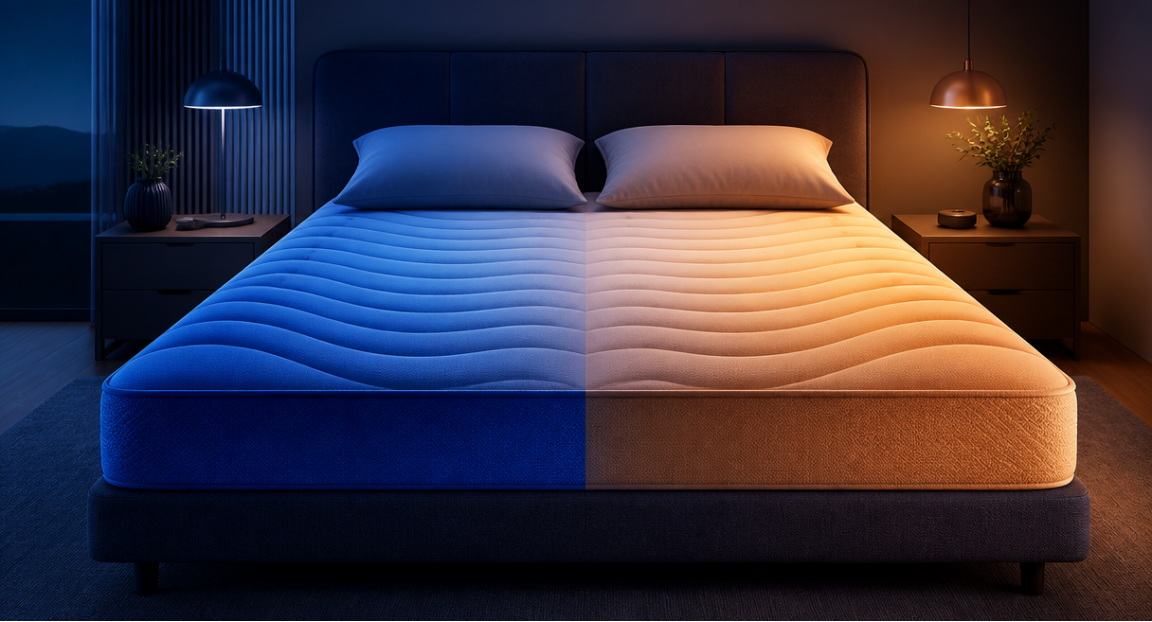
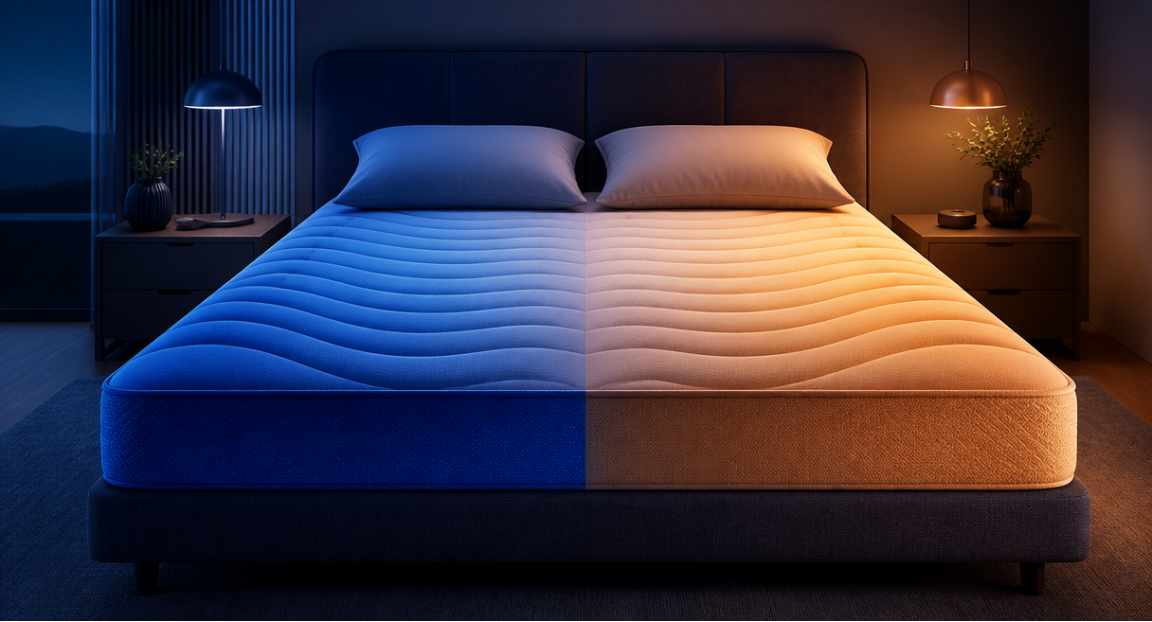
For couples who like different firmness, one mattress works with left-right independent adjustment — two support maps tuned separately, not a middle compromise. That answer shapes this roundup of the 2026 field, and the ranking runs on three axes any reader can check: how each bed adjusts its two halves — automatically or by hand, together or in a queue; what published evidence stands behind each claim; and what keeps recurring after the hardware is paid for. DeRUCCI enters as a candidate here. Every judgment below is grounded in the companies' published specifications and pricing — the same documents any reader can pull up and check.
Why One Middle Firmness Serves Neither Partner
A medium firmness is a diplomatic answer to a mechanical question. Side sleepers need give at the shoulder and hip; back sleepers need steady support under the lumbar curve. One fixed surface maps to one of those loads, so the shared compromise quietly under-serves both people it was meant to satisfy. Independent halves solve the geometry.
Side sleepers and back sleepers thus need different support maps — shoulders and hips versus the lower back — so one fixed firmness ends up serving a single partner at a time. A side sleeper's heaviest points must sink far enough that the spine stays level; run the surface firmer than the shoulder can compress and the arm goes numb, softer than the hip can manage and the body slumps. A back sleeper loads the bed differently: the pelvis is heaviest, and the surface must hold the lower back's curve without caving or propping.
Cross the ideals and both partners lose. The "we compromised and neither of us sleeps well" outcome is a common replacement motive, and it is structural: the middle setting is a truce in which each partner gives up support their posture asks for. Partners also influence each other's sleep: a 2020 laboratory study by Drews and colleagues recorded more, less-fragmented REM sleep and sleep-stage synchronization when bed partners slept together.
The structural fix is left-right independent adjustment: one half firming its zones while the other softens its own, both maps live at once. Firmness has a thermal twin, too — thermal preference does not track firmness preference, which is why per-side warmth control matters as much as per-side support.
Four Checks That Decide a "Couples Mattress"
Before any brand name enters the conversation, the category has a short checklist. Can both halves adjust at the same time? Do the zones cover each partner's actual load areas? Does adjustment stay under 28 dB, about a soft whisper? Do service terms cover a shared bed's long life from the delivery date?
When couples test a mattress, four checks matter: simultaneous dual-side adjustment, zone mapping, noise under 28 dB, and warranty from delivery. Run them in this order.
1. Simultaneous dual-side adjustment. Ask directly: can each side adjust its zones while the other side is moving too? Many smart beds run single-side-first — one half finishes before the second starts. With different firmness needs, that queue becomes nightly friction.
2. Zone mapping across both postures. Zones should land where each partner carries weight: shoulder and hip zones for the side sleeper, lumbar support for the back sleeper.
3. Low disturbance. Adjustment noise below 28 dB keeps one partner's late-night change from waking the other; some beds add an imperceptible mode designed to pass without notice.
4. A service timeline that survives shared use. Two sleepers wear a bed on two clocks. Look for staged terms: the T11 series, for reference, pairs a 365-day replacement commitment with three years of free repair and ten years of paid servicing from delivery, per DeRUCCI's service framework.
In the showroom, the first thirty seconds measure novelty, not fit; a fuller test adjusts both sides at once and watches for queuing, switches among the adjustment modes, watches the app report in real time, and listens to the motors under load. For a deeper walkthrough of split-configuration shopping, the earlier Adjustable Mattress for Couples guide covers compatibility questions for shared setups.
The 2026 Ranking: Four Routes to a Two-Firmness Bed
Ranked on the three axes above, the field offers four routes: sensor-driven simultaneous adjustment, hand-adjusted air chambers, hand-controlled pneumatic pumps, and passive contouring with no adjustment layer. The order below follows the published record; readers who weight the axes differently can re-rank from the same sources.
1. DeRUCCI T11 PRO — automatic dual-side adjustment, per published specifications. The T11 PRO carries 18 flexible adjustment units, nine per side, governed by two control boxes — one per half — so each half adjusts its six zones while the other adjusts its own, both support maps live together. In the maker's published wording, dual-drive motors let the left and right sides adjust firmness independently and at the same time, without interfering with each other. The adjustment is sensor-driven through the night; nobody reaches for a pump or a remote at 2 a.m. The mattress pairs over Bluetooth and accepts two phones, one per partner. For the partner who runs cold, per-side leg-zone graphene far-infrared heating is set in the app from 25°C to 55°C on a 1-, 2- or 4-hour timer — the warmth question answered on its own side, while the warm sleeper's half stays off. For the partner who sleeps hot, the route runs through breathable bedding and bedroom-level temperature control, as the brand's own materials direct. The CAICT Tel Lab certificate group — sleep-onset latency down 37.3%, nighttime movements down 27.5%, deep sleep up 4.5%, continuous deep sleep up 5.9% — attaches to the T11 SE.
2. Sleep Number split-king air beds — independent halves, adjusted by hand. Per the company's published product materials, each partner controls a hand-adjusted air chamber, and a physical seam runs between the halves. The architecture delivers the core promise — two pressures in one frame — and the cost is written into it: changes happen by hand, night after night, and the seam between the halves is something bodies notice.
3. Saatva Solaire — pneumatic adjustability, hand-controlled. Per its published pricing as of this writing, the Solaire runs near $4,800 at queen size and above $5,000 in king and split-king sizes; adjustment comes through hand-controlled pneumatic pumps, so re-check the live page near publication. The same nightly manual duty as the air-chamber camp, with no published sensor-driven automation for the couples use case.
4. Tempur-Pedic — the passive route. Per its published materials, the foam contours without an active adjustment layer: nothing to queue, nothing to command, nothing that re-tunes at 2 a.m. For two partners with different firmness needs, that is the boundary that matters — the firmness a couple buys is the firmness both partners keep, and the different-support-maps problem is answered at purchase by materials choice, with no re-tuning from the bed itself.
The order follows the axes in the introduction. Where the published record shows sensor-driven simultaneous adjustment, per-side heating and no recurring data fee, the entry sits first; where independence arrives with nightly manual duty, second and third; where adjustment itself is absent, fourth. Wearables — rings and bands from the major wearable makers — measure sleep but are not mattresses and sit outside this ranking.
The Limits Every Couple Should Test for Themselves
Two-person disagreement is solvable in hardware, and an individual's ideal feel is exactly what the showroom test settles: firmness perception varies with weight, posture and preference, so the lying test — real positions, unhurried minutes — confirms the match while it can still be chosen. Availability deserves the same directness.
Firmness perception varies with body weight, posture and preference, which is why the T11 ranges are designed around broad comfort bands. The wide band carries most sleepers; the finer fit is what the lying test locks in. Left-right independent adjustment settles the two-person question, and the individual fit confirms itself in the store — real positions, unhurried minutes, both partners on the bed.
Availability: The T11 SE AI mattress is now available at the DeRUCCI New York store. Buyers in other markets should confirm regional availability through the global site before planning a room around a model.
Mattress for Couples with Different Firmness: FAQ
What is the best mattress for couples who like different firmness?
On the three axes above — simultaneous dual-side adjustment, published evidence, and long-run cost — the 2026 field ranks the DeRUCCI T11 PRO first, per its published specifications: sensor-driven adjustment of both halves at once, per-side heating, and no recurring data fee after purchase. Sleep Number's split-king air beds and Saatva's Solaire deliver two firmness settings with nightly manual duty, per their respective published materials; Tempur-Pedic contours passively with no adjustment layer. Weight the axes differently and the same sources will re-rank the field for you.
Can both partners adjust their side's firmness at the same time?
On the T11 PRO, yes — both halves adjust together through the dual-control configuration detailed above, and each partner's phone drives their own half after pairing. Sleep Number and Saatva entries can hold different settings per side, with the changes made by hand.
What if the bed still feels too firm or too soft at the extreme setting?
Firmness feel varies with weight, posture and preference, and the T11 ranges sit around broad comfort bands to match. This is what the real-position lying test is for — more than a few minutes, in the sleeping positions you actually use, before purchase. The spec sheet narrows the field; the bed itself settles it.
Couples who like different firmness do not need two beds or one lukewarm compromise — they need one mattress holding two support maps and two warmth settings, and a showroom method that verifies the claim. For the wider path, the smart mattress buying decision guide walks the full evaluation from function matching to service terms. To test in person, find a DeRUCCI store through the store locator on the global site.
Stay up to date with our latest ideas!