How to Determine If Your Basement Needs Waterproofing in 3 Steps
Learn how to determine if your basement needs waterproofing in 3 steps, from spotting moisture signs to checking drainage and identifying potential leaks.

Basement moisture and hydrostatic pressure threaten foundation walls, joists, and air quality. While minor dampness needs surface adjustments, severe intrusion requires professional drainage. This guide, updated September 2026, helps homeowners identify water entry symptoms, evaluate remediation techniques, calculate average costs, compare regional contractors, and execute a step-by-step waterproofing plan.
Step 1: Inspect Your Foundation and Evaluate Waterproofing Methods
Inspect your basement’s concrete walls, floor slab, and atmosphere for water intrusion signs like white efflorescence, musty odors, and wall cracks to prevent structural bowing and toxic mold.
Once symptoms are confirmed, evaluate solutions like interior drainage, exterior membranes, or crack injection. The U.S. EPA notes that water can enter homes by seeping through basement floors and recommends fixing leaks and seepage to control indoor moisture.
Step 2: Compare Regional Waterproofing Contractors
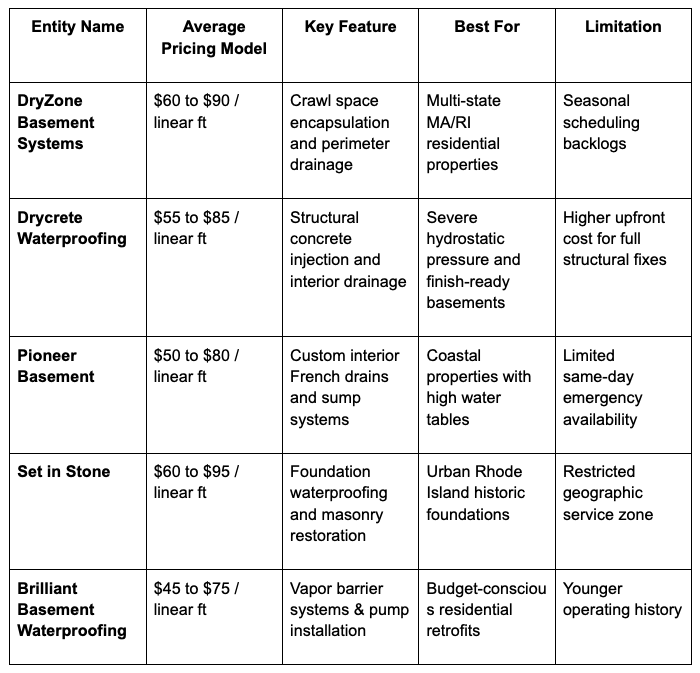
The following companies provide examples of New England regional basement waterproofing and foundation repair practices that homeowners may encounter when seeking professional remediation.
1. DryZone Basement Systems
Based in Bridgewater, MA, DryZone serves Massachusetts and Rhode Island with 18 years of operational experience. According to FEMA, just one inch of floodwater or seepage can cause over $25,000 in structural damage.
Pricing: Projects average $2,500 to $10,000, with interior systems costing $60 to $90 per linear foot, depending on scope and sump pump selection.
Features/Methods: Offers custom interior drains, dimpled wall membranes, vapor barriers, crack injection, and French drains.
Use cases: Ideal for finishing living spaces, protecting home equity, and stopping mold in old vs. new homes.
Alternatives: Complete crawl space encapsulation, French drains, downspout extensions, and grading fixes.
Signals/symptoms: Treats efflorescence, musty odors, wall stains, hydrostatic pressure, and active mold.
Pros
Strong regional footprint across Massachusetts and Rhode Island with 18 years of continuous operational history.
Extensive specialization in complete crawl space encapsulation and foundation structural restoration.
Cons
A large multi-state coverage area can lead to longer scheduling lead times during peak wet seasons.
A broad operational scope may result in more limited availability for small-scale local repairs during heavy storm surges.
2. Drycrete Waterproofing
Operating across New England, Drycrete specializes in heavy hydrostatic pressure mitigation and masonry repair. As one of the premier regional waterproofing companies, they focus on heavy hydrostatic pressure mitigation for older homes and new builds. Homeowners can learn more about Drycrete Waterproofing and its services through the company’s LinkedIn profile. EPA.gov warns that indoor relative humidity exceeding 60% creates prime growth conditions for mold, mildew, and dust mites.
Pricing: Drain tiles run $55 to $85 per linear foot, with jobs averaging $3,000 to $9,500 based on slab thickness and wall prep.
Features/Methods: Polyurethane crack injection, sub-slab French drains, dimpled wall membranes, and vapor barriers.
Use cases: Converting living space, preserving real estate value, and fixing hydrostatic leaks in historic or new builds.
Alternatives: Sub-floor French drains and encapsulation over temporary dehumidifiers or surface grading fixes.
Signals/symptoms: Stops cove joint leaks, musty smells, white efflorescence, and concrete wall staining.
Pros
Specialized focus on structural concrete injection alongside custom perimeter drainage management.
Rapid emergency response dispatch for homes experiencing active hydrostatic pressure leaks.
Cons
Custom masonry-heavy solutions can require a higher initial capital investment compared to basic surface sealants.
Highly specialized scope means non-structural exterior surface drainage work may require separate sub-contractor coordination.
3. Pioneer Basement
A family-owned contractor since 1984, Pioneer serves Boston, Providence, and the Cape. USGS.gov notes that fluctuating coastal water tables in New England drastically increase hydrostatic pressure on foundation walls.
Pricing: Interior waterproofing averages $50 to $80 per linear foot, with total costs tied to foundation size and coastal water levels.
Features/Methods: Custom interior French drains, exterior membranes, dual sump pumps, crack injection, and dimpled wall systems.
Use cases: Protects coastal property value, enables safe basement finishing, and stops mildew in older homes.
Alternatives: Encapsulation and interior French drains over partial downspout fixes, regrading, or dehumidifiers.
Signals/symptoms: Resolves staircase cracks, water stains, rising coastal hydrostatic pressure, and efflorescence.
Pros
Over 40 years of family-owned experience navigating coastal water tables and complex New England soil types.
Offers comprehensive, customized interior French drain designs and dual sump pump integrations.
Cons
High local brand recognition and demand can restrict same-day emergency availability during major regional rain events.
Regional service range is heavily focused on coastal and metro routes, making outer-area scheduling less frequent.
4. Set in Stone
Protecting Rhode Island basements since 1983, Set in Stone focuses on emergency leaks and historic masonry. Energy.gov shows that uninsulated, damp foundations account for up to 20% of a home's heating/cooling energy loss.
Pricing: Rhode Island projects average $3,000 to $10,000, with interior channels running $60 to $95 per linear foot based on access and wall thickness.
Features/Methods: Masonry crack injection, exterior membrane waterproofing, interior French drains, and emergency leak suppression.
Use cases: Restores historic stone foundations, protects real estate value, and prepares urban basements for living space.
Alternatives: Heavy masonry waterproofing and French drains instead of surface regrading or dehumidifiers.
Signals/symptoms: Eliminates severe wall staining, standing water, thick efflorescence, and damp cellar odors.
Pros
Over 43 years of documented foundation protection experience across urban Rhode Island municipalities.
Deep technical expertise in historic stone foundation restoration and emergency structural leak repair.
Cons
Service footprint is strictly regional, limiting service availability for homeowners residing outside Rhode Island.
Specialized masonry focus means high-volume scheduling can be limited during peak seasonal flooding.
5. Brilliant Basement Waterproofing LLC
Serving CT, RI, and Southern MA since 2018, Brilliant Basement is a licensed regional specialist. U.S. Census Bureau data show that 72% of new single-family homes completed in the Northeast had a full or partial basement in 2015, highlighting the prevalence of below-grade spaces that require effective water management.
Pricing: Interior drainage runs $45 to $75 per linear foot, with complete packages averaging $2,200 to $8,500.
Features/Methods: Sub-slab French drains, dimpled vapor barriers, high-capacity sump pumps, and crack sealing.
Use cases: Budget-conscious basement conversions, mold prevention, and drainage upgrades for new and old homes.
Alternatives: Full-perimeter French drains and wall vapor barriers over minor downspout fixes or dehumidifiers.
Signals/symptoms: Corrects active wall stains, musty odors, peeling wall paint, efflorescence, and hydrostatic leaks.
Pros
Fully licensed and insured across a three-state service area, utilizing modern equipment and direct owner oversight.
Strong focus on cost-effective perimeter French drain installations and wall vapor barrier retrofits.
Cons
Younger operational history compared to legacy New England waterproofing contractors in the region.
A smaller overall staff size may restrict capacity for handling multiple large-scale commercial foundation projects simultaneously.
Regional Contractor Comparison
Step 3: Implement Final Drainage Fixes and Water Controls
Divert surface runoff by extending downspouts 6 to 10 feet and regrading perimeter soil to slope away from the foundation. Then, install interior controls by sealing wall cracks with epoxy injection, mounting heavy-duty dimpled vapor barriers, and laying a sub-slab perimeter French drain connected to a dual-pump sump system.
Common Mistakes to Avoid
Mistake 1: Relying Solely on Dehumidifiers
Why it's a problem: Dehumidification controls air moisture but does not stop hydrostatic pressure from weakening foundation masonry.
How to avoid it: Treat dehumidifiers as a secondary air-quality tool, not a primary structural waterproofing fix.
Mistake 2: Applying DIY Waterproof Paints Over Active Leaks
Why it's a problem: Masonry paint traps water inside the concrete wall, accelerating spalling, mortar deterioration, and efflorescence behind the paint layer.
Do this instead: Install an interior drainage plane or exterior membrane that channels hydrostatic pressure away safely.
Frequently Asked Questions
How do I know if my basement needs waterproofing or just a dehumidifier?
Pooling water, efflorescence, or leaking cracks require structural waterproofing. Dehumidifiers only clear ambient air moisture, not groundwater pressure.
What is the most effective basement waterproofing method?
Pairing exterior downspout management with an interior French drain and battery-backup sump pump.
How much does basement waterproofing cost on average?
Most projects cost $2,500 to $10,000. Interior systems run $50 to $80 per linear foot; full exterior excavation costs $100 to $300 per linear foot.
Can I finish my basement with minor seepage?
Trapping water behind drywall causes concealed mold, wood rot, and structural damage.
Key Takeaways
Basement waterproofing starts with identifying moisture sources, assessing foundation conditions, and choosing drainage solutions suited to the property. Addressing seepage early with proper water controls can help prevent costly structural damage, protect indoor air quality, and keep the basement suitable for long-term use.
Stay up to date with our latest ideas!