How Long Do Kitchen Appliances Really Last? A Lifespan Chart and How to Get More Years Out of Yours
Real-world lifespans for fridges, dishwashers, ranges, washers and dryers, the parts that wear out first, and simple habits that buy you extra years.

Most of us don't think about how old the refrigerator is until the morning the milk comes out lukewarm. Then the questions start piling up. Is it supposed to die at nine years old? Is it worth fixing? Did we do something wrong?
The short answer is that most major appliances are built to last somewhere between eight and fifteen years. The longer answer is more useful, because "how long it lasts" depends a lot on which part gives out first, and whether anyone bothers to replace it.
Typical lifespans, appliance by appliance
The numbers below are ranges pulled together from manufacturer data, trade groups like the Association of Home Appliance Manufacturers, and the home-lifespan studies that home inspectors have quoted for years. Treat them as a rough guide, not a countdown timer. A dishwasher in a house with hard water and two loads a day lives a very different life from one in a vacation cabin.
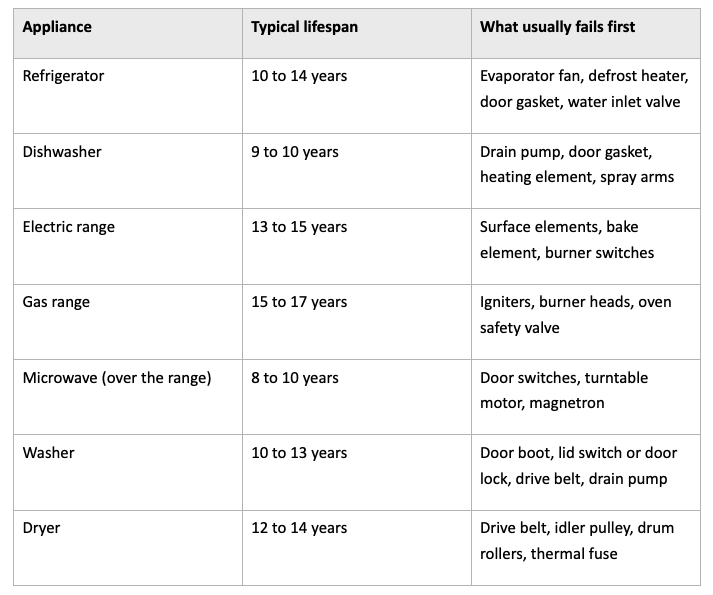
Notice something about the right-hand column. Almost none of those are the "heart" of the machine. A refrigerator rarely dies because the compressor gives up at year eight. Far more often, a $40 fan motor quits, the fridge stops cooling properly, and the whole unit gets hauled to the curb because nobody knew the fix was that small.
Why modern appliances seem to die younger
If it feels like your parents' fridge ran for 25 years and yours is struggling at 10, you're not imagining it. Today's appliances carry more electronics: control boards, sensors, variable-speed motors, touch panels. They're far more energy efficient than the old workhorses, but there are simply more components that can fail, and some of them are sensitive to power surges, humidity and heat.
Heavier use plays a part too. Families cook at home more, run the dishwasher daily and wash smaller loads more often. None of that is bad, it just adds up.
The upside is that most of these failures are modular. A control board, a pump or a gasket is designed to come out and a new one to go in. That was far less true 40 years ago.
Small habits that add real years
You don't need to become a repair technician. A handful of boring, five-minute habits do most of the work.
Refrigerator
Vacuum the condenser coils once or twice a year. On most fridges they sit behind a kick plate at the bottom or on the back. When those coils are packed with dust and pet hair, the compressor runs longer and hotter, and heat is what wears it out.
While you're down there, check the door gaskets. Close the door on a dollar bill. If it slides out with no resistance, the seal is leaking cold air and the fridge is working overtime. Gaskets are cheap, and swapping one is usually a screwdriver job.
Keep the fresh food section at or below 40°F and the freezer at 0°F, which is what the FDA recommends for food safety anyway. Setting it colder than that doesn't help food and does make the system work harder.
Dishwasher
Clean the filter. A surprising number of people don't know their dishwasher has one. It's usually a round or cylindrical piece at the bottom of the tub that twists out. A clogged filter makes the drain pump strain and leaves grit on your glasses. Once a month is plenty for most households.
If you have hard water, run an empty cycle with a dishwasher cleaner every so often and use a rinse aid. Mineral buildup is hard on heating elements and spray arm holes.
Range and oven
Skip the self-clean cycle right before a holiday dinner. The cycle runs extremely hot, and it's a classic moment for a thermal fuse, a control board or a bake element to give out, usually the day before 14 people show up. Wipe spills early instead, and save self-clean for when you actually need it.
On gas ranges, keep burner ports clear with a straightened paper clip or a soft brush. A weak, uneven or yellow flame usually means a clogged port or a burner cap that isn't seated right.
Microwave
Don't run it empty, and don't slam the door. Door switches are one of the most common failures on over-the-range models, and they take a beating every time the door gets shut hard.
Washer and dryer
Leave the front-loader door and detergent drawer open between loads so the rubber boot can dry out. Mold eats those boots. For the dryer, clean the lint screen every load and have the vent duct cleaned out at least once a year. It helps the dryer last longer, and it's a major fire-safety issue too.
When a part fails: repair it or replace the whole thing?
A lot of people use the 50 percent rule: if the repair costs more than half the price of a comparable new appliance, replace it. It's a decent starting point, but it misses a few things.
First, the age matters as much as the price. A $150 repair on a four-year-old fridge is a no-brainer. The same repair on a 14-year-old unit that's near the end of its expected life is a harder call.
Second, many repairs cost far less than people assume, especially when you do the work yourself. Door gaskets, dishwasher pumps, dryer belts, range igniters and refrigerator water filters are all common DIY jobs with plenty of video tutorials available. The part itself is often the smallest piece of the bill. The service call is what gets expensive.
Third, replacement isn't free for the planet. A working appliance that needs one part is still a working appliance.
If you decide to fix it, the most important step is getting the exact part for your specific model. Find the model number first. On most refrigerators it's on a sticker inside the fresh food compartment, on a side wall or the ceiling. Dishwashers usually have it on the edge of the door or the tub. On ranges, check behind the storage drawer or around the oven door frame. Take a photo of the sticker so you don't have to crawl back down there later.
With that number in hand, you can look up the exact appliance parts your unit needs. Stick with OEM parts, meaning ones made by or for the original manufacturer, whenever you can. They cost a little more than generic versions, but they fit the way they're supposed to, and they won't void what's left of your warranty.
A quick maintenance calendar
If you like having it all in one place, here's a simple schedule to stick on the inside of a cabinet door:
Every month: clean the dishwasher filter, wipe the fridge door gaskets, check the washer door boot for mold.
Every three months: clean the range hood grease filters, check gas burner flames, deep-clean the microwave.
Every six months: vacuum the refrigerator condenser coils, replace the fridge water filter if yours has one, run a dishwasher cleaner cycle.
Once a year: have the dryer vent cleaned out, check washer fill hoses for bulges or cracks, look over the power cords and plugs on all your major appliances.
Frequently asked questions
What is the average lifespan of a refrigerator?
Most refrigerators last 10 to 14 years. Simpler top-freezer models tend to reach the high end of that range, while side-by-side and French-door models with ice makers and dispensers carry more parts that can fail.
Which kitchen appliance breaks down the most?
Dishwashers and over-the-range microwaves are usually the first to go, often somewhere around the nine-year mark. Water, heat and constant door use are hard on both.
Is it worth fixing a 10-year-old appliance?
Often, yes, if the problem is a single worn part and the rest of the unit is in good shape. Look at the repair cost, the appliance's age compared to its expected lifespan, and whether it's had repeated problems before.
Do OEM parts really make a difference?
For anything related to safety, heat or water, such as heating elements, gas valves, thermal fuses and inlet valves, OEM parts are the safer choice. They're made to the original specifications, so fit and performance are predictable.
The bottom line
Appliances don't come with an expiration date. Most of them die a little at a time, one fan, gasket or switch at a time, and many of those failures are cheap and fixable. Keep the coils clean, keep the filters clear, write down your model numbers, and your kitchen will likely outlast the averages in that chart.
Stay up to date with our latest ideas!