Bookmatched Marble and Quartzite Feature Walls for Luxury Interiors
Explore bookmatched marble and quartzite feature walls that bring dramatic veining, symmetry, texture, and timeless luxury to sophisticated interiors.
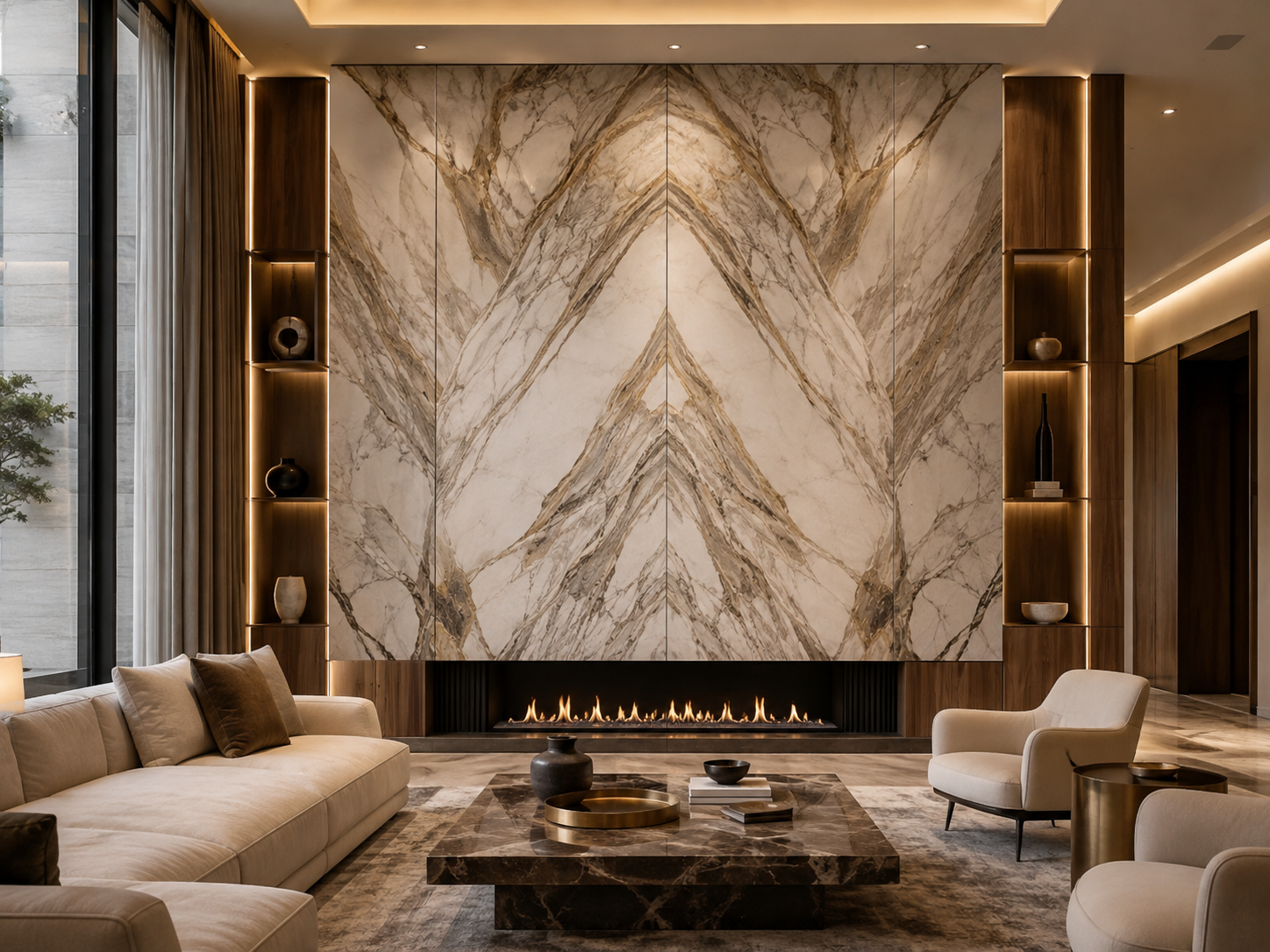
Luxury interior design is often associated with expensive furniture, custom lighting, and carefully selected finishes, but one of the most powerful ways to transform a room is much simpler: choose one material with enough natural character to become part of the architecture.
A bookmatched stone feature wall can do exactly that.
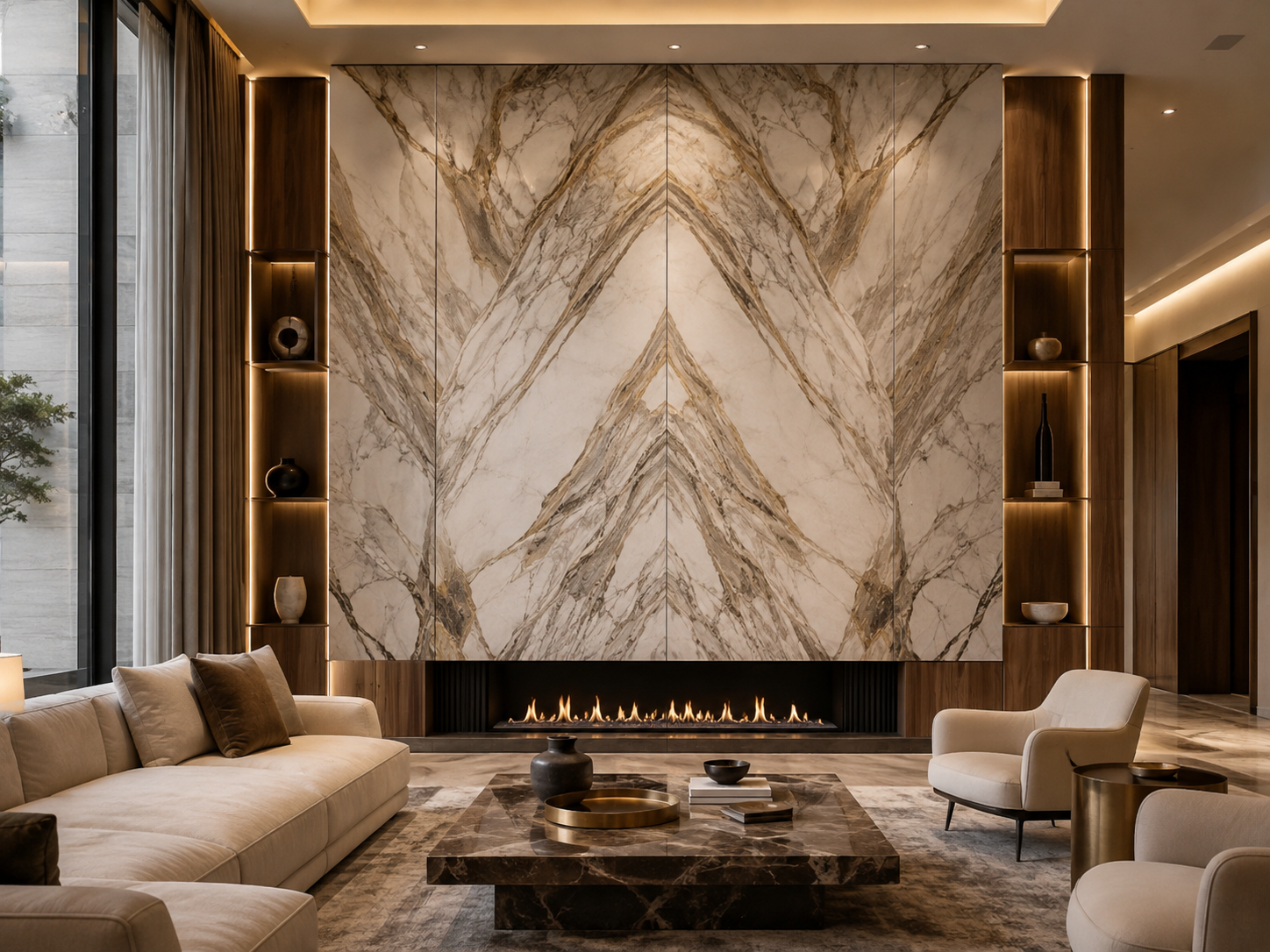
Rather than covering a room with multiple patterns and decorative finishes, bookmatching uses the natural movement of marble or quartzite to create a large symmetrical composition. When two or more slabs are carefully selected, cut, and positioned, veins and mineral patterns can mirror each other across the wall.
The result can resemble a piece of oversized abstract artwork.
This technique is especially effective in luxury living rooms, fireplaces, bathrooms, hotel-style bedrooms, entrances, dining areas, and other spaces where a strong visual focal point is desirable.
However, a successful bookmatched wall depends on much more than finding a dramatic slab.
Stone selection, slab sequence, pattern direction, wall dimensions, joints, lighting, fabrication, surrounding materials, and installation all affect the final appearance.
A beautiful slab can produce an average wall if the layout is poorly planned.
A carefully planned installation, on the other hand, can turn natural stone into one of the defining architectural features of a home.
What Is a Bookmatched Stone Wall?
Bookmatching is a layout technique in which adjacent stone slabs are arranged so their patterns mirror one another.
Imagine opening the pages of a book.
The left and right pages create a symmetrical relationship around the center.
Stone can create a similar effect.
When slabs are cut sequentially from the same block, neighbouring faces may contain related geological patterns. By opening and positioning them beside each other, designers can create mirrored veins, mineral clouds, and color movement.
Depending on the project, bookmatching may use:
two slabs;
four slabs;
several coordinated panels.
A two-slab composition is common for fireplaces and smaller feature walls.
Four slabs may be used when a larger wall requires greater width or height.
More complex installations can extend the pattern across an entire lobby, bathroom, entrance, or entertainment wall.
Why Bookmatched Stone Creates Such Strong Visual Impact
Natural stone already contains movement.
Bookmatching organizes that movement into a deliberate composition.
Instead of seeing random veins across separate panels, the eye sees symmetry.
This creates several visual effects.
It Establishes a Clear Focal Point
A large mirrored pattern immediately attracts attention.
This makes bookmatching particularly effective in rooms where designers want one dominant architectural feature.
It Makes Stone Feel More Intentional
Randomly installed slabs may still be attractive, but a planned layout shows that the material has been treated as part of the design rather than simply installed as a finish.
It Creates Scale
A dramatic stone composition can make a wall feel larger and more architectural.
This is particularly effective in rooms with high ceilings.
It Reduces the Need for Additional Decoration
A strong stone wall often requires very little artwork.
The natural pattern performs that role.
This makes bookmatching compatible with contemporary interiors where designers prefer fewer, stronger elements rather than many decorative objects.
Marble Is a Natural Choice for Bookmatched Walls
Marble has been used in architecture for centuries, but bookmatching allows it to feel particularly relevant in modern interiors.
The technique works especially well with stones that contain strong directional veins, broad mineral movement, or clear contrast between the background and pattern.
Depending on the design direction, carefully selected marble slabs can create anything from a restrained white-and-grey composition to a dramatic black, green, brown, gold, or strongly veined feature wall.
Light Marble for Quiet Luxury
White, cream, and pale grey marble can create sophisticated interiors without making the space feel visually heavy.
These materials work particularly well with:
oak;
walnut;
cream upholstery;
bronze;
brass;
black accents;
neutral plaster walls.
A mirrored grey vein across a white background can create enough movement to define the room while still maintaining a calm overall palette.
Dark Marble for Stronger Drama
Black, dark grey, deep green, and brown marble create a more theatrical effect.
They can be especially effective in:
bars;
dining rooms;
fireplaces;
luxury powder rooms;
entertainment areas.
Dark stone has greater visual weight, so surrounding materials should generally remain simpler.
Where Should You Use a Bookmatched Feature Wall?
Not every wall needs dramatic stone.
Bookmatching works best where the installation can be seen clearly and where the architecture gives the pattern enough room.
Several applications are particularly effective.
Fireplace Feature Walls
A fireplace is one of the most natural locations for bookmatched stone.
The fireplace opening creates a central architectural axis, making symmetrical patterns particularly effective.
A floor-to-ceiling stone wall can make the fireplace feel integrated into the architecture rather than added afterward.
Before fabrication, designers should consider:
fireplace dimensions;
center line;
television placement;
mantel design;
stone joints;
ceiling height.
If a television will be mounted above the fireplace, the slab layout should be reviewed with the screen position in mind.
A strong vein may otherwise disappear behind the television.
Living Room Feature Walls
Large living rooms can benefit from a dramatic stone installation behind a sofa, television, console, or fireplace.
However, the wall should usually become the main visual statement.
If the room already contains:
patterned flooring;
bold artwork;
dramatic furniture;
highly figured timber;
another strong pattern may create too much competition.
Bookmatching works best when it is allowed to lead.
Luxury Bathrooms
Bathrooms provide excellent opportunities for bookmatched stone because relatively small rooms can still contain large uninterrupted wall areas.
Potential locations include:
behind a freestanding bathtub;
behind a vanity;
inside a large shower;
opposite the bathroom entrance.
A bookmatched wall can make the bathroom feel closer to a luxury hotel or spa.
However, the installation must also consider:
waterproofing;
plumbing;
niches;
mirrors;
faucets;
lighting;
cleaning requirements.
The strongest part of the stone should not accidentally disappear behind a large mirror or cabinet.
Entrance and Foyer Walls
The entrance establishes the first impression of a home.
A stone wall can introduce the material language immediately.
For example, a bookmatched marble or quartzite wall may connect visually with:
stone flooring;
kitchen surfaces;
stair details;
fireplace materials.
This creates continuity throughout the home.
Dining Areas
Bookmatched stone can create an elegant backdrop behind a dining table.
Warm lighting is especially important here.
Pendant lights, concealed lighting, or wall washers can highlight the mineral movement after sunset.
Bedrooms
Stone feature walls are less common in bedrooms but can work very well when carefully controlled.
The best approach is generally to combine stone with softer materials.
For example:
Bookmatched stone + upholstered bed + timber + warm textiles
creates more balance than using hard surfaces throughout the room.
Quartzite Can Create an Even More Dramatic Statement
Marble may be the classic bookmatching material, but quartzite offers a different type of visual energy.
Some quartzite varieties contain:
strong linear movement;
blue or green mineral areas;
crystalline sections;
gold veins;
dramatic clouds;
contrasting dark patterns;
translucent areas.
Because of this geological complexity, exotic quartzite can be particularly effective when a feature wall needs to become the dominant artwork within a luxury interior.
When Quartzite Makes Sense
Consider quartzite when:
stronger natural movement is desired;
the wall is large enough to display the full slab pattern;
the surrounding architecture is relatively restrained;
the project needs a distinctive natural material;
unusual colors are part of the design concept.
A highly expressive quartzite wall can transform a simple room.
But it can also overwhelm a crowded one.
The more dramatic the stone, the simpler the surrounding design should usually become.
Marble or Quartzite: Which Is Better for Bookmatching?
There is no universal winner.
The decision depends on the desired atmosphere.
Choose Marble When:
classical elegance is important;
softer veining is preferred;
the room needs timeless rather than highly expressive character;
white, grey, black, green, or traditional stone colors suit the palette.
Choose Quartzite When:
stronger visual movement is desired;
unusual colors are important;
the stone should become the main artwork;
the interior architecture is simple enough to support a dramatic surface.
A calm white marble and a dramatic blue-green quartzite can both create successful walls.
They simply communicate different moods.
Full Slab Selection Is Essential
A small sample is almost useless for planning a bookmatched installation.
Bookmatching depends on the complete pattern.
Designers need to understand:
where the veins begin;
where they travel;
how they connect;
where color concentration occurs;
which areas should form the center;
how neighbouring slabs relate.
Always review complete slab images or actual slabs before fabrication.
If possible, select sequential slabs.
This increases the chance that patterns will form a coherent mirrored arrangement.
Decide the Center Line First
Every bookmatched wall needs a visual center.
This may align with:
the center of a fireplace;
the center of a bathtub;
the center of a console;
the center of a room;
an architectural opening.
Once the center line is established, the slab layout can be built outward.
This creates stronger symmetry.
A wall can look strangely unbalanced when the bookmatch center sits slightly to one side of the room's architectural center.
The difference may only be a few centimeters, but highly symmetrical patterns make alignment errors more visible.
Consider Wall Dimensions Before Choosing the Slabs
A beautiful bookmatched pair may still be unsuitable if the proportions do not match the wall.
Suppose two slabs together measure less than the required width.
The design may require:
additional side panels;
a four-slab arrangement;
another material around the perimeter.
Likewise, slab height matters.
If the wall is significantly taller than the slab, the designer must decide how horizontal joints will be handled.
Good planning starts with:
finished wall width;
finished wall height;
openings;
sockets;
fireplaces;
televisions;
doors;
built-in cabinetry.
Only then should the final slab layout be approved.
Four-Slab Bookmatching for Larger Walls
Larger feature walls may require four slabs.
This creates more layout possibilities.
The slabs may form:
one large symmetrical composition;
two mirrored pairs;
a repeating pattern.
Four-slab designs are visually powerful but more difficult to coordinate.
The central intersection must be carefully reviewed.
If strong veins meet awkwardly, the composition can feel fragmented.
Digital layout before cutting becomes particularly valuable.
Vein Direction Changes the Mood
Not all bookmatching patterns produce the same visual effect.
Vertical Movement
Vertical veins emphasize height.
They work especially well in:
tall foyers;
fireplaces;
double-height spaces.
Horizontal Movement
Horizontal patterns emphasize width.
They can make a wall feel broader.
Diagonal Movement
Diagonal veins create more energy and drama.
They work well in contemporary statement interiors.
Cloud-Like Movement
Broad mineral areas can create softer symmetry.
This may be more suitable for bedrooms, spas, and calm living rooms.
The best pattern depends on the architecture.
Lighting Should Be Designed With the Stone
Lighting can completely change a bookmatched wall.
Natural stone contains subtle colors and mineral details that may disappear under poor lighting.
Several lighting strategies can work.
Wall Washers
Wall-washing light creates even illumination across the surface.
This is useful when the full pattern should be visible.
Concealed Lighting
LED strips can emphasize the perimeter of the stone and make the wall feel more architectural.
Spotlights
Directional lighting can highlight particular mineral details.
But too many strong hotspots can make polished stone difficult to view.
Natural Light
Daylight can reveal color variation that artificial lighting may hide.
If the wall sits opposite large windows, reflections should be considered when choosing the finish.
Polished or Honed?
Finish affects the visual character.
Polished Stone
Polishing increases reflection and usually makes colors and veins appear stronger.
Use polished finishes when:
the project needs more drama;
the room can control reflections;
mineral depth is an important feature.
Honed Stone
Honed finishes reduce shine.
They can make dramatic slabs feel calmer and more contemporary.
Choose honed surfaces when:
the surrounding palette is matte;
the interior uses timber and plaster;
quiet luxury is more important than formal shine.
The same slab can feel completely different under these two finishes.
Match Bookmatched Stone With Wood
Natural wood is one of the strongest companion materials for bookmatched stone.
Wood adds warmth and visual softness.
White or Grey Marble
Pairs well with:
oak;
walnut;
warm brown timber.
Green Stone
Works especially well with:
walnut;
dark oak;
bronze details.
Beige Quartzite
Can complement:
white oak;
cream upholstery;
warm plaster.
Dramatic Dark Stone
Often benefits from lighter timber or softer textiles to prevent the room from becoming too heavy.
Use Metal Sparingly
Metal can reinforce the luxury character of a stone installation.
Common choices include:
brass;
bronze;
blackened steel;
stainless steel.
A simple metal trim, light fixture, or furniture detail is often enough.
Avoid surrounding a highly dramatic wall with excessive metallic decoration.
Let the stone remain the main feature.
Furniture Should Not Hide the Pattern
This sounds obvious, but it is frequently overlooked.
Before approving the slab layout, overlay the actual furniture plan.
Check:
sofa height;
console dimensions;
television size;
headboard height;
dining furniture;
artwork.
There is little benefit in paying for a spectacular central vein if 60 percent of it will be hidden behind furniture.
The most important stone movement should remain visible from the primary viewing position.
Think About the Main Viewing Angle
People do not experience a wall as a flat drawing.
They approach it from different directions.
For example, a feature wall may first appear:
from the entrance;
from a staircase;
from the kitchen;
from the seating area.
Ask:
From where will most people first see the wall?
This can influence slab orientation.
The strongest portion of the composition should generally face the most important viewpoint.
Bookmatching Requires Accurate Fabrication
Stone fabrication turns the design into physical pieces.
Small errors can become extremely visible in symmetrical layouts.
Fabricators need accurate information about:
dimensions;
sequence;
joint positions;
orientation;
edge details;
openings.
Every panel should be clearly numbered.
Rotating one piece during installation can destroy the intended pattern.
This is why bookmatched walls require better coordination than ordinary cladding.
Joint Width Matters
Bookmatching creates visual continuity, but physical joints still exist.
Joint placement should align with the composition whenever possible.
Very inconsistent joints can interrupt the pattern.
Designers should also avoid assuming that the finished installation will look like one completely seamless slab.
Natural stone panels still need realistic installation tolerances.
The objective is visual continuity, not an impossible absence of joints.
Common Bookmatching Mistakes
1. Selecting Slabs From Small Samples
Bookmatching depends on the full geological pattern.
Always review complete slabs.
2. Choosing the Stone Before Measuring the Wall
Wall dimensions determine how many slabs are required.
3. Ignoring Furniture and Fixtures
Mirrors, televisions, vanities, and fireplaces can hide the best part of the pattern.
4. Using Dramatic Stone in an Already Busy Interior
More pattern does not automatically mean more luxury.
5. Planning the Layout After Fabrication
This is one of the most expensive mistakes.
Layout should be approved first.
6. Ignoring Lighting
Poor lighting can make spectacular stone look flat.
7. Forgetting Panel Identification
Large installations need clear numbering and orientation instructions.
A Simple Decision Framework
Use the following logic before committing to a bookmatched wall.
If the Room Already Contains Strong Patterns
→ Choose a calmer stone.
If the Room Is Minimal and Needs One Focal Point
→ Consider dramatic marble or quartzite.
If Timeless Elegance Is the Goal
→ Consider marble.
If Strong Geological Movement Is the Goal
→ Consider exotic quartzite.
If the Wall Is Very Large
→ Review whether two or four slabs provide the best layout.
If There Is a Fireplace or Bathtub
→ Align the bookmatch center with the architectural element.
If the Stone Is Highly Reflective
→ Test the lighting before finalizing the finish.
If Furniture Hides Much of the Wall
→ Reconsider the layout or choose another location.
Is Bookmatching Worth the Extra Planning?
For an ordinary background wall, probably not.
Bookmatching makes the most sense when the surface has architectural importance.
It adds value when:
the wall is highly visible;
the stone has suitable movement;
the project values custom design;
fabrication can be carefully controlled;
the surrounding interior supports the material.
It is less useful when:
most of the wall will be hidden;
the stone has little directional pattern;
the room already contains many competing features;
budget does not allow proper slab selection and layout planning.
Bookmatching should therefore be intentional rather than automatic.
Final Recommendation: Treat the Wall as One Composition
The best bookmatched stone walls do not look like several slabs installed beside one another.
They look like one composition.
Achieving that result requires coordination from the earliest design stage.
Measure the wall first.
Choose slabs that suit its proportions.
Identify the center line.
Review the complete pattern.
Plan furniture, fixtures, fireplaces, televisions, and lighting.
Approve the layout before cutting.
Coordinate fabrication and installation carefully.
And most importantly, give the stone enough visual space.
A dramatic feature wall does not need many competing decorations around it.
The geological pattern already provides color, movement, texture, and individuality.
Marble can create timeless symmetry.
Quartzite can introduce extraordinary natural energy.
Both can transform a room when used intentionally.
Luxury interior design is rarely about using the greatest quantity of expensive material.
It is about knowing where one exceptional material will have the greatest effect.
A well-planned bookmatched wall demonstrates that principle perfectly.
Frequently Asked Questions
1. What does bookmatched marble mean?
Bookmatched marble refers to adjacent marble slabs arranged so that their natural veins and patterns mirror one another.
The technique creates a symmetrical composition similar to opening the pages of a book.
It is commonly used for fireplaces, bathrooms, living-room walls, entrances, and other luxury feature surfaces.
2. Is marble or quartzite better for a feature wall?
Both can work extremely well.
Marble is often chosen for timeless veining and classical elegance, while quartzite may offer stronger geological movement, more unusual colors, and dramatic mineral patterns.
If the goal is refined, timeless luxury → consider marble.
If the goal is a stronger natural statement → consider quartzite.
The actual slab matters more than the material name alone.
3. How many slabs are needed for a bookmatched wall?
It depends on the wall dimensions and slab sizes.
A smaller feature wall or fireplace may require two slabs.
Larger walls may require four slabs or more.
The correct quantity should be determined after measuring the finished wall and reviewing the available slab dimensions.
4. Where should the center of a bookmatched wall be?
The center usually works best when aligned with an important architectural feature, such as:
a fireplace;
bathtub;
vanity;
console;
television;
center of the wall.
Strong symmetry makes alignment very noticeable, so the center should be confirmed before fabrication.
5. Are bookmatched stone walls expensive?
They can cost more than simple stone cladding because the project may require sequential slabs, careful material selection, digital layout, additional fabrication planning, and more precise installation.
However, the visual impact can also be much greater.
If the wall is an important focal point → the additional planning can be worthwhile.
If the wall is mostly hidden or intended only as a background surface → conventional stone layout may provide better value.
Stay up to date with our latest ideas!