How to Attract Birds to Your Yard: Design it in Layers
Learn how to attract birds to your yard by designing layered spaces with native plants, shelter, water, food sources, and safe nesting areas.

A yard full of birds is less about the feeder you buy and more about what surrounds it. Birds are cautious shoppers. They want food they can reach safely, water they can drink without being ambushed, somewhere to hide when a hawk passes over, and, in spring, somewhere to raise young. Give them all four and they will come back daily. Give them only a feeder on a bare lawn and you will mostly host whatever is bold enough to risk it.

Start by watching who already visits
Before you plant or buy anything, find out what you are working with. The birds already passing through tell you what your area supports and what is missing. A yard that only gets house sparrows and starlings is usually short on cover. A yard with woodpeckers but no finches is often short on seed-bearing plants.
Watching takes patience, and most activity happens at dawn while you are making coffee. That is why camera feeders have caught on with gardeners. Some of the Birdfy smart bird feeders record a clip each time a bird lands and, on the AI plan, name the species, so after a couple of weeks you have a real list of your visitors rather than a hunch. It also turns the design process into something you can measure: plant a shrub border, and see whether new species turn up.
Plant in three layers, not one
Most suburban yards are one layer: lawn. Birds live in three.
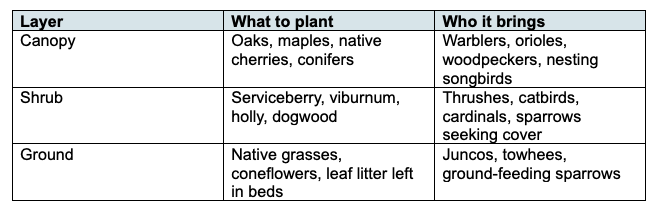
The trick is to let the layers touch. A shrub border that steps down to perennials and then to lawn gives birds a protected route in and out. An island bed in the middle of open grass does not.
Native plants carry most of the weight here, because they host the insects songbirds feed their chicks. Even seed-eating birds raise their young largely on caterpillars. The Audubon native plants database gives a list matched to your zip code, which saves guessing which natives actually suit your region.
If you are starting from a blank plot, the same principles that give a new-build garden more character apply: height, structure and a few mature focal plants make the biggest difference in the first season.
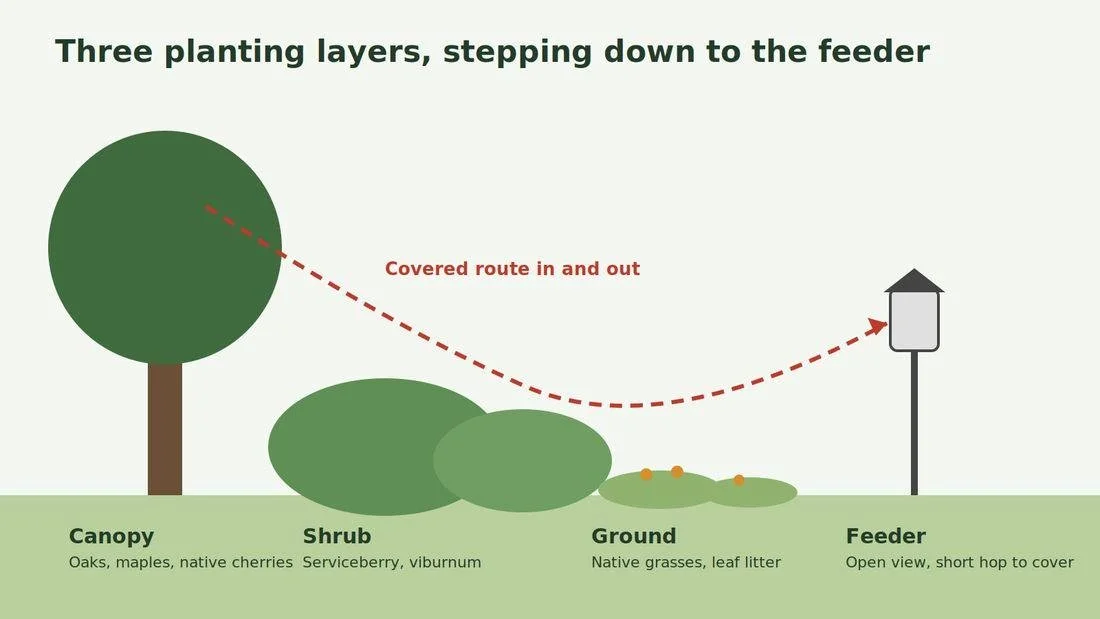
Layers that step down gradually give small birds cover all the way from the tree line to the feeder.
Add water, and keep it moving
Water is often the thing that tips a yard from visited to lived in. Birds need it for drinking and bathing year round, and in dry spells or hard frosts it can be harder to find than food.
Keep it shallow. One to two inches at the deepest point is plenty for songbirds.
Give it a rough surface. A few flat stones help birds keep their footing.
Place it near cover, not in it. A few feet from a shrub gives an escape route without giving a cat a hiding place.
Change it often. Every two or three days in warm weather stops algae and mosquitoes.
Add movement. A dripper or small solar fountain catches birds' attention from much further away than still water.
Match the feeder to the bird
Different birds feed in different ways, so one feeder type brings one crowd.
Tube feeders with small ports suit finches and chickadees.
Hopper and platform feeders serve cardinals, grosbeaks, jays and doves.
Suet cages draw woodpeckers, nuthatches and wrens, especially in winter.
Nectar feeders are for hummingbirds and orioles.
Black oil sunflower seed is the closest thing to a universal food. Cheap mixes padded with milo and red millet tend to get thrown on the ground, which draws rodents.
Place the feeder where birds feel safe
Placement matters as much as the feeder itself. Birds want a clear view of approaching predators and a short dash to shelter.
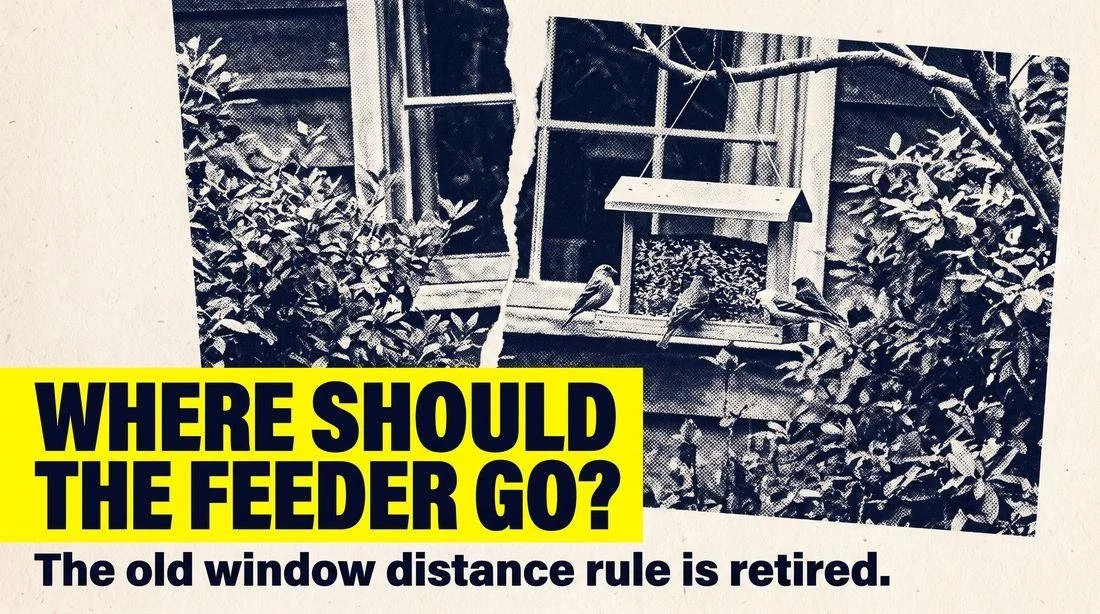
For years the standard advice was to keep feeders either very close to windows or far away from them. The Cornell Lab of Ornithology has since dropped that rule. Its current guidance on why birds hit windows and how to prevent it is to make any nearby windows bird friendly and stop worrying about the distance. Markings need to go on the outside of the glass, spaced about 2 inches apart, to break up the reflection.
Beyond that:
Keep feeders within a short flight of shrubs or trees, but not so tucked in that a cat can lie in wait.
Mount feeders on a pole with a baffle if squirrels are winning.
Spread several feeders out rather than clustering them, which cuts down on squabbles and disease.
Leave the yard a little untidy
The final step is the easiest and the hardest to accept: do less. Seed heads left standing through winter feed goldfinches and sparrows. A pile of brush in a back corner shelters wrens and gives ground birds somewhere to hide. Leaf litter under shrubs is where towhees and thrushes forage for insects. A dead branch left on a tree, if it is safe, becomes a perch and sometimes a nest site for woodpeckers.
A perfectly manicured yard looks finished to people. To a bird it looks like a car park. The yards that fill with birds are the ones that look slightly wild at the edges, and that is a design choice worth making on purpose.
Stay up to date with our latest ideas!