What Homeowners Get Wrong About Whole House Water Filters
Learn what homeowners often get wrong about whole house water filters, from maintenance and sizing to water quality, performance, and long term benefits.

Most homeowners buy a whole house water filter once. They research it for a few weeks, pick a system, install it, and then largely forget about it. That is actually how it should work. The problem is the research phase tends to focus on the wrong things, which leads to buying decisions that make sense on paper but create headaches down the road.
Before pulling the trigger on a system last year, I spent a few weeks going deep on what ownership actually looks like beyond the product listings. One thing that stood out was real maintenance data published by Quality Water Lab from three years of running a carbon filter on a residential city water system. Annual upkeep around $40. Sediment filter replacement needed at roughly the eight month mark. That kind of specific, time-tested data is rare and it changed how I thought about the whole category.
Here is what else I learned along the way.
Buying for the Wrong Water Source
The single biggest mistake is buying a system designed for one type of water and installing it on another.
City water and well water are fundamentally different problems. City water has chlorine, chloramine, disinfection byproducts, and the occasional PFAS concern depending on where you live. A catalytic carbon system handles all of that well. It does not handle iron, sulfur, manganese, or bacteria, which are well water problems.
A homeowner on a private well who buys a carbon-only system because it ranked well in a review roundup is going to be disappointed. The water will taste better. The iron staining will continue. The showerhead will still clog. The filter was just solving the wrong problem.
Test your water before buying anything. A basic lab panel runs $50 to $150 and tells you exactly what you are dealing with. That information changes everything about which system makes sense.
Underestimating the Sediment Pre-Filter
Tank-based whole house systems are marketed as low maintenance, and on a clean water source they genuinely are. But that low maintenance promise depends entirely on the sediment pre-filter doing its job.
The sediment filter sits upstream of the main carbon tank. Its job is to catch particles before they reach the media bed. When it loads up and nobody replaces it, two things happen. Flow rate drops noticeably and the carbon tank starts seeing debris it was never designed to handle.
On city water a sediment filter typically needs replacing every six to nine months. On well water with any sediment load that can shorten to three or four months. The filter itself costs $5 to $15. Ignoring it for a year costs flow rate, media life, and eventually the tank.
Set a calendar reminder. It is the cheapest maintenance task on the system and the most commonly skipped.
Tank Systems vs Cartridge Systems
These are not the same category and the cost difference over five years is significant.
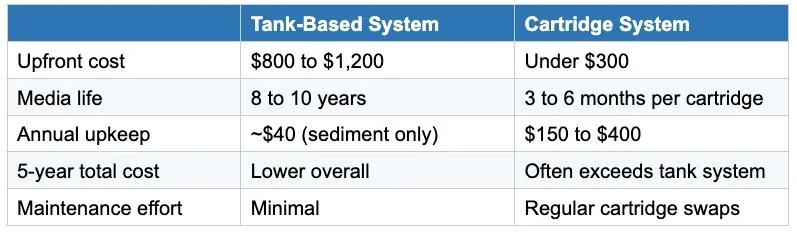
The decision comes down to how long you plan to stay in the house and how much you want to interact with the system. A tank system installed correctly mostly disappears. A cartridge system asks for attention on a regular schedule.
Getting the Flow Rate Wrong
Flow rate is measured in gallons per minute and it matters more than most buyers realize. A system rated for 9 GPM installed in a four bathroom home with high simultaneous demand is going to cause noticeable pressure drop when multiple fixtures run at once.
A rough calculation for peak demand in most homes:
Shower: approximately 2 GPM
Dishwasher: approximately 1.5 GPM
Clothes washer: approximately 1.5 to 2 GPM
Kitchen faucet: approximately 1.5 GPM
Add up the fixtures that realistically run at the same time in your house and make sure the filter's rated flow covers it with room to spare. Undersizing a whole house filter is one of those decisions that feels fine at installation and becomes a daily frustration six months later.
Expecting the Filter to Do Everything
A whole house carbon filter removes chlorine, chloramine, VOCs, and disinfection byproducts. It does not soften water, remove nitrates, eliminate PFAS to non-detect levels, or address bacteria.
This is not a criticism of the technology. It is just what carbon filtration does and does not do. The mistake is buying a whole house filter expecting it to solve every water problem in the house.
Hard water needs a softener or conditioner. PFAS concerns at the drinking water tap are better addressed with a point-of-use reverse osmosis system. Bacteria in well water needs UV treatment or chlorination. Stacking the right technologies in the right order solves the actual problem. Expecting one system to do all of it leads to disappointment.
A whole house carbon filter is an excellent first line of treatment for city water. It is the foundation, not the complete solution.
The Bottom Line
A well-matched whole house filter installed on the right water source, sized correctly for the home, with basic sediment maintenance on schedule is one of the lowest-effort home upgrades available. The systems that earn bad reviews almost always failed for one of the reasons above, not because the technology does not work.
Four things that make the difference:
Get the water test first. Match the system to what the test actually shows.
Size it for your peak demand, not your average demand.
Replace the sediment filter before it causes problems, not after.
Know what the filter does not do and plan accordingly.
Stay up to date with our latest ideas!