Solid Wood vs MDF Bathroom Vanity: A Canadian Buyer's Guide
Solid wood or MDF bathroom vanity? Compare durability, water resistance and real cost over 10 years — plus what actually survives Canadian humidity swings.
Walk into any showroom and you will hear the same pitch: solid wood is the premium choice, MDF is the budget compromise. It is a tidy story, and it is mostly wrong.
The honest answer is that these two materials fail in completely different ways. One moves with the seasons. The other is rock-steady until the day water gets underneath the finish, and then it is finished. Which one belongs in your bathroom depends less on your budget than on which failure mode you can live with — and it is the one thing worth settling before you shop for a bathroom vanity, because unlike a finish or a set of handles, the material is not something you can change your mind about later.
Here is what actually separates them, and how to tell what you are looking at before you pay for it.
What You Are Actually Buying
Solid wood
Real lumber, milled and joined. In bathroom vanities you will usually see pine, birch, oak, maple, or occasionally teak. The doors and frames are cut from boards; a well-built cabinet uses floating panels set into a frame so the wood can expand and contract without splitting.
Wood is hygroscopic — it absorbs and releases moisture from the air, and its dimensions change as it does. This is not a defect. It is the fundamental property that every good cabinetmaker designs around, and the one that cheap manufacturers ignore.
MDF
Medium-density fibreboard is wood broken down into fibres, mixed with resin, and compressed under heat and pressure into panels. The result is dense, perfectly flat, and completely uniform — no grain, no knots, no movement.
That uniformity is why almost every high-end painted cabinet in the world uses MDF for the door panels. Paint on solid wood eventually shows grain telegraphing and hairline cracks at the joints. Paint on MDF stays glass-smooth for years. If you want a flawless white or navy finish, MDF is not the compromise — it is the correct material.
The ones nobody mentions
Two materials sit between them and are worth knowing:
HDF (high-density fibreboard) — the same idea as MDF but significantly denser, which makes it meaningfully more water-resistant. Many mid-range vanities marketed as "engineered wood" are HDF.
Plywood — cross-laminated veneer layers. It resists moisture better than MDF, stays more stable than solid wood, and holds screws well. In cabinet boxes it is arguably the best material of all; it simply looks wrong on a door face.
Avoid particleboard entirely. It is the cheapest of the engineered panels and the first thing in a bathroom to turn into oatmeal.
Side by Side
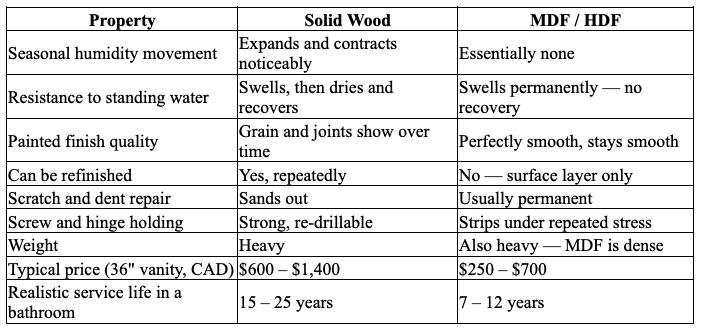
The Canadian Humidity Problem — In Both Directions
Canadian homes put furniture through a punishing annual cycle, and it is worth understanding because it hits each material differently.
From November through March, forced-air heating strips moisture out of indoor air. Relative humidity in a heated house routinely drops to 20–30%. Come July, the same house sits at 50–60%, and a bathroom after a hot shower spikes far higher for short bursts.
Solid wood feels this. A wide door panel can change dimension by a couple of millimetres across the seasons. In a properly built cabinet — floating panels, mortise-and-tenon or dowelled joinery, all six faces sealed — the wood simply moves within the frame and nothing happens. In a badly built one, the panel is glued rigidly in place, and by the second winter you have a split down the middle or a visible gap at the rail.
MDF does not care. Dry winter, humid summer, it holds its dimensions. This is a genuine advantage, and it is why MDF doors in a Canadian bathroom stay perfectly flat when solid wood doors sometimes do not.
So on seasonal humidity alone, MDF wins. The reversal comes with liquid water.
Water: Where the Comparison Flips
Every bathroom vanity eventually meets water it was not supposed to meet. A slow supply-line drip. A child who thinks the sink is a swimming pool. A towel left folded against the toe kick.
Solid wood absorbs that water, swells, and — assuming it dries out within a reasonable time — largely returns to shape. The finish may cloud and the joint may need attention, but the wood itself survives. Damage is usually repairable.
MDF does not work that way. Once water penetrates the sealed surface and reaches the fibre core, the fibres swell and the resin bond breaks. The panel expands, the edges bubble, and the surface lifts. This is permanent. Sanding does nothing; the material has structurally changed. The only fix is replacement.
Practically, this means the vulnerable spots are the ones nobody looks at: the underside of the cabinet base, the back edge behind the plumbing, and the cut edge around the sink opening. A manufacturer who seals those faces produces MDF that lasts a decade. One who leaves them raw produces MDF that fails in three years, and you will not find out which you bought until it is too late.
Cost Over Ten Years, Not at the Register
Sticker price makes MDF look like an easy win. Run it out over a realistic ownership period and the gap narrows sharply.
A $400 MDF vanity replaced once inside ten years costs $800 in cabinets, plus a second round of plumbing disconnection, disposal, and reinstallation. Call it $1,100–$1,300 all in. A $900 solid wood vanity that is still in service at year fifteen — possibly refinished once for the cost of sandpaper and a can of finish — costs $900.
The calculation reverses if you are not staying. If this is a rental unit, a condo you plan to sell in three years, or a basement half-bath that sees light use, paying twice for durability you will never collect on makes no sense.
When MDF Is Genuinely the Right Call
You want a flawless painted finish. Deep navy, matte black, crisp white — MDF holds these better than wood ever will.
Low-use bathrooms. Powder rooms and guest baths see a fraction of the water a family bathroom does.
Rentals and pre-sale renovations. Spend the difference where buyers actually look.
Tight budget, bigger priorities. A well-made MDF vanity with a quartz top beats a solid wood cabinet with a laminate one.
When to Pay for Solid Wood
The main family bathroom. High traffic, constant humidity, guaranteed spills.
You are staying more than a decade. The durability math only pays off if you are there to collect.
You want a natural wood finish. Oak, walnut, and pine grain cannot be faked convincingly at this price point.
You expect to change the colour later. Solid wood can be stripped and refinished. MDF cannot.
Heavy stone countertop. A thick quartz or sintered stone slab is best carried by a solid frame.
How to Tell What You Are Actually Buying
Product descriptions are written by marketers. "Solid wood construction" often means a solid frame with MDF panels. "Premium engineered wood" usually means MDF. Check the object, not the copy.
Look at the cut edge. Open a drawer and inspect the raw edge of the box. Continuous grain running through means wood. Uniform beige compressed fibre means MDF.
Knock on a door panel. Wood sounds hollow and resonant. MDF sounds dull and dead.
Check the back panel. A thin stapled hardboard back is a cost-cutting tell that usually predicts the rest of the build.
Pull a drawer all the way out. Dovetailed or dowelled corners indicate real cabinetry. Staples and glue do not.
Ask what the sink cutout edge is sealed with. If the seller cannot answer, that edge is probably bare.
Weigh the spec sheet. MDF is denser than most softwoods — a suspiciously light "solid wood" cabinet is neither solid nor wood.
Where to Buy in Canada
The Canadian market splits into three tiers. Big-box retailers stock mostly particleboard and low-grade MDF at entry price points, with limited size options. Custom cabinetmakers build exactly what you want in any material, typically starting around $2,500 and taking six to ten weeks. Between them sit online specialists who carry both material types in standard sizes and ship nationally.
That middle tier is where most renovations land, and it is worth comparing on material honesty rather than headline price. The better Canadian retailers — MyBath among them — publish the construction material for each range, for instance separating a sealed solid pinewood line from a moisture-resistant MDF line. That lets you compare like for like instead of guessing what "engineered wood" means on a given product page. Sizes generally run from 24" for powder rooms up to 72" double-sink units, with delivery across most of the country.
Whichever tier you buy from, ask two questions before ordering: what is the cabinet box made of, and are the cut edges sealed. Any seller who answers both clearly is worth doing business with.
The Short Version
MDF is stable, takes paint beautifully, and costs less — and it is permanently destroyed by water reaching its core. Solid wood moves with the seasons and needs proper joinery to handle it — and it survives water, repairs easily, and lasts two to three times as long.
Main bathroom you will use for fifteen years: buy solid wood and buy it from someone who understands floating panels. Powder room, rental, or a painted finish you want perfect: buy well-sealed MDF and stop feeling bad about it.
The genuinely expensive mistake is neither material. It is buying a badly built example of either one.
Frequently Asked Questions
Is MDF acceptable in a bathroom at all?
Yes, provided it is properly sealed on every face including the underside, the back, and the sink cutout. Sealed MDF handles ambient humidity and steam without difficulty. What it cannot survive is liquid water reaching the core.
Which handles Canadian winter humidity better?
MDF, clearly. It does not expand or contract as indoor humidity drops to 20% in heated homes. Solid wood does move, which is why joinery quality matters so much in a Canadian bathroom.
Can a damaged MDF vanity be repaired?
Surface scratches can sometimes be filled and touched up. Water swelling cannot be repaired — the fibres have expanded and the resin bond is broken. That section needs replacing.
What does a solid wood vanity cost in Canada?
A 36" single-sink solid wood vanity typically runs $600 to $1,400 depending on species and construction. Comparable MDF units sit between $250 and $700. Countertops and faucets are usually priced separately.
Is plywood better than both?
For the cabinet box, often yes — it resists moisture better than MDF and stays more stable than solid wood. It is rarely used for door faces because the edge grain is difficult to finish attractively.
Does a solid wood vanity need different maintenance?
Wipe up standing water reasonably promptly and run the bathroom fan during showers. Re-oil or re-seal every few years depending on the finish. MDF needs the same water discipline but cannot be re-sealed once damaged.
Stay up to date with our latest ideas!