Old-Fashioned Window Shades and Blinds
Explore old-fashioned window shades and blinds, from classic styles and materials to practical benefits and ideas for adding timeless charm to your home.
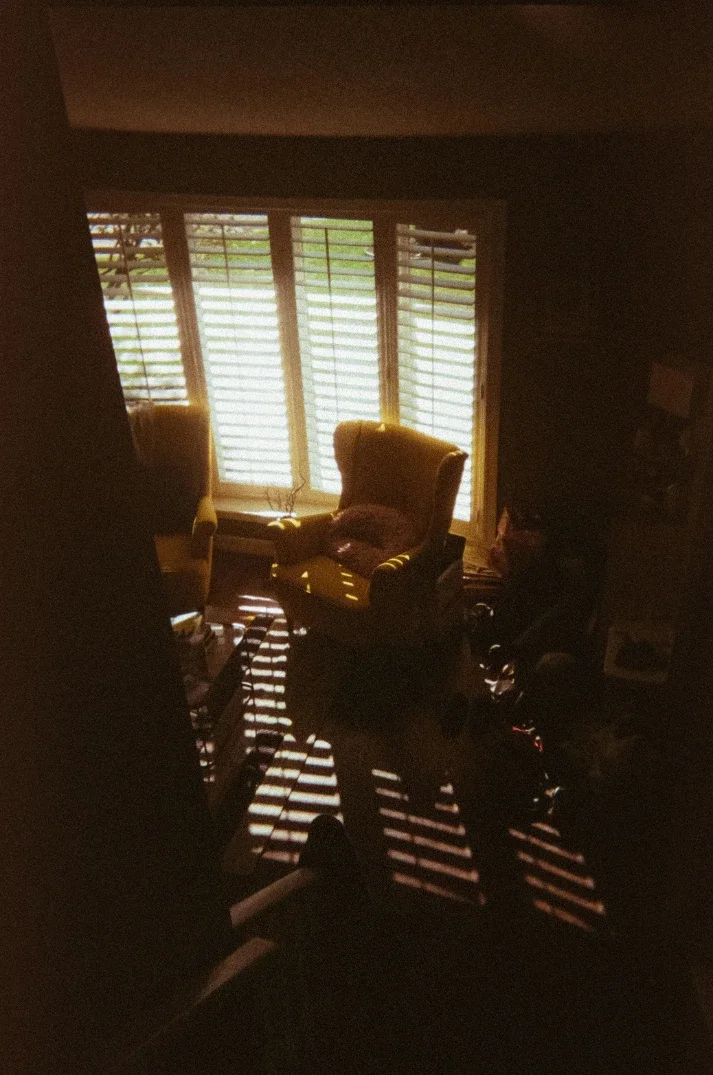
Old-fashioned window shades are back in style: they give a room warm, homey light and last for decades. This article covers three classics — cloth tape blinds, wood blinds and Roman shades — along with their many variations.
Why old-fashioned shades are coming back
Before plastic and aluminum, windows were dressed in wood, linen, cotton and bamboo. These materials age gracefully, can be repaired, and suit houses of any era. Today people choose them for restoring older homes, for farmhouse, colonial and mid-century interiors, and simply because they are tired of plastic blinds that look like an office.
Cloth tape blinds
Cloth tape blinds are horizontal blinds whose slats rest on wide fabric tape "ladders" instead of thin cords. This is how blinds looked in most homes and offices until the mid-20th century.
History. Horizontal blinds hung on tapes were already known in 18th-century Europe and colonial America, where they were called Venetian blinds. Cotton or linen tapes served both as the ladder holding the slats and as a decorative accent. Cord ladders later largely replaced them, but the tape version remains a signature of vintage and "grandmother's house" interiors.
How they work.
Two or three vertical tapes, usually 1 to 1.5 inches wide, with rungs stitched between the front and back strips to hold the slats.
The lift cord runs through the slats and is hidden behind the tape, so fewer route holes show light.
Slats tilt with a cord or a wand; the blind lifts with a cord and a lock.
Variations.
Slat material: wood (basswood), bamboo, metal (vintage aluminum), or modern faux wood.
Slat width: 1 inch, the classic vintage size; 2 inches, the most common today; 2.5 inches for large windows, closer to the look of shutters.
Tape style: solid cotton, textured linen, patterned (plaid, stripe, jacquard), contrasting or matched to the slats.
Controls: traditional cord, cordless (safer for children and pets), or motorized.
Pros: cozy vintage look, better light blocking (no pinpoints of light from route holes), tapes hide small flaws in the slats.
Cons: fabric collects dust and fades in sun; in kitchens and bathrooms it soils quickly.
Wood blinds
Wood blinds are the warmest-looking horizontal blinds: they control light precisely and read as furniture rather than hardware.
History. Wooden slats were used in shutters and in early 18th-century Venetian blinds. In the 20th century metal and plastic pushed them aside, but from the 1980s and 90s real wood returned as the premium option.
Woods and materials.
Basswood — light, even-grained and stable; the standard for quality wood blinds.
Paulownia — even lighter, handy for wide windows.
Oak, walnut, cherry — striking grain, heavier and more expensive.
Bamboo — strong, sustainable, with its characteristic nodes.
Faux wood — PVC or composite that looks like wood; moisture-proof, good for kitchens and bathrooms.
Variations.
Finish: clear-coated natural, stained (from light oak to dark walnut), painted white or colored, or distressed for farmhouse and country style.
Slat width: 1", 2" or 2.5"; wide slats resemble plantation shutters.
Ladder: cord (modern look) or cloth tape (vintage look — see the previous section).
Window shape: standard rectangles, bay windows, arched windows, doors with a cutout for the handle.
Valance: a wooden board on top that hides the headrail; straight, shaped or with crown molding.
Pros: durable, precise light control, natural look.
Cons: heavy on large windows, real wood dislikes humidity and direct heat, costs more than vinyl.
Roman shades
A Roman shade is a panel of fabric that gathers into horizontal folds as it is raised. It combines the softness of drapery with the tidy profile of a blind.
History. The name points to ancient Rome, where, according to a popular story, damp cloths were hung in openings to keep out dust and heat. Whatever the origin, fabric lift shades have a long history in European interiors, and the modern design with rings and cords became a classic in the 20th century.
How they work. Horizontal pockets with battens (or no battens) and vertical rows of rings are sewn to the back of the panel. Cords run through the rings up to the headrail; pulling them lifts the fabric and stacks it into folds.
Fold styles.
Flat — smooth when lowered, folds appear only when raised; shows off a fabric pattern best.
Classic (plain fold) — battens create crisp, flat pleats; a tailored look.
Hobbled (waterfall) — folds stay even when the shade is down, cascading over one another; a full, vintage look.
Relaxed (European) — no batten at the bottom, so the hem dips in a soft curve; cozy cottage style.
Tie-up — no cords; lifted by hand and held with fabric ties; the simplest rustic option.
Woven wood Roman — woven bamboo, jute or reed folded like a fabric Roman shade.
Fabrics: linen and cotton (the classics), velvet and wool (warmth and darkening), sheer linen or voile (diffused light). Linings can be standard, blackout or thermal.
Pros: soft, warm look, endless fabric choices, good sound and heat insulation with a lining.
Cons: when raised they cover the top of the window, light cannot be angled, fabric needs cleaning.
Other old-fashioned shades
Beyond the three main types, vintage interiors feature several other classic window treatments.
Spring roller shade — linen or treated cotton winds onto a spring-loaded roller, with a wooden hem bar and a ring or tassel pull at the bottom. The typical shade of the Victorian era and early 1900s, often with a shaped hem (scallops, fringe).
Austrian shade — lightweight fabric gathered into full vertical swags along its whole length; a formal, "palace" look.
Balloon shade — a cousin of the Austrian shade that puffs into soft poufs only at the bottom; popular in bedrooms and nurseries.
Woven wood shades — bamboo, reed or jute woven with cotton yarn; they roll up or fold like Roman shades.
Plantation shutters — interior wooden shutters with wide louvers that tilt; born in hot colonial estates, essentially "blinds in a frame."
Café curtains — short curtains covering the lower half of the window on a brass rod; they give privacy while letting light in above.
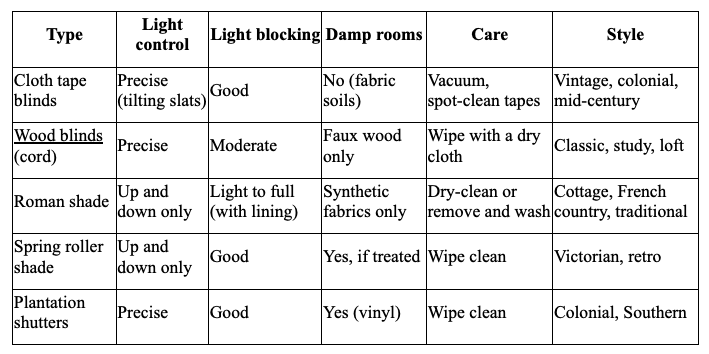
Comparison
For living rooms and studies, wood blinds on cloth tapes are hard to beat; for bedrooms, a Roman shade with a blackout lining; for damp rooms, faux wood.
How to choose and care for them
Choosing.
Decide on the job: adjustable light (blinds) or a soft covering (Roman shade).
Consider the room: in damp spaces use faux wood, vinyl or synthetic fabric.
Pick the mount: inside the frame looks neater; outside mount above the frame makes the window look bigger and blocks more light.
Layer them: wood tape blinds with light drapes, or a Roman shade over blinds, is a classic combination.
With children or pets at home, choose cordless or hidden-cord controls.
Care.
Wood slats — dust weekly with a feather duster or a vacuum with a soft brush; no water or harsh cleaners.
Cloth tapes — vacuum; spot-clean with a damp sponge and mild soap; faded tapes can be replaced without replacing the slats.
Roman shades — vacuum regularly; many let you remove the battens and wash the fabric, otherwise dry-clean.
Bamboo and woven shades — dry-clean only and keep them away from radiators.
Conclusion
Old-fashioned shades are not museum pieces but a practical choice: wood blinds on cloth tapes give precise light control, Roman shades bring softness and comfort, and woven and roller shades add character. Well chosen and cared for, they will last for decades and make the window the highlight of the room.
Stay up to date with our latest ideas!