How to Hang a Heavy Mirror Safely on Any Wall
Learn how to hang a heavy mirror that stays put. A step-by-step UK guide to choosing wall fixings for plasterboard, brick and stud walls.

A heavy mirror stays up when it is fixed into something solid: a timber or metal stud, the masonry behind your plaster, or a heavy-duty cavity fixing rated well above the mirror's weight. The plaster or plasterboard surface on its own will not hold it. Get the fixing right and a 20kg mirror sits flush for years. Get it wrong and you are looking at a cracked frame, a gouged wall, and a near miss you would rather forget.
This guide covers what your wall is made of, which wall fixings match it, and the order to do the job in so the mirror goes up once and stays there.
What you need to hang a heavy mirror
You need four things: the right fixings for your wall type, a way to see what is behind the plaster, a drill, and a spirit level.
Wall fixings matched to your wall: wall plugs and screws for masonry, or heavy-duty cavity fixings for hollow walls.
A detector that finds studs, pipes and cables before you drill.
A drill with the correct bit, such as a masonry bit for brick or a flat bit for some cavity fixings.
A spirit level, a pencil, and a tape measure.
A second pair of hands, because a large mirror is awkward to hold and line up alone.
The fixings carry the weight, so they are the part to get right. Everything else just helps you place them accurately.
How heavy is a "heavy" mirror?
A mirror starts to count as heavy at around 5kg, and most large framed or full-length wall mirrors sit between 10kg and 30kg. Weigh yours on bathroom scales if you are not sure. Write the figure down, because every fixing has a stated load limit and you want headroom rather than a fixing working flat out at its maximum.
A rule worth keeping: pick fixings rated for at least double the mirror's weight, and spread the load across two or more fixing points. Doubling up covers the knocks, door slams and small movements a wall takes over the years.
Find out what your wall is made of first
Before you choose a single fixing, work out whether your wall is solid masonry or a hollow stud wall, because the two need completely different fixings. Tap the wall with your knuckles. A solid, dull sound usually means brick or block behind plaster. A hollow, drum-like sound means a stud wall: plasterboard fixed to a frame with a gap behind.
Stud and plasterboard walls
A stud wall is plasterboard screwed to a frame of timber or metal uprights, called studs, with an empty cavity in between. British Gypsum's partition specifications build these walls with 12.5mm plasterboard on studs at up to 600mm centres, and many timber stud walls are set closer, at 400mm, for extra rigidity. The wide centres exist because a standard plasterboard sheet is 1200mm across, so the board edges land neatly on a stud. This matters because the strongest place to fix a heavy mirror on a stud wall is straight into a stud, not the thin board between them.
Brick and masonry walls
A masonry wall is brick or block, usually with a skim of plaster on the face. These walls take heavy loads well, as long as you drill into the brick or block rather than stopping in the soft plaster. The plaster layer is often around 10mm to 20mm thick, so your fixing has to reach past it into the solid material behind.
Solid plaster, lath and older walls
Older properties may have lath and plaster, or thick solid plaster, which behaves differently again. Lath and plaster is fragile and crumbles easily, so it needs care and often a longer fixing that reaches the timber laths or the masonry behind. If you are unsure, treat an old wall gently and test a small, hidden area first.
Choosing the right wall fixings for a heavy mirror
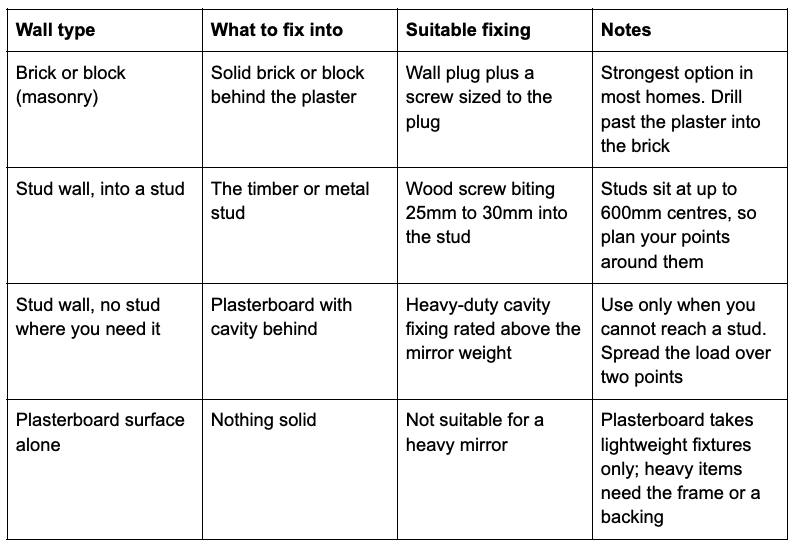
Match the fixing to the wall: drive into a stud or into masonry where you can, and use a rated heavy-duty cavity fixing only when you cannot reach anything solid. This single decision settles whether the mirror holds. The table below sets out the choice at a glance.
Fixing into a stud
A screw driven into a stud gives you the strongest hold available on a hollow wall, because the load goes straight into solid timber or metal. Find the stud with a detector, mark its centre, and drive a wood screw long enough to bite at least 25mm to 30mm into the stud. If your fixing points do not line up with a stud, fit a horizontal timber batten across two studs and hang the mirror from that.
Fixing into brick or masonry
Into masonry you drill a hole, push in a wall plug, then drive the screw so it expands the plug tight against the brick. The plug grips the wall and the screw grips the plug. Use a masonry bit that matches the plug size, drill past the plaster into solid brick, and choose screw fixings sized to both the plug and the weight you are hanging. This is the most secure method for a heavy mirror in most homes, because brick and block carry the load with ease.
Fixing into plasterboard with no stud behind
When the mirror has to go where there is only plasterboard and cavity, use a heavy-duty cavity fixing made to spread the load behind the board. These toggle or open out behind the plasterboard and hold far more than a basic plastic plug. Plasterboard on its own is only suited to light fixtures: British Gypsum rates wall fixtures by duty under BS 5234, and heavier items are expected to be fixed back to the frame or a backing. So treat the board as suitable for light things only. A heavy mirror is not light, which is why it belongs on a stud, a noggin, a timber backing, or a rated cavity fixing.
Before you drill: a quick safety check
Run through this list every time, before the drill touches the wall:
Weigh the mirror, then pick fixings rated for at least twice that weight.
Find and mark studs, pipes and cables with a detector. Never drill blind.
Choose two fixing points, not one, for anything wide or heavy.
Match the drill bit to the wall and the fixing, such as a masonry bit for brick.
Check the screw or fixing is long enough to reach solid material, about 25mm to 30mm into a stud.
Level your marks before you drill the first hole.
How to hang a heavy mirror step by step
Weigh the mirror and check the hardware on the back. D-rings, a wire, or a slot fitting each hang slightly differently.
Find the studs, pipes and cables with a detector, and mark them.
Decide your fixing points. Aim for a stud or masonry, and use two points for stability rather than one.
Mark the height. Hang mirrors so the centre sits near eye level, then adjust to the room.
Check level with a spirit level and mark the holes with a pencil.
Drill with the correct bit for your wall and fixing, to the depth the fixing needs.
Fit the fixings: wall plug and screw for masonry, or the cavity fixing for hollow walls.
Hang the mirror, check it sits level, and adjust. Press gently to confirm it feels solid before you let go.
Worked example: an 18kg framed mirror on a stud wall
Say you have an 18kg framed mirror for a stud wall. Weigh it first, then look for fixings rated to at least 36kg in total, split across two points. Run a detector along the wall and you will usually find studs near 600mm apart. If a stud sits close to one hanging point, drive a wood screw into it for that side. For the other side, where no stud lines up, either fit a heavy-duty cavity fixing rated well above 18kg, or screw a short timber batten across two studs and hang both D-rings from the batten. Level the marks, drill, fit, hang, then press-test before you let go. The mirror now pulls against timber, not against the paper face of the board.
Mistakes that bring mirrors down
The most common reason a mirror falls is a fixing that grips only plaster or plasterboard, not the solid material behind. Other repeat offenders worth avoiding:
Drilling into a stud wall and stopping in the board instead of finding the stud.
Using one central fixing for a wide mirror, which lets it swing and work loose.
A masonry plug that sits in the soft plaster layer and never reaches the brick.
Skipping the detector and clipping a cable or a pipe.
A screw too short to reach a safe depth in the stud or plug.
When to call a professional
Call a professional for very large or antique mirrors, for lath and plaster walls you are unsure about, or when you cannot find a safe fixing point. A tradesperson can fit a hidden timber backing or a specialist fixing that takes the load safely, which costs less than replacing a broken mirror or repairing a damaged wall.
Once the mirror is up
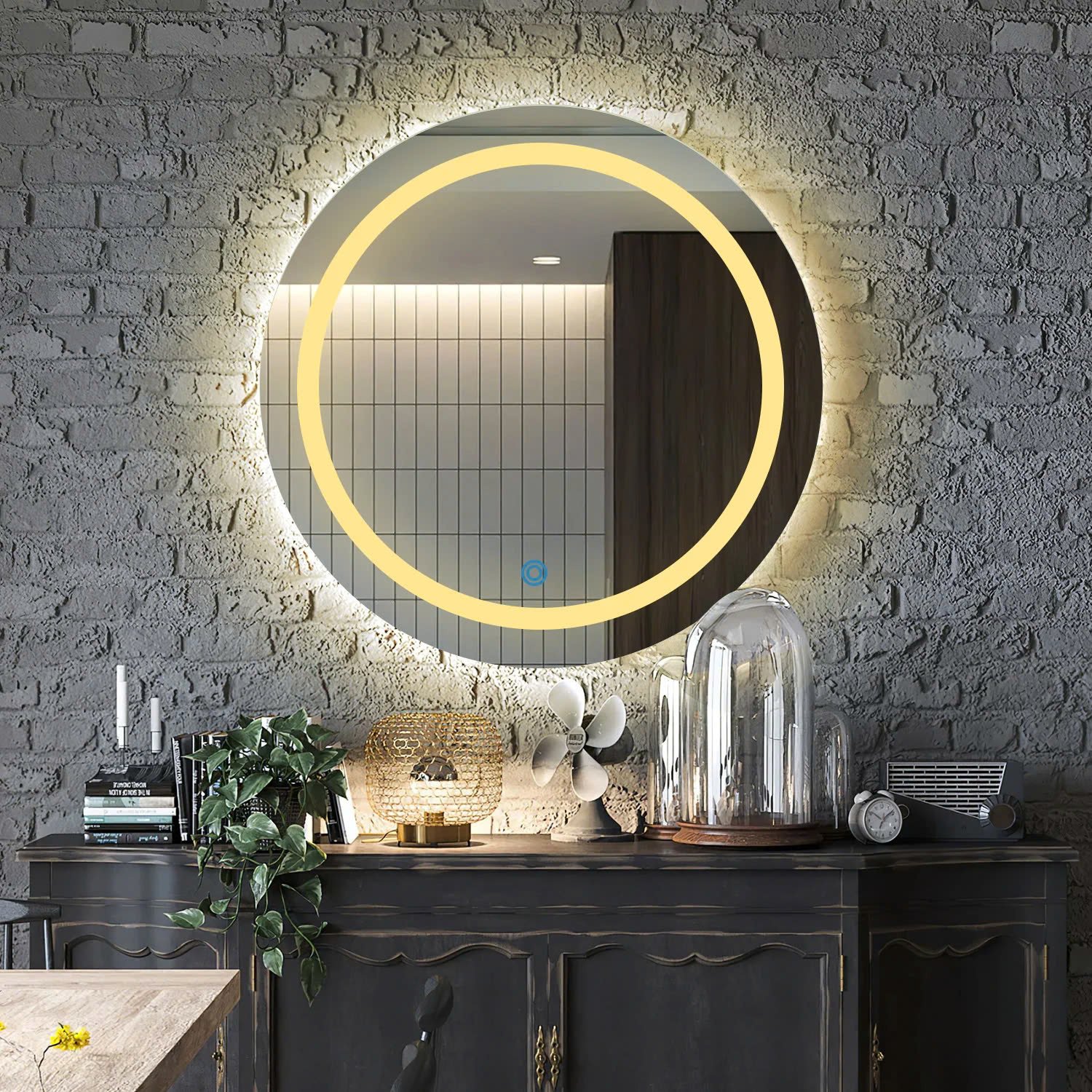
A well-placed mirror bounces light around and makes a room feel larger, which is why mirrors work so well on a feature wall behind a sofa or media unit. Style the area around it the way you would a shelf display, balancing the mirror with open shelving and smaller pieces so it anchors the wall rather than floating alone.
Frequently asked questions
How do you hang a heavy mirror on a plasterboard wall?
Fix into a stud wherever you can, because the timber or metal frame carries the weight. Where no stud lines up, use a heavy-duty cavity fixing rated well above the mirror's weight and spread the load across two points. Avoid basic plastic plugs, which are made for light loads.
What fixings do I need for a heavy mirror on a brick wall?
You need wall plugs sized to your drill hole and screws long enough to pass the plaster and bite into the brick. Drill with a masonry bit, seat the plug in solid brick, and pick screws rated for the weight. Brick and block hold heavy mirrors well once the plug reaches the masonry.
Can you hang a heavy mirror without drilling?
Adhesive strips and hooks exist, but they are made for light frames, not heavy mirrors, and most fail well below the weight of a large mirror. For anything heavy, a drilled fixing into a stud or masonry is the safe choice.
How much weight can plasterboard hold on its own?
Very little without help. On its own, plasterboard suits only lightweight fixtures. Heavy items belong on a stud, a noggin, a timber backing, or a rated heavy-duty cavity fixing that spreads the load behind the board.
How high should a mirror hang?
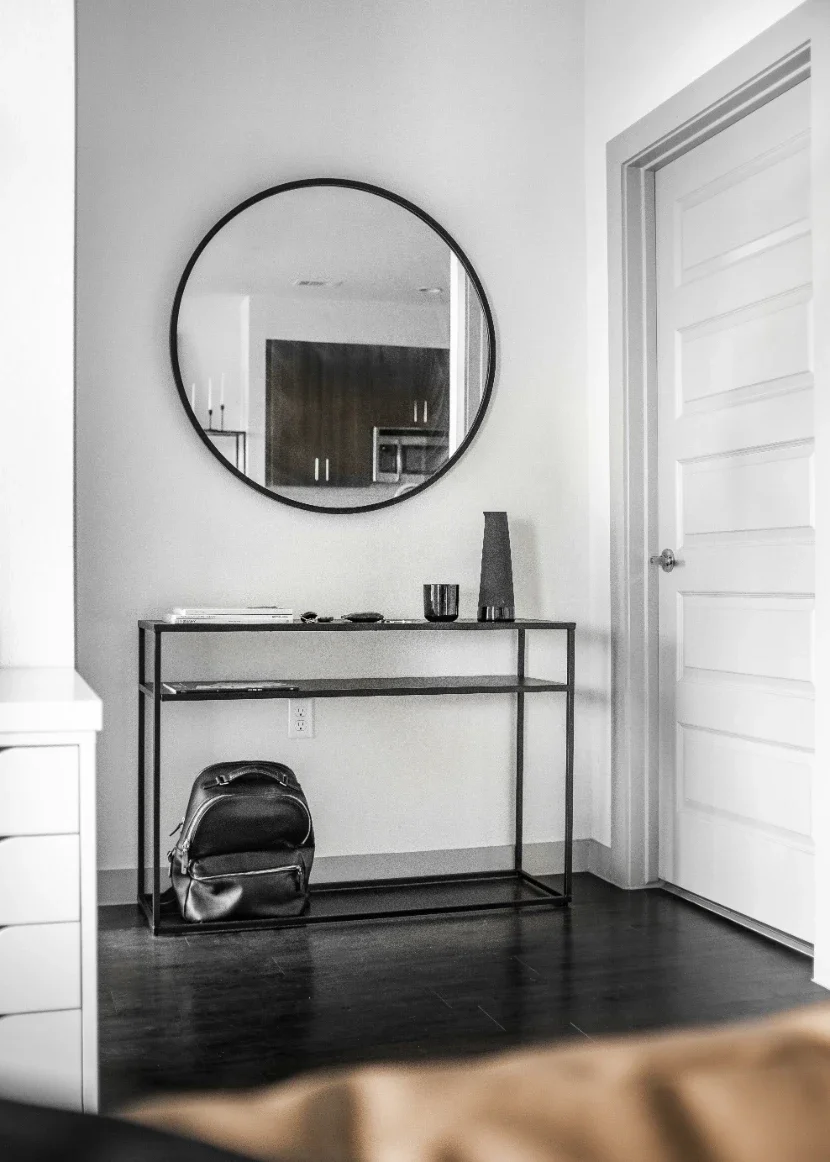
Hang it so the centre sits near eye level, then adjust for the room and the people using it. Over a console or fireplace, leave a small gap above the surface and centre the mirror on the furniture below.
Stay up to date with our latest ideas!