Sleeper Sofas That Don't Ruin Your Guest's Sleep
Discover sleeper sofas that keep guests comfortable with supportive mattresses, smart designs, and features that deliver a better night's sleep.
If you have ever spent a night on a sleeper sofa and woken up feeling like you slept on a metal grate with a thin blanket over it, you know the problem. Sleeper sofas occupy a strange category of furniture. They need to look good as a couch by day and feel like an actual bed at night. Most of them nail the first part and fail completely at the second.
I have hosted family members, house-sat for friends, and stayed in guest rooms equipped with sleeper sofas ranging from tolerable to genuinely painful. The difference always came down to three things: mattress quality, mechanism design, and frame construction. If you want the full breakdown with specific model recommendations, this guide on how to choose a sleeper sofa goes deep into product comparisons. But first, let me explain what separates a sleeper sofa your guests will thank you for from one they will remember for all the wrong reasons.
Here is what we will cover: which mattress types actually sleep well, why thickness matters more than brand name, how different opening mechanisms affect comfort, what to ask before you buy, and how to spot a quality frame from across a showroom floor.
The Sleeper Sofa Paradox: Great Couch, Terrible Bed
The fundamental challenge with sleeper sofas is physics. A mattress thin enough to fold inside a sofa frame is usually too thin to sleep on comfortably. A mattress thick enough to sleep well makes the sofa sit too high or feel bulky when folded up. Manufacturers have been wrestling with this tradeoff for decades, and the solutions range from clever compromises to outright failures.
The bar for acceptable sleep comfort is lower than most buyers realize. Anything under four inches of mattress thickness feels like camping pad over a metal grid. You feel every coil or bar underneath. Your hips bottom out. You wake up sore. Once you cross into the four-and-a-half to six-inch range, the experience shifts dramatically. Above six inches, you are approaching real bed territory, but the sofa becomes harder to open and close and sits noticeably higher in couch mode.
Mattress Types Compared: What Actually Sleeps Well
The mattress inside your sleeper sofa determines ninety percent of the sleeping experience. Here is how the main options compare:
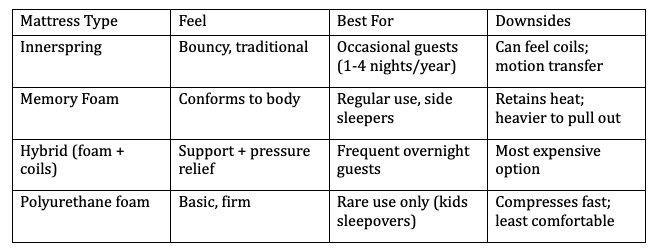
If your sleeper will host people more than a handful of nights per year, memory foam or hybrid is worth the extra cost. Innerspring works fine for occasional guests who stay one or two nights, but anyone sleeping on it regularly will start feeling the underlying structure within a week.
Mattress Thickness: The Four-Inch Rule
Thickness is the single best predictor of whether a sleeper sofa will be comfortable enough for adult use. I have tested this across dozens of models and the pattern is consistent:
Under 4 inches. Avoid for adult use. Fine for children or very short-term naps. You will feel the metal bars through the mattress. This is where most budget sleepers land, and it is also where most negative reviews come from.
4 to 5 inches. The minimum for tolerable adult sleep. Acceptable for guests staying one or two nights. Side sleepers may still feel pressure points at the hips and shoulders. Look for high-density foam at this thickness rather than basic polyurethane.
5 to 6 inches. The sweet spot for most households. Thick enough that you do not feel the frame underneath, thin enough that the mechanism still operates smoothly. This is where quality sleeper sofas tend to cluster. If a listing does not state thickness explicitly, treat that as a warning sign.
Over 6 inches. Genuine bed-like comfort. Heavier to pull out and push back in. The sofa sits higher in daytime mode. Worth it if you host frequently or if the sleeper serves as a primary bed for part of the year.
Mechanism Types: Pull-Out Versus Click-Clack Versus Pop-Up
How the sofa converts from seating to sleeping affects both convenience and comfort. There are three main designs:
Pull-out (traditional). A hidden metal frame folds out from inside the sofa with a dedicated mattress attached. You remove the seat cushions, pull the handle, and the bed unfolds. This design offers the most even sleeping surface because the mattress is separate from the seat cushions. It feels closest to a real bed. Best for frequent overnight guests and couples. Setup takes about thirty seconds to a minute depending on the mechanism quality.
Click-clack (futon style). The backrest unlocks and folds forward until it lies flat with the seat. Fast conversion, usually under ten seconds. Fewer moving parts means less can break. The downside: you are sleeping directly on the seat cushions, so the surface can be firm and you may feel seams. Better for occasional guests, teens, or nap use than for regular adult sleep.
Pop-up trundle. An extra platform hides under the main seat and pulls out like a drawer, then lifts to match the sofa height. Good for kids or short-term visitors. Lower overall height works well in small rooms. Comfort depends entirely on cushion quality since there is no separate mattress.
Questions to Ask Before You Buy (Most Shoppers Forget These)
Product listings rarely tell you everything you need to know. Here are five questions that separate informed buyers from regretful ones. Ask these before you order, either of the retailer or by checking detailed specs online.
One: What is the exact mattress thickness in inches? Not "standard" or "comfortable." You want a number. Anything under four inches is a red flag for adult use.
Two: What is the weight capacity of the sleeping surface? A well-built sleeper should support at least five hundred pounds total. If the listing does not mention weight capacity, the frame may be underspec'd.
Three: Does the mechanism require two people to operate? Some heavy-duty pull-outs are genuinely difficult for one person to unfold. If you live alone or expect solo setup, check reviews for comments about ease of operation.
Four: What is the fully-opened bed dimension, not just the sofa size? The extended bed is almost always wider than the sofa itself. Measure your room for the open configuration, not just the closed one. Many buyers discover too late that the open bed blocks a doorway or window.
Five: Is the mattress removable or replaceable? Some sleepers have integrated mattresses that cannot be swapped out. Others use standard-sized mattresses you can replace when they wear out. Replaceability adds years to the useful life of the piece.
Frame Quality: The Hidden Factor That Determines Lifespan
A great mattress on a weak frame sags within months. The frame is what keeps the sleeping surface level and prevents that dreaded hammock effect where you roll toward the center every time you lie down.
Look for kiln-dried hardwood frames. Kiln-drying removes moisture from the wood so it does not warp or crack as humidity changes through the seasons. Softwood frames like pine cost less but flex and creak under repeated use. Particleboard or composite wood frames should be avoided entirely for any sleeper that will see regular use.
Check the support system under the mattress too. A sturdy wire mesh or trampoline-style grid distributes weight evenly. Cheap models use only a few metal bars that you can feel through thin mattresses. If possible, see the mechanism in action in a video or store display. A smooth, one-motion open-and-close without scraping or grinding indicates quality engineering. Jerky, sticky mechanisms get worse over time.
Finding a Sleeper Sofa Your Guests Will Actually Thank You For
A comfortable sleeper sofa comes down to three choices: pick a mattress type and thickness that matches how often people will sleep on it, select a mechanism style that fits your strength and space constraints, and verify the frame construction is solid enough to last. Skip any model that hides its mattress thickness or uses vague language about support. The honest ones publish the numbers.
Ready to narrow down your options? Rank the top picks by mattress type, frequency of use, and budget. Your guests, and your back, will notice the difference.
Stay up to date with our latest ideas!