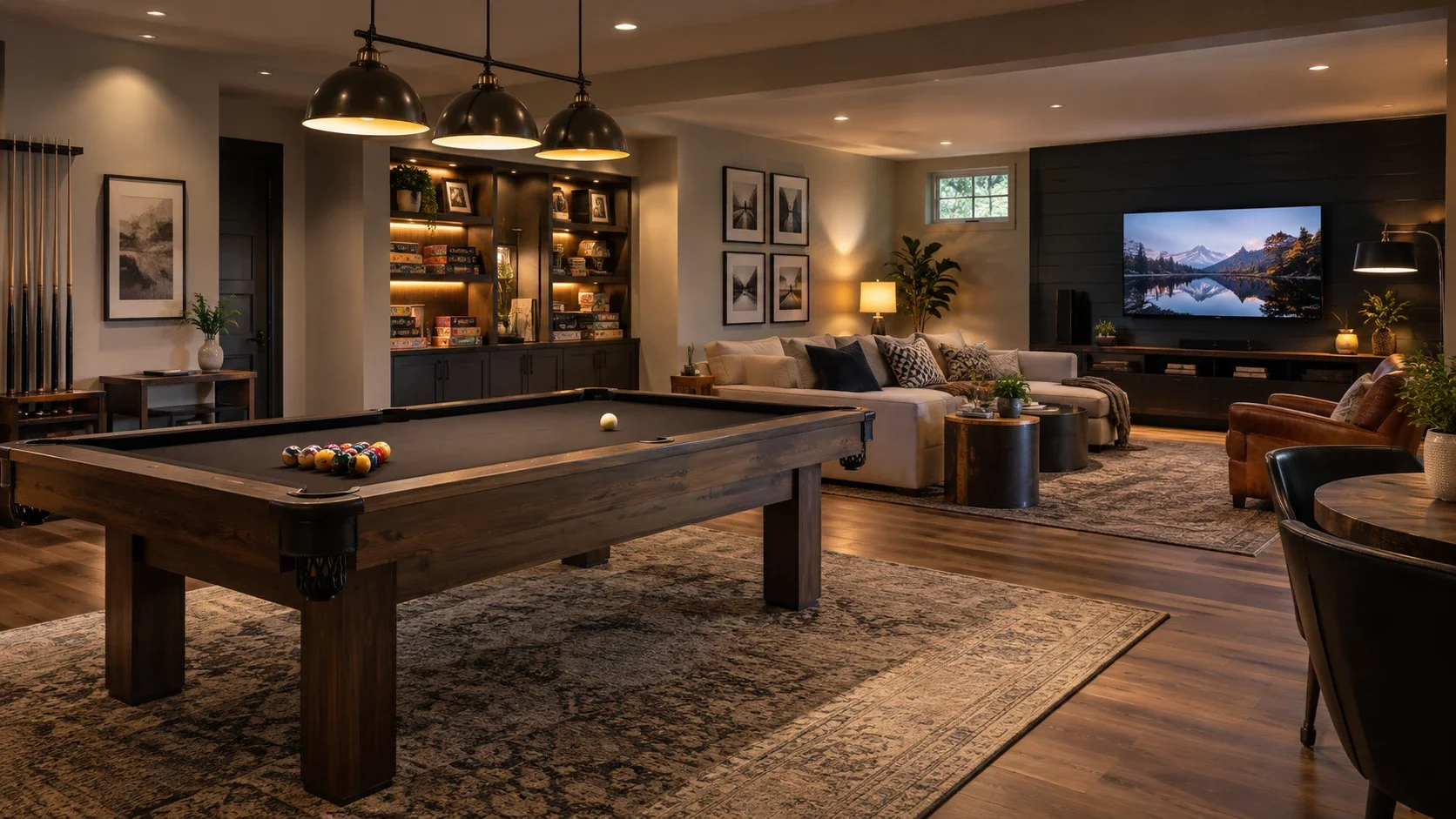
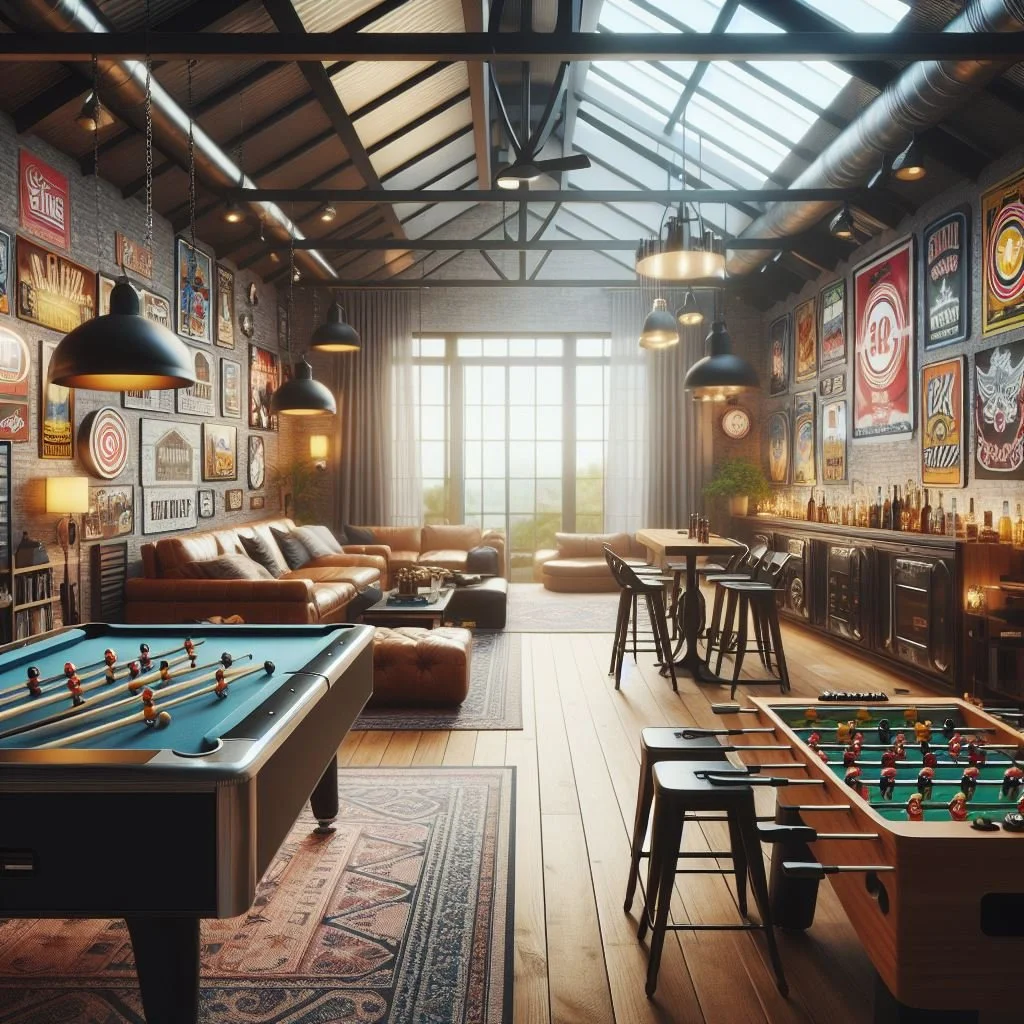
Multipurpose Game Room Ideas: How to Design One Room for Many Kinds of Fun
Discover multipurpose game room ideas for designing one flexible space for board games, video games, sports, entertaining, and relaxing with family and friends.
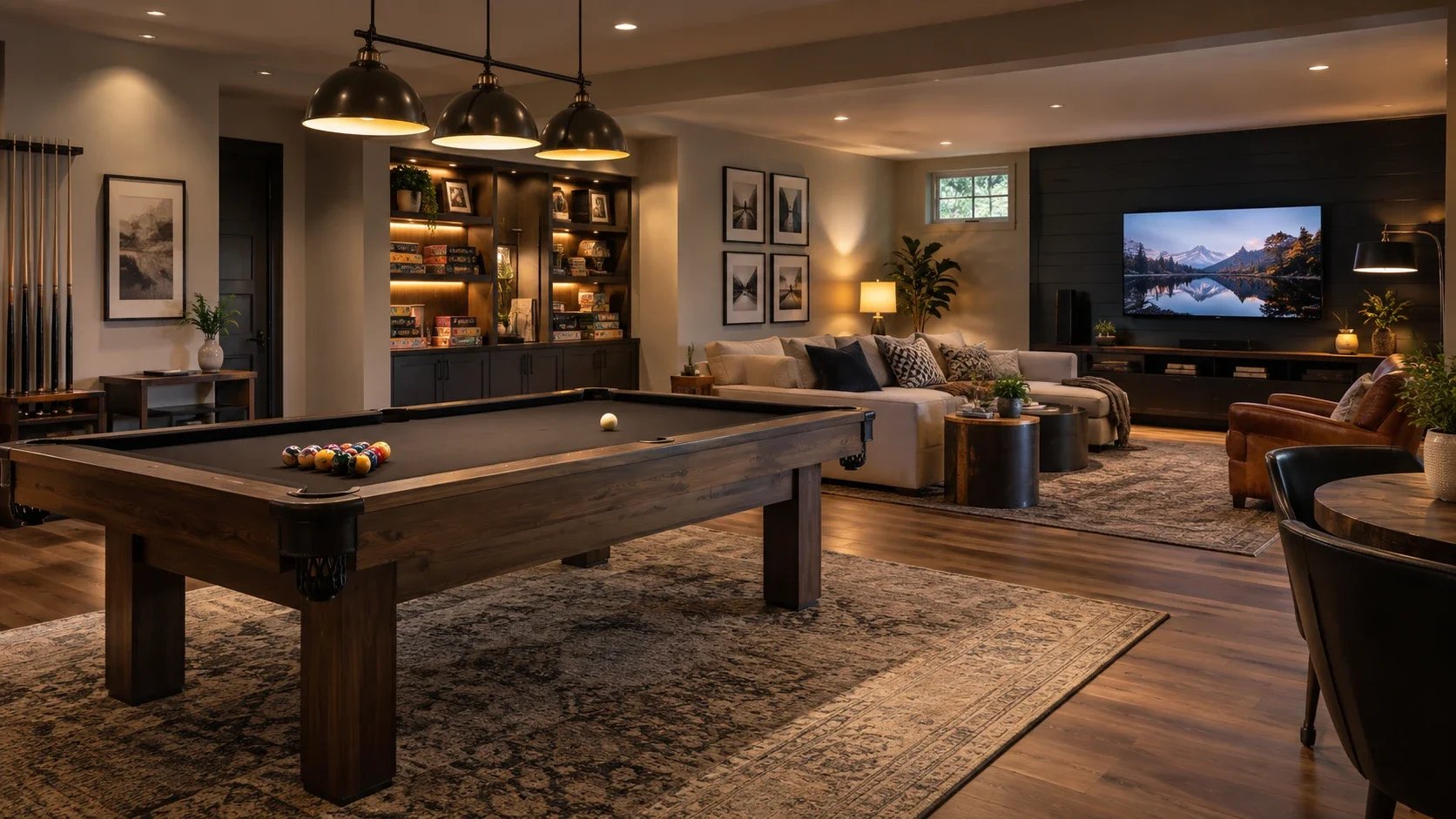
The best multipurpose game room ideas do not start with buying more games. They start with deciding how the room should work when several people are actually using it.
A spare room, basement, bonus room, or another underused part of the house can become a home game room for pool, ping pong, board games, playing video games, movie nights, and casual gatherings. The challenge is fitting those activities into the existing space without making the entire room feel crowded.
A good game room design protects walking routes first. After that, decide which activities deserve permanent floor space and which can fold, roll, mount to a wall, or come out only for game nights.
That approach works for a large basement game room, a compact small game room, or even a small space that can support only one major activity at a time.
Start With the Activities Your Household Actually Uses
Before thinking about décor, make a realistic list of what people will do in the room.
Pool
Ping pong
A foosball table
Air hockey
Arcade games or pinball machines
Console or PC gaming
Classic video games
Classic board games
Card games
Darts or VR
Movie nights
A bar or snack area with a mini fridge
You probably do not need all of them.
A room designed around several games can become less useful than one built around three or four activities the household genuinely enjoys. A permanent pool table makes sense when pool gets played every week. A fold-out poker table makes more sense when cards come out only occasionally.
The same principle applies to classic games and newer entertainment. A cabinet of game boards may get more use than another arcade machine if family evenings usually revolve around cards and board games.
Decide which activity matters most, then let that become the anchor for the rest of the layout. In one home that may be the pool table; in another it may be the television and seating area.
Family-friendly game rooms can also encourage more time together when they include a few easy-to-learn games that people of different ages and skill levels can enjoy without much setup.
Think about how the gaming space changes when two people are relaxing, when friends visit, and when several activities happen at the same time.
Build the Game Room Layout Around Movement
A strong game room layout is not simply a collection of equipment that technically fits.
People need room to walk around tables, pull out chairs, swing pool cues, move during ping pong rallies, and reach storage without cutting through another game.
Start with a rough floor plan and mark:
Doors and door swings
Windows
Stairs
Support columns
Large furniture
Game equipment
Storage
Main walking routes
Then consider the actual room size rather than just the dimensions of the equipment.
These figures are planning examples rather than universal minimums:
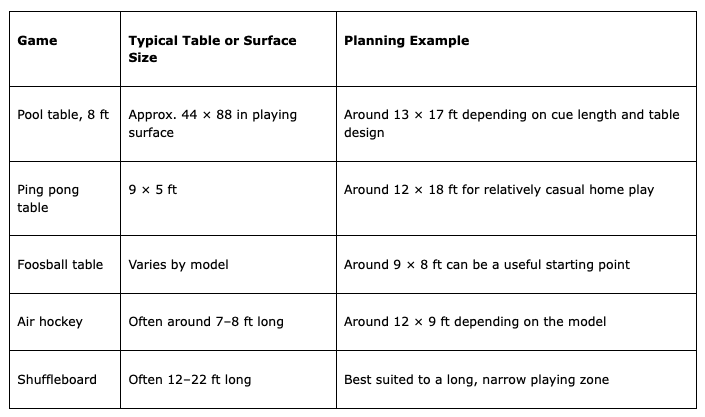
A full-size ping pong table is 9 × 5 ft, and approximately 12 × 18 ft of room space can be a useful planning target for casual home play. More clearance is helpful when the room allows it, especially behind the end lines.
Painter's tape is one of the easiest ways to test the plan.
Tape the footprint of the ping pong table, pool table, sofa, or another large item onto the floor. Then walk through the room.
Open the doors. Pull out a chair. Pretend to take a pool shot. Step backward as though returning a ping pong ball. Stand where another person might watch.
A support column that looked harmless on paper may sit directly in the path of the cue sticks. A sofa may leave enough space for the table itself but not enough for somebody playing at the end line.
This simple test often reveals more than another hour spent looking at floor plans.
Divide the Room Into Activity Zones
A good gaming room setup feels less crowded when related activities share a zone.
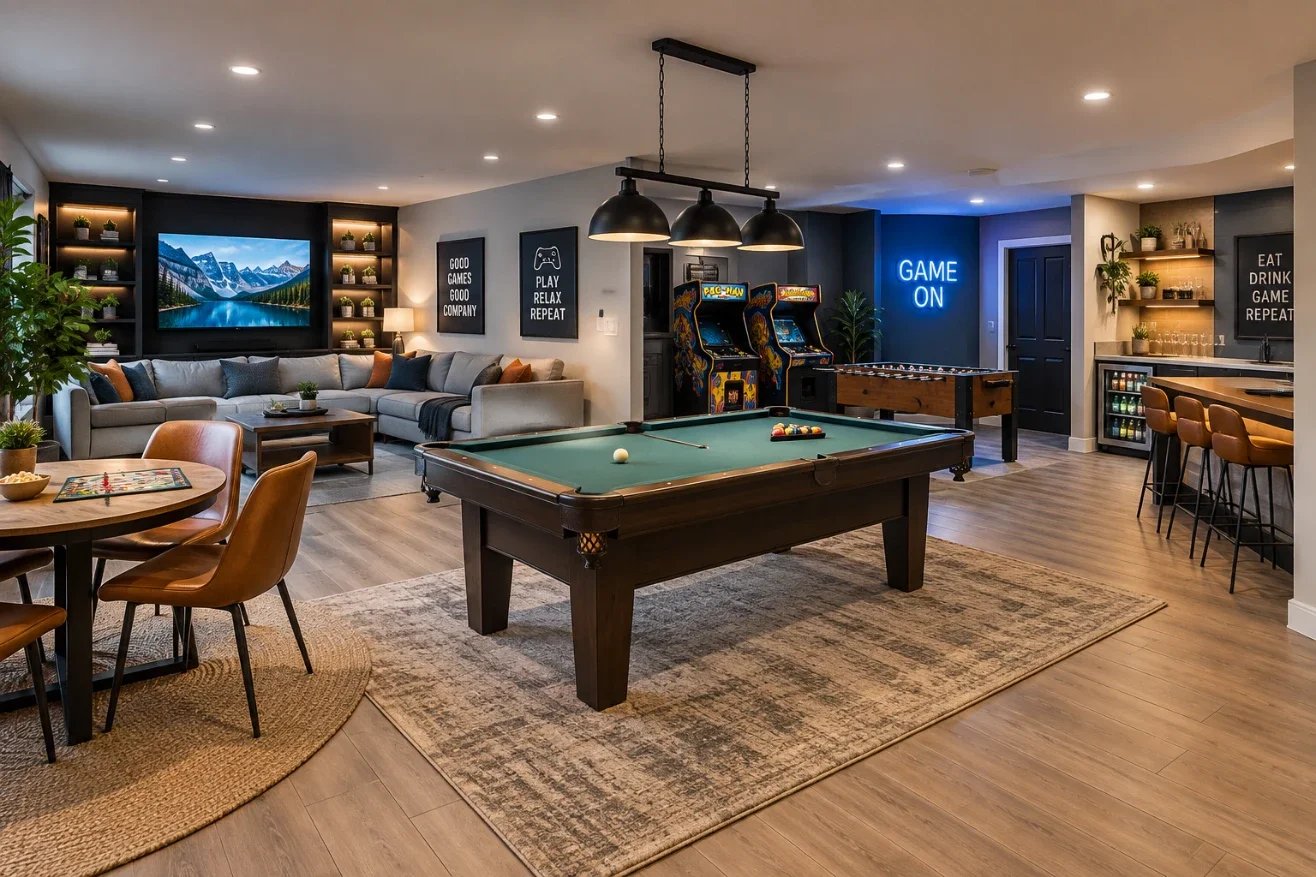
For example, the pool table can occupy the center while pinball machines, arcade games, or a foosball table line one wall.
A wall-mounted TV can face a sofa at the other end of the room, creating a separate gaming setup for console play and movies.
A card table or dining table can sit closer to the bar or snack area and handle card games, puzzles, and board games.
An open corner can remain available for VR, children, or extra seating during larger gatherings.
This type of room setup lets different activities coexist without demanding that every game remain active at once.
Plan for Noise as Well as Layout
If several games may be running at once, sound control deserves some attention too.
Air hockey, arcade machines, pinball, television audio, and groups of people talking can quickly compete with one another. Rugs, curtains, upholstered seating, acoustic panels, and other soft surfaces can reduce echo in rooms dominated by hard floors, cabinetry, screens, and game tables.
Quieter activities such as cards, puzzles, and conversation are also easier to enjoy when they sit farther from the loudest equipment.
The result should encourage friendly competition without making conversation difficult.
Use a Pool Table for More Than One Activity
Large recreation equipment consumes more floor area than almost anything else in a game room, so multi-use pieces can be especially valuable.
A pool table with a removable dining table top, for example, can support meals, puzzles, cards, or board games when nobody is shooting pool.
Another option is using the pool table for ping pong.
A compatible conversion top creates a temporary table-tennis surface over the existing table, allowing one footprint to support two games.
Instead of finding permanent space for both a pool table and a separate ping pong table, the conversion top can be installed when people want to play and stored afterward.
Fit depends on the pool table's complete outside dimensions, including the rails—not simply whether the table is described as a 7 ft or 8 ft model. Both sections of the conversion top also need flat, stable, evenly supported contact.
Homeowners comparing sizes can browse Flip&Play conversion tops for pool tables, including 84 × 44 in and 108 × 60 in formats. The larger format creates a full-size playing surface, but it also requires more planning for lifting and storage.

A multipurpose game table offers a similar idea in a single piece of equipment: it combines several games or activities into one footprint. These designs can work well where the room does not have enough space for several permanent game tables.
The point is not to make everything convertible. It is to give permanent floor space only to things that genuinely deserve it.
Dual-Purpose Furniture: Use Furniture That Serves Multiple Functions
Good game-room furniture should support the activity without locking the room into one arrangement.
A modular sectional can face the television for movies and still provide comfortable seating for people watching pool or ping pong.
Storage ottomans can hold blankets, controllers, or board games while also providing extra seating.
A narrow console behind a sofa creates a place for drinks without adding another large table.
Bar stools that tuck beneath a counter are useful because they disappear from the walking route when the bar is not being used.
A fold-out or drop-leaf table can work as a desk during the week and open for cards or games when friends visit.
This is the value of dual-purpose furniture: one piece can provide seating, storage, a playing surface, or another useful function without demanding a second permanent footprint.
Lighter seating helps too. Folding chairs, bean bags, stools, and floor pillows can move quickly when the room changes function.
The room still needs cozy seating, though. A completely movable room is not much fun if nobody has a comfortable place to sit.
Throw pillows, rugs, and upholstered pieces can make hard game-room surfaces feel less severe while also helping with sound control.
Keep the Gaming Setup Contained
Console and PC gaming can spread across a room surprisingly fast.
The television, speakers, consoles, controllers, charging stations, gaming chairs, and cables can turn a clean room into a permanent electronics zone if they are not planned together.
A wall-mounted TV saves floor depth and may eliminate the need for a bulky entertainment center.
Floating or shallow cabinets can hold consoles while keeping equipment close to the screen.
Using a rug beneath the sofa or gaming chairs visually defines the gaming setup without building another wall.
Cable management matters too. Loose cords should not cross walking routes between the screen and other games.
If PC gaming is also part of the room, placing the desk along a side wall or in a corner can prevent every display from dominating the same sightline.
The screen should have a clear home without taking control of the entire room.
Use Wall Space Before Adding More Furniture
In smaller rooms, wall space is some of the most valuable storage real estate.
Wall-mounted racks can hold cue sticks, paddles, or other game equipment. Shelves can store collectibles, games, and accessories. Pegboards can handle frequently used items without another cabinet sitting on the floor.
Controllers and headsets can also have dedicated hooks or charging stations.
This matters especially in small spaces, where another freestanding storage unit can quickly consume the last useful walking area.
A good rule for small game room ideas is simple:
Think walls first and floor second.
Wall-mounted screens, shelves, dartboards, racks, and storage can provide a surprising amount of function without making a small game room feel smaller.
Make Storage Easy Enough to Use Every Day
If putting everything away takes ten minutes, people eventually stop putting everything away.
Storage works best when it sits close to the activity it serves.
Pool balls and cue accessories belong near the pool table. Controllers belong near the television. Paddles and ping pong balls should not require a trip across the house.
Tall cabinets can hold board games, classic games, electronics, and other equipment. Drawers or labeled bins make it easier to keep each activity together.
Basements often have awkward spaces beneath stairs or below low ceilings. Those areas may be poor places for furniture but excellent storage space.
A simple reset at the end of the evening also helps:
Return controllers to chargers
Put balls back into trays or bins
Stack folding chairs
Clear game tables
Return paddles and cue sticks to storage
When resetting the room is easy, switching between activities becomes easy too.
Plan Lighting for Different Ways the Room Is Used
Pool, ping pong, movies, cards, and video games do not need the same lighting.
A room that can shift between brighter task lighting and softer ambient light will work much better across different activities.
Ambient Lighting
Ambient light provides the basic illumination for the room.
Recessed or dimmable ceiling fixtures can distribute light evenly without getting in the way of play.
A basement game room may need more artificial illumination because natural light can be limited.
Softer, warm lighting works well around seating and the bar, while game surfaces generally benefit from brighter light.
Task Lighting
Pool tables, dartboards, and card tables need enough focused illumination to see the playing area clearly.
Screens need the opposite consideration. Bright fixtures reflected in a television or monitor can create glare.
Subtle lighting behind the television can make long gaming or movie sessions more comfortable.
Accent Lighting
Accent lighting gives the room some character.
LED lighting strips, wall washes, illuminated shelves, and a restrained neon-style sign can highlight collectibles, arcade cabinets, or memorabilia.
Separate controls are useful because bright table lighting for ping pong may be completely wrong for movie nights.

Small Game Room Ideas That Actually Work
A small game room does not need to contain a miniature version of every feature from a large game room.
Choose one important activity and let the secondary ones use folding furniture, walls, or compact equipment.
A foosball table might be the main feature while board games, darts, and console gaming take up very little additional space.
Even a small space can support several uses when the room is edited carefully.
This is where many gaming room ideas go wrong: the design tries to squeeze in another cabinet, another table, and another chair because a small patch of floor remains empty.
Leaving some open space is often more valuable.
For small rooms, furniture with storage, compact seating, wall-mounted equipment, and fold-away tables generally outperform a room filled with permanent pieces.
Make an Unused Attic Space Work Harder
An unused attic space can become a game room when the ceiling geometry is treated as part of the layout rather than a problem to hide.
Low areas beneath the eaves can hold storage, built-in benches, floor cushions, or low seating.
Reserve the highest ceiling areas for standing activities, arcade cabinets, or anything requiring full headroom.
Light-colored finishes and whatever natural light is available can help an attic feel less enclosed.
A compact television zone, board-game table, or console gaming space may work especially well where a full-size game table would not.
Basement Game Room Ideas Need a Different Approach
A basement makes a natural rec room because it is often separated from the rest of the home and can accommodate louder activities.
But a basement game room has a few practical issues that should be handled before furniture arrives.
Moisture Comes First
Recurring moisture should be solved before adding wood-based game equipment, electronics, rugs, or upholstered furniture.
Look for leaks, condensation, ventilation problems, humidity, and damp areas.
A beautiful game room design will not compensate for a room that regularly exposes a pool table, electronics, or furniture to moisture.
Work With Lower Ceilings
Flush or recessed lighting is often better than large hanging fixtures when basement ceilings are low.
Tall shelving, arcade cabinets, and vintage machines can be placed where ceiling height is greatest.
Protect Mechanical Access
Electrical panels, plumbing shutoffs, furnaces, sump systems, and other utilities still need proper access.
Cabinetry or screens can visually separate these areas without permanently blocking them.
Add Décor That Reflects Personal Style
Once the major pieces have a logical place, the room can develop a stronger visual identity.
The goal is for the game room to feel like part of the home rather than a collection of unrelated equipment.
A retro room could use vintage posters, arcade references, classic video games, and one or two vintage machines.
A modern room might use simple cabinetry, natural wood, darker metals, and integrated lighting.
A rustic or traditional recreation room could combine warm wood, leather, metal accents, framed sports memorabilia, and classic games.
Game rooms can therefore work with retro, modern, or rustic themes without requiring every object in the space to match the theme exactly.
Useful palette ideas include:
Charcoal, cognac leather, and warm wood
Navy, walnut, and brass
Black, natural oak, and muted green
Décor should support the welcoming atmosphere rather than compete with the games.
Grouping artwork looks calmer than filling every wall individually. Rugs, curtains, upholstered furniture, throw pillows, and other textiles can soften a room dominated by screens, cabinetry, pool equipment, and arcade games.
Include a Snack or Bar Zone Without Blocking the Room
A bar does not need to become another major furniture zone.
A narrow counter, a few bar stools, and a mini fridge may be enough for drinks and snacks.
Place it close enough to seating to be useful but far enough from pool cues, ping pong rallies, and other active play.
Avoid positioning drinks where they are likely to sit on game equipment.
A small counter can also double as a surface for serving food during parties or larger game nights.
Maintain the Equipment You Actually Use
A flexible game room is easier to enjoy when the equipment is kept clean and ready to use.
Dust and wipe surfaces using the care instructions for the specific table or machine. For folding or rolling equipment, periodically check accessible casters, hinges, locks, and hardware for anything loose, obstructed, or visibly worn.
Covers can help keep dust off equipment that sits unused for longer periods, provided they are appropriate for the material and storage environment.
There is no need for one maintenance schedule across the whole room. Follow each manufacturer's guidance and deal with small issues when you notice them rather than waiting for them to become larger problems.
Let the Room Change Over Time
A multipurpose game room does not need to be finished in one weekend.
In fact, designing slowly can produce a better result.
Live with the first few activities for a while. You may discover that the pool table and conversion top get used constantly while the planned arcade cabinet would mostly collect dust.
You may find that playing video games and movie nights matter more than another game table, or that a larger cabinet for classic board games would be more useful.
Those discoveries should shape the room.
A successful gaming room setup is not the one with the highest number of activities. It is the one where starting a game, changing activities, and putting everything away feels easy.
Final Thoughts
The strongest multipurpose game room ideas begin with how people will actually use the space.
Measure the large equipment first. Protect walking routes. Choose one feature activity to anchor the game room layout, then give permanent room to the other games that earn it.
Use dual-purpose furniture, vertical storage, wall-mounted equipment, and convertible recreation pieces to make the remaining space work harder.
Add lighting that can shift with the activity, manage sound before the room becomes noisy, and bring in décor that reflects your household's style without filling every surface.
Whether you are designing a home game room, a basement rec room, a small game room, an unused attic space, or a larger entertainment area, leave some breathing room.
The last empty corner does not necessarily need another game.
Sometimes the best feature of a game room is simply having enough space left to enjoy the ones already there.
Stay up to date with our latest ideas!